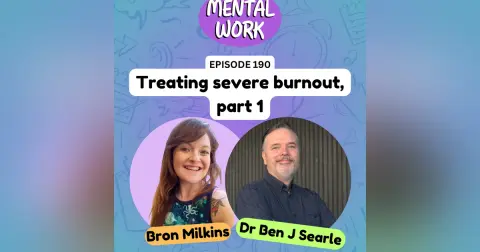
Bron is joined by Ben Searle (Organisational Psychologist and burnout researcher) to unpack what it really looks like to treat clients with severe burnout. Ben shares his own experience of burning out during COVID after years of researching stress, and why even doing “all the right things” didn’t lead to quick recovery.
They chat about:
👉🏽 Why burnout is still poorly understood and often lacks clear treatment pathways
👉🏻 How to tell the difference between stress and severe burnout in your clients
👉 The hidden severity of burnout, including cognitive, emotional, and physical impacts
👉🏿 Why time off alone often isn’t enough for recovery (and what the research actually shows)
👉🏾 Practical ways to support clients, including hope-building, pacing, and re-engaging with meaningful activities
👉🏼 Working with cynicism, detachment, and loss of motivation in therapy
You’ll walk away from this episode with a clearer framework for recognising severe burnout and some realistic, compassionate ways to support recovery when clients feel completely stuck.
Guest: Dr Ben J. Searle - Organisational psychologist, survivor of burnout, host of 'Mind on the Job' podcast
LINKS
THE END BITS
Mental Work is the podcast for psychologists about the realities of working in mental health, with an early-career focus. Hosted by psychologist/researcher Dr Bronwyn Milkins.
Support the show by buying me a virtual coffee ☕🍵
Have a question, episode idea or just want to say hi? DM Bron on Instagram, leave a comment on the Spotify episode, or email mentalworkpodcast@gmail.com
Apply to be a guest / YouTube (with captions & transcript) / Website
CREDITS
Producer: Michael English
Music: Home
Commitment: Mental Work believes in an inclusive and diverse mental health workforce. We honour the strength, resilience, and invaluable contributions of mental health workers with lived experiences of mental illness, disability, neurodivergence, LGBTIQA+ identities, and diverse culture and language. We recognise our First Nations colleagues as Traditional Custodians of the land and pay respect to Elders past, present, and emerging. Mental Work is recorded on unceded Whadjuk Noongar boodja.
Disclaimer: Mental Work provides informational content. Mental Work is not a psychological service and being a listener or guest does not establish a therapeutic relationship. Content should not be considered a replacement for professional consultation or therapy. All views expressed are personal, subject to change, and do not represent those of any affiliated employer, service, or organisation past or present. Efforts are made to ensure accuracy, but opinions may not always align with fact. Listeners are encouraged to thoughtfully assess the information presented and report any inaccuracies or concerns via email. Further information can be found here.
See omnystudio.com/listener for privacy information.
[00:00:05] Bronwyn: Hey, mental workers. You're listening to the Mental Work podcast, the podcast about working in mental health for early career mental health workers. I'm your host, Bronwyn Milkins, and today we are talking about treating clients with severe burnout.
Burnout is something most of us will see in our clients in the course of our professional work. When burnout is severe, how do we support recovery in our clients when the research is actually quite limited, training is scarce and our clients feel really stuck. In this episode, we're going to explore practical strategies to help clients move from exhaustion and cynicism to meaning and connection. Here to help us out with this topic is our guest, Ben Searle. Hi, Ben.
[00:00:39] Ben: Hi, Bronwyn. Thank you for having me on.
[00:00:41] Bronwyn: It's such a pleasure to have you on. Could you please start by telling listeners who you are?
[00:00:46] Ben: Okay. Good day everyone. I am an organizational psychologist. My PhD was on occupational stress and how it's influenced by personal and environmental factors. I spent 20 years as a, an academic or, or college professor if this goes out to people in the us, and what I was doing was studying stress and burnout and related issues for, you know, for many years.
I wound up leaving academia in, uh, 2021 as we will probably get to very soon, I now direct my own independent practice mindonthejob.com.
[00:01:18] Bronwyn: Awesome. So yeah, I'm interested in how you came to be interested in treating clients with severe burnout, was choosing the research topic of your PhD, did that come from personal, or did your personal life end up becoming your research?
[00:01:31] Ben: It was the latter Bronwyn, and it's a little bit embarrassing to say that I had spent so long researching and teaching about burnout and then didn't realize it was happening until it was already quite severe and then wasn't really able to do a lot to prevent it.
So like with so many people, COVID provided a perfect storm of burnout circumstances for me. Uh, there was the, the situation itself, there's a lot of anxiety when people start saying, oh, this is a pandemic, oh, this thing could kill you... there were the personal implications of that, of having your movement restricted, of losing a lot of your connections and social support networks. There were the implications on me as a parent. So my kids were moving to schooling from home because of COVID, and that wasn't easy for them, and it was difficult for me to support that. My older child is an autistic person and he really, really struggled and I wasn't able to be there for him all the time, and I wasn't able to provide him with the support he needed.
Because of the professional implications of COVID, there was this massive change in academia and change in teaching, change in assessment, change in how research projects were going to run. So many things got shelved. We had to make a huge change to how things were gonna happen. There was a huge increase in workload. There was nearly constant online meetings, and I was directing our team, so I had responsibility for a bunch of other people as well. And there were other things that went on, not small things. My father died. Um, so there were, there was a lot going on and, I wound up burning out.
I wound up doing what I would hope that I would've advised others to do at the time. I took a long break. I exercised, I sought help from mental health professionals, but I didn't get much better. It was, it was very frustrating and demoralizing and I was wondering, oh, where is this gonna go?
But fortunately, Bronwyn, I am a massive nerd, so I also thought this was quite interesting. So I wound up going through some of the research literature to see what the evidence says is helpful for people who are really burned out. There is a surprisingly small amount of research and, and not all of that research is good quality about people who have burnout and how supports for them and guidance and treatment works. So I looked at that and then I went to further afield a little bit into treatments for some of the component symptoms of burnout, things that were similar to burnout.
[00:04:13] Bronwyn: What a story. Yeah, I'm really sorry to hear about your burnout first and foremost, like it just sounds like it was a really, really crappy situation and a perfect storm of life difficulties and unexpected situations. I mean, nobody could predict a pandemic and then having a family member pass away during that and then having children who have high needs, it's, it just sounds like a really difficult time.
[00:04:35] Ben: Yeah, yeah. It sucked it, it really did.
[00:04:37] Bronwyn: So it sounds like it was quite understandable for that to be very stressful for you, and it sounds like you did all the things that, I guess intuitively we would think that people do, go get help, but you said yourself that that just didn't make things much better.
[00:04:53] Ben: No, it didn't, and it's not that I wasn't prepared to try, it wasn't that I didn't find some experienced mental health professionals. It is just that I think we were all still a little bit unsure as to, to what was going to work, and what are some of the limitations that you have as a person with burnout trying to do some of the things that are recommended in in mental health, health support systems.
[00:05:22] Bronwyn: So you mentioned you then got your nerd on and went to the literature and there wasn't much research, and what there was was poor quality. Was there any guidance that you did find research wise for severe burnout? Or was it just like, uh, not much.
[00:05:39] Ben: So short answer is there isn't a lot. There is relatively little research that is focused on treatment of people with burnout as a primary condition. There is some, and that can be categorized in a number of different ways. So there's some research, for instance, on the effects of exercise for people with burnout and that's complicated because some of the research says that that's very effective, some of that research says it's effective for very specific aspects of burnout, and some of it suggests that it is not very effective at all, and it's not really clear whether that depends on how long someone has been burned out or, or how severe the burnout symptoms have got, or whether there are age factors in there, or resource factors. So, you know, that's one of the areas, exercise does seem to be valuable for a lot of people, but there are a whole lot of caveats around that.
[00:06:39] Bronwyn: I think that's a really surprising finding that people might not know as well. Strangely enough I know about that because you know how sometimes when you're a nerd and you look up research so that you can show other people or prove them wrong or that kind of thing,
[00:06:52] Ben: Too well.
[00:06:53] Bronwyn: I remember a family member was like, exercise doesn't work for me when I'm severely depressed. And I was, but surely like, you know, research says otherwise. And then when I looked it up, I found like a systematic review, and it was not a linear dose effect thing, it was moderate depression, exercise works well, and then for the severe folks, exercise didn't work well. And I was like, well, you showed me!
[00:07:15] Ben: Yeah, yeah. So it's exactly that sort of thing. And, and that is itself something that you won't necessarily turn out from a single study, you actually need the volume of research for someone to do a systematic review and to say, oh, within this research we can see these patterns that, you know, affect people depending on severity and, and such. And with burnout being a condition that is fairly poorly understood in the first place, there are, there are complications around that as well.
[00:07:46] Bronwyn: Why do you think that burnout is so poorly understood? Because it 's quite common, you know, particularly around COVID and, and a lot of people experience burnout around that. Why do, why is it still so poorly understood?
[00:07:59] Ben: Look, I think there are a couple of reasons. It is, it is an interesting area. There are several problems that exist in the world where researchers from different fields have come together and compared notes and taken a multidisciplinary approach to trying to understand what's going on and trying to work together to do something about that.
Burnout isn't one of those things. So we have a number of issues with burnout where there are disagreements about what it is. Is burnout a form of depression or, or is it some other kind of already recognized psychological condition in, in a slightly different form? Is it in fact a distinct medical condition of any kind? Or is it maybe not a medical condition, but rather a, maybe an attitudinal phenomenon or something about the relationship between a worker and the work that they're doing? Is it about the place where people are doing work?
You go into areas of discussion by experts about burnout and you'll see all of these ideas being floated and argued. And because there is a lot of disagreement about that, there isn't really an area for people to come together and find areas of, of agreement and ways they can work together on it.
So there are disagreements about what it is, there are disagreements about who owns it. Is this an organizational phenomena that the organizational psychologists should be dealing with? Is it a clinical phenomenon? And because of that, there's also issues of research, who is funding the research. For example, in Australia, we have a National Health and Medical Research council. If this was a medical condition, then this would be something that the National Health and Medical Research Council would fund, but if it's not a medical condition, then it's some other group that gets to fund it. And so if you are a, a medical researcher and you're not sure whether it's going to get the funding, you're going to focus on something else.
So. That is a, a factor. The sort of research that gets done is important. The overwhelming majority of research on burnout is on the causes. It's on things that are going on in organizations and that is very good. That is very important, it's valuable, it's moral. The implications are there for how do we prevent something that needs to be prevented rather than treated at the end, though, the actual research on prevention is also pretty limited, but, you know, notwithstanding that it's, it's really important we understand that this is primarily an organizational phenomenon and that organizational change is the best way of dealing with it.
But a couple of things there. One of them is that you wind up with this message going out that, oh, well, we need to be only focused on organizational solutions to burnout. And that's a, that's a false dichotomy. You could, you could do that and look at ways of treating people who have already burned out. It doesn't undermine, I certainly believe, it doesn't undermine the work that's being done to get organizations to work harder to prevent burnout, to say, let's find the most effective ways of treating people who have burned out. It also means that most of what we know about burnout is based on sort of large sample studies of whom few if any participants might have severe burnout.
[00:11:20] Bronwyn: Okay. There's a lot in there. I wanted to ask you about how you view burnout, given that there's so many disagreements it seems, amongst people in the literature. It sounds like you view it as an occupational thing . Is that right? Or is it something else?
[00:11:35] Ben: I think that many things can be true. I understand the motivation to see this as an organizational phenomenon. Um, it is very much where the majority of burnout comes from. It is, sort of, the best focus for trying to prevent it. And there are also other things that people don't tend to talk about, but I think politically are important. Like there are places in the world where if this was treated as a medical condition, then maybe they'd be able to say, oh, well, you are not healthy enough to work in our workplace, or we can deny you healthcare because you have this existing, um, uh, burnout problem.
But for every situation like that, you could probably find another situation like, there is a kind of insurance called income protection insurance, where if you have a medical condition that prevents you from working, you can have your income supplemented. This was something that I had done, and then I discovered that they said, oh, well, okay, you say you're burned out, but do you have a medical condition? It is complicated from the perspective of, of how does this interact with health systems.
I think that at the end of the day though, what we're talking about is a condition where chronic stress starts to, to warp how the nervous system is working and that sounds kind of medical to me. I can't really see how people could have some of the symptoms, if there weren't some neurological issues. And there have been some neurological studies that have shown severe burnout to be associated with indicators of brain damage.
[00:13:18] Bronwyn: Well, that's what I was thinking as well. Like, some of the symptoms that we associate with burnout, they do seem to be medical in nature. I'm thinking of like somatic symptoms, like pain, headaches, nausea, uh, jaw tightness. Like it does seem to have medical type manifestations.
[00:13:35] Ben: Yeah, yeah, for sure. And, and look, you can argue well, the, the primary, primary symptoms, the initial symptoms, the things that happen early on aren't so much medical in nature... But that's true of a lot of psychological conditions, right? That it only tends to be when someone becomes fairly seriously impaired by a psychological condition that you start to see that paying off into, uh, somatic symptoms.
[00:14:04] Bronwyn: So how do we know when a client has reached this stage? I guess we, we spoke about somatic symptoms... Um, are there any other signs that we can look out for that... it's like a client has had a bunch of stuff happen, let's say, and then they're like, you know, I'm feeling pretty stressed. How do we know if it goes from mere stress to severe burnout?
[00:14:23] Ben: One of the, the indicators that maybe what your client is dealing with is general stress rather than burnout, is if they're going through a period of stress that is short term, if it's, or even if it's something intermittent or cyclical. You know, teachers who might find that they get really stressed towards the end of a term or salespeople towards the end of a quarter. Um, if those people are taking good care of themselves during those peak periods, if they're making sure they get a bit more rest during the slower periods, then they might be okay. Do do they have good resources? Do they feel like they're getting support that they need? Are they using some effective coping strategies? Uh, you might be able to teach them some more coping strategies.
But with burnout, what we're talking about is something that really is quite chronic. They feel like they have been carrying a load, carrying a weight of, of challenging circumstances for a very long time, and are starting to get to the point where they don't feel like they can cope anymore.
So, you know, there are a few things to watch for with exhaustion, for instance, which is one of the, the core components of burnout. What you need to look for is not, do they often feel tired, because there's a lot of things that can affect that... You can ask about how long does this persist through the day? Do they feel exhausted first thing in the morning? Do they feel exhausted when they're leaving for work? Do they feel exhausted when they're starting their work day?
If that exhaustion is there all the time, or worse if it, if it actually starts to become a lot worse when they sit down to do their work, that might be an indicator. You can ask them about other aspects of exhaustion... Have they been unusually clumsy? Have they started to have as I did, it was absolutely terrifying, I started having micro sleeps while I was driving.
[00:16:22] Bronwyn: Oh wow.
[00:16:23] Ben: So, you know, I'd be driving through, uh, the, the Harbor Tunnel in, in Northern Sydney, and suddenly, oh, I'm driving a car. I was, few seconds ago, I was entirely unconscious. And, you know, that was absolutely, uh, disturbing. That was an indicator for me that this wasn't just a regular feeling of tiredness. This was something new and something much more serious than I'd had before.
[00:16:53] Bronwyn: Yeah. I- thank you for sharing that because I did wanna ask like, I think sometimes people can underestimate how serious burnout can be at this severe end, and I think that highlights really like what can happen. A lot of clients who come to us in therapy, um, they may have been dealing with chronic stress for years, let's say, like a caring responsibility, and they're so used to it in a way that they're used to the decline in functioning, but maybe they don't realize how severe it is. And pointing this out to them can be of great help.
[00:17:23] Ben: That is, that's absolutely right. An issue for me was I recognized that I was burned out and I said, well, okay, it's, it's not great, but it's not as bad as I imagined because at some level I must have seen this as a, an on switch versus off switch type arrangement, and burnout is not like that at all. It can continue to degrade your functioning. It can continue to make you more exhausted, more cynical, more, you know, have more difficulty in, in how you see yourself and your abilities to cope. And, you know, ultimately there is the brain damage thing.
So it is, it is important to get clients to recognize that, yeah, chronic stress can be quite bad, but it can get to the point where you can't really function anymore, and the fact that you haven't got there yet is a great opportunity for us to try and work on this, to try and interrupt this cycle of chronic stress, rather than a sign that it's gonna be fine and 'cause you can obviously just keep coping with it forever.
[00:18:33] Bronwyn: So I wonder if this is a good segue into recovery, and maybe we can talk a bit more about your story as well... what is the first step to recovery in general? I know it's like, it could be different for everyone, but it's like what do you do with someone who's really that impaired and stressed? Where do you start? How did it start for you?
[00:18:52] Ben: So, as I said, I recognized that I was burned out and I went and tried to get some help in my workplace and didn't find a lot. Um, so that's what a number of people will do, is they will turn to others for help and hopefully they will get some. Um, it is an important step to be able to recognize that this is not normal, this is a problem. This is something that you're going to need some help with, because it is very easy to assume that this is another challenge that you are going to be able to, to overcome because a lot of people who burn out are people who push themselves very hard, right. So they tend to be, you know, they're not all workaholics, but many of them are. They're not all perfectionists, but many of them are. They're not all people who have a, a driving value for achieving things, but many of them are because what's happened is that at some point further up in the chain, when they could have relaxed more, they could have given themselves a bit of slack, they have kept going.
Now, sometimes it's got nothing to do with their own choices. Sometimes they're put in an environment where there are very heavy expectations placed on them. But again, what that means is that they don't necessarily feel like they have a choice. They don't really feel like they have options other than to keep going the way things are going. So one of the first things to do as a clinician, as a friend of somebody with burnout is to say, Hey, I'm really concerned that this seems to be quite serious and there is the potential for it to get even worse and something might need to happen.
[00:20:45] Bronwyn: I guess like, um, do we stop for things? Like, I think that's the best way I can ask it. It's like, let's say work is causing us stress, we quit our jobs?
[00:20:55] Ben: It's not always the the essential thing to do, but it is more often than we would like to think, the case that you're going to need at least a substantial break from work. Uh, and this is certainly what various countries guidelines on managing burnout seem to say. In many cases, people will need a substantial period of, of, uh, break from the work, uh, environment.
If you catch these things early enough, there are other options open to, you can start looking at, you know, if you catch it really early, then you can look at coping strategies. If you catch it a bit later, you might first be able to look at what accommodations does the organization have? Can they move into a slightly different role? Can the role be redesigned around them so they aren't dealing with so many of the intense things that are contributing to their burnout? You can look at are there periods of leave that can be taken for medical reasons? Although again, we get into this awkward situation of how does the organization evaluate whether you have medical reasons, this is something that the psychologist might be able to work with, um, or other mental health professional. Are there ways that they can support somebody in accessing some of these accommodations? Some of these leave provisions that might exist within the work that people are doing.
But if it is very late, then at very least you're likely to need someone to take a, a prolonged period of, of leave from work and see what can be accomplished before a decision is made whether they go back to their job
[00:22:38] Bronwyn: Can we please clarify how long is a prolonged period of time? Because sometimes I've had in practice people be like, oh, I'll take a week off, and I'll be like, no, no, no, that's, that's not a prolonged period. What do you consider a prolonged period?
[00:22:52] Ben: So Bronwyn, there is a famous study, Westman and Eden, 1997, uh, where what they did was they took people who, uh, you know, had different levels of burnout, they measured burnout in advance. What they were really interested in, which they didn't find any of, was this possibility that if you were about to take a vacation, you would start to see these benefits in wellbeing a few weeks in advance, 'cause you are anticipating it, right? So what they did was they measured this cohort of people three weeks beforehand, three week, uh, three days beforehand, and then in the middle of their three week vacation, and then three week, uh, three days after they came back and three weeks after they came back.
And in terms of burnout, what they saw was firstly, anticipating didn't really do anything. When they were on vacation, burnout levels dropped, they did not go to zero. Within three days of returning, they were much higher than they had been during vacation. Within three weeks of being back, they were just as high as they had been before the vacation.
[00:24:05] Bronwyn: Oh, that sucks.
[00:24:06] Ben: And this was not a group of people who were selected because they were known to be severely burned out. So moderate levels, even low levels of burnout may not be extinguished by taking a three week break, we are probably talking about months. If anyone is at a level where you're saying this is quite concerning, I would be suspecting this to be a severe case of burnout, you are probably talking about a very long time away.
[00:24:37] Bronwyn: Mm.
[00:24:39] Ben: Now you've gotta work with what you can do, right? If someone says they can't take three months off work, then that's what you've got to work with. You've got to find out what you've, what you have, but you need to be aware that a break beyond some very early stages of, of stress, a break is not in and of itself going to allow recovery to occur. Once people are in that chronic stress burnout process, once the, the, um, nervous system is struggling to work the way it is supposed to, a break alone doesn't seem to trigger recovery.
[00:25:26] Bronwyn: Even like for like, let's say three months, like is there any research on that? Like, if we just have a long enough break, is that good?
[00:25:33] Ben: That's a lovely idea. Bronwyn. I haven't seen research on what happens if people don't work for three months. I do, however, have a, uh, a case study that I've personally been following very closely, and that's me. Um, and I can tell you that within six months of leaving my job and doing very little work in that period, I was not very much improved at all.
[00:26:00] Bronwyn: Oh, okay. And, and like, how do you make sense of that? Is that related to what you were saying earlier about the, I guess, your nervous system being altered? Um, or do you explain it in some other way?
[00:26:11] Ben: Look, I think that is, that is a big part of it. I don't, I don't have all of the answers for things like this, Bronwyn, but yes, I think, I think the nervous system is, is damaged and it is, it is functioning in a slightly erroneous way. In Sweden they do have a medical- it's one of the few places in the world where burnout has a equivalent recognized medical condition. It's called Utmattningssyndrom,
[00:26:36] Bronwyn: Interesting!
[00:26:37] Ben: Um, uh, which is exhaustion syndrome, and exhaustion syndrome is equivalent to burnout. And, but a symptom that they talk about with, with Utmattningssyndrom is stress intolerance. So this is things like, you know, when something even fairly minor happens that is, is unpleasant, your stress levels suddenly shoot up and, and it is much more like something terrible happened. And you might even be able to quite consciously think, this is crazy, I don't, I don't need to react like this. And yet it will, you'll continue to feel that stress response kicking around your system for much longer than is necessary. They went back to some people who had been diagnosed with Utmattningssyndrom seven to 10 years later, and 70% of them were still showing signs of that intolerance to stress... seven to 10 years later.
[00:27:35] Bronwyn: Okay, that's a long time. I am, I'm beginning to feel a bit hopeless.
[00:27:41] Ben: So, so, yeah, so I, I think, I think there are some, some changes that can occur with the, the nervous system. But what I think that tells us is, again, time isn't going to be enough to, to heal this. Like, you know, we, we understand now to a degree we didn't 30, 40 years ago, that depression and anxiety involve certain chemical imbalances, but that doesn't mean, oh well, we throw up our hands, we can't do anything. We can work in a number of different, uh, avenues to try to improve the situation so we can work on things like how people are managing their response to stress.
[00:28:28] Bronwyn: Yes. Okay. So, so we can recover from severe burnout just to put that on the table.
[00:28:35] Ben: Both in terms of a anecdotal reports and some of the research where they have followed people with burnout, there are some good indications that people recover. Now, I, I'll put a caveat around that as well. I, I, I don't want to be too gloomy about it, and I don't want to give people an overly optimistic impression, particularly for the clinicians who are trying to manage this.
If you imagine that, you know, mental illness is equivalent to, to physical illness and you know, a broken leg is something that a person can recover from. If you do an x-ray, you can probably still see 20 years later that, oh, there's the spot on their leg where it's broken, but they're able to function quite normally. That's what will happen if the injury happens when someone is relatively young and they get good medical treatment and they follow some good, you know, rehabilitation, you know, rest and rehabilitation practice.
If someone is much older, if the break is, is much worse, you get a compound fracture. Um, if someone is not getting good medical attention and is, is given poor advice on how to manage getting back into the, the swing of things, they are not gonna have 20 more years of looking like everything was fine.
So I think a lot depends on the nature of the circumstances where someone burned out and the support that they get through that process. I think a lot of people have the potential to recover the majority of their functioning, but only if they get good support. And a big challenge with people who burn out is we tend to wanna push away people who offer us support.
[00:30:31] Bronwyn: Yeah, I really like that analogy, and I think that's a really helpful way of thinking about it. I don't think it's, um, doom and gloom necessary. I'm actually a bit doom and gloom in practice with clients who have severe burnout, 'cause I try and get 'em to understand how severe it is and I'm like, this is really serious, you need more than a week off. This will take time to recover. It's not gonna be a linear improvement. So I'm actually the doom and gloom because I'm trying to get them to, to understand the severity of it. So I really like that analogy.
I wanted to talk about a few ways to support clients. I'm wondering if we can explore cynicism. Um, this seems to be a real hallmark of burnout. Is there ways that we can help clients work with cynicism, reduce it and, and regain some, I guess, clarity around their outlook on the world?
[00:31:18] Ben: Yeah, yeah. There are several things that we can do to, um, that help with cynicism and, you know, the related feelings of detachment. I'll say first out that cynicism is part of the burnout experience, but I tend to prefer to use the word detachment. I'm maybe alone in doing this, but cynicism can be something that isn't as obvious in the early stages of burnout where you might, you might start to see someone showing some disengagement from the, the things they used to enjoy at work. Maybe even starting to disengage from some of the things they used to enjoy outside of work. You might see them becoming a little bit less close to the people that they're trying to help their clients, their students, their patients.
And it tends to be once they have really felt that their experience of the workplace is, is irredeemable and they've, they've lost trust in, in the organization and they've lost faith that anything is gonna improve, that's when you tend to see cynicism. That is itself something that is tricky because someone might be very cynical because they work in a terrible workplace.
[00:32:35] Bronwyn: It could be real. It's like the workplace isn't supportive. They don't care about me. I am just a cog in a wheel, you know?
[00:32:42] Ben: Yeah, yeah, for sure. And you know, let's not kid ourselves. There are a lot of workplaces that are very much like that. So, so let's talk broadly about detachment, but cynicism can be one of the worst stages of that. So when you have a client who is experiencing a lot of cynicism, there are a few practices that can be worth trying to, uh, to, use. One of those is about hope so we can look at identifying with them, what are some things that you would like to see happen in the future that you think might be possible and scaffolding a, a path towards that, you know, what are some of the first steps you'd need to take? What resources would you need to make that work? Who could you get to help you? And getting them to reflect on their plans and their pathways towards hope on a regular basis. The, the Hope Theory research suggests that that can be very powerful in creating a sense that there are things to look forward to.
[00:33:52] Bronwyn: Like a bit of light at the end of the tunnel.
[00:33:54] Ben: Yes, yes, yes. And it doesn't, you can start that with something fairly small, something that is relatively easy to achieve, and that might be quite important because one of the things that can happen with burnout is that we tend to, we tend to have a lot of doubts about our capabilities and our likelihood of achieving things, which combines with, with cynicism to say, well, okay, I'm not gonna be able to do anything. If you start with something small and see some success, then you might be willing to work towards something a little bit more ambitious. And if it is something that you want to see happen, if it's something that you want to achieve, whether it is a, uh, a craft or art project, and that can be very good if it's something that someone enjoys. Getting that intrinsic motivation activated, getting people spending time on things that they enjoy can be very useful for engaging the right parts of the nervous system. Moving away from thinking, oh no, you know, my life is over because I burned out and thinking, Hey, this thing kind of rules to be able to sit here and build a model boat or, or bake a, you know, complicated cake or whatever it is, um, can be a very motivating experience.
[00:35:11] Bronwyn: I was just thinking, like, something that I might say to clients who experience severe burnout is. I'll literally say to them, like, this is one of my least favorite conditions if I have favorite conditions, and one of the reasons for that is, is because you have to do things and not get the nice feelings before you see improvement. And by that I mean like you might bake a cake, but you still feel nothing. But you have to do it like 10 times before you actually start to feel those positive feelings. Um, I just wondered, like as somebody who has experienced severe burnout, is this something that resonates with you, that you need to do it over a, a few times to get the, the positive vibes, I guess?
[00:35:46] Ben: Look, it depends what it is. I, quite early on, I took it upon myself to, to try a few projects and some of the ones that I did quite early on, I was quite thrilled by.
[00:35:58] Bronwyn: Oh, good!
[00:36:00] Ben: Um, and others, I did things and I did them quite well, and I said, oh, well that was because I set the bar too low and it was too easy. It is very difficult to get the meter exactly right to find the the sweet spot because we all have this, this motivational force that comes from challenge, from doing something that is a bit tricky, but it may be attainable. And a lot of that gets washed out by burnout and we're only seeing threat. We're only seeing, well, I, I'm not gonna be able to do that.
So trying to set, particularly for those of us who are perfectionists, ambition focused, uh, uh, achievement focused, trying to set ourselves a goal that we feel good about is, is difficult, but yes, it is far better to set one relatively low and keep trying and, and just be slightly ratcheting up that a little bit each time, even if it doesn't feel great at first, then to say, oh, well what you should do is sit down and write a novel and, and, you know, three weeks later they are beating their head against a wall
[00:37:16] Bronwyn: So we really need that sweet spot of like just enough challenge and also satisfaction and knowing our capabilities as a person who's severely burnt out.
[00:37:26] Ben: yeah, Yeah.
so hope is one side of things. Um, another thing that you can, uh, another practice you can use that's fairly easy is gratitude, gratitude diaries. Uh, this is something that it takes quite a bit of persuading for people with burnout. Um, I, I will confess that of the techniques that I researched for my book, this is one of the last ones I was prepared to try. I was not expecting it to help.
[00:37:52] Bronwyn: What was the barrier for you? I'm just interested.
[00:37:54] Ben: Look, I, I had this sense of, one of the reasons why I burned out is that I felt that I was carrying a lot of load on behalf of other people. And so in my head, gratitude was thanking other people for helping me, whereas I was thinking, oh, these other people really ought to give me a lot more help.
[00:38:21] Bronwyn: I completely see what you mean and that is very understandable.
[00:38:24] Ben: So when I actually researched it and said, oh, actually I don't have to be grateful for people going above and beyond in helping me, I can be grateful that, you know, my kids who were then going, both going to school, they didn't get themselves ready for school every day, but some days they did, and I could be grateful for that rather than waiting for my kids to, to come and make me breakfast, which was never gonna happen. Um, so reflecting on things that people did that made life easier for you.
[00:38:58] Bronwyn: Okay. So is it like, is it being grateful for things as they are rather than how you wish they were?
[00:39:05] Ben: That's an important part of it, yes, yes. Being grateful that things are, as they are. Being grateful for things that turned out the way they did.
[00:39:15] Bronwyn: Yeah.
[00:39:16] Ben: And so it needn't be it, it's often better if it is, but it needn't be about other people. You can be grateful that the bus was late when you turned up a couple of minutes later than you intended to get to the bus stop. You can be grateful that an opportunity came up at a time when you were looking for opportunities. You can look to the past and say, oh, look, I'm really grateful that I had this opportunity to meet this person when they were in Sydney.
So they're, they're all ways of reflecting on things that are going well, that have gone well for you in the past. Another one that I found really useful was for other reasons that we won't get to today, um, I started using for certain kinds of work, I started using the Pomodoro method of working in, in short breaks. So I'd do, uh, 25 minutes of work and then I would take a break for five minutes. And one of the unexpected outcomes of that was I had, you know, long since started developing this, this pathology where I would be infuriated by, this is one of the things that came out of burning out that, you know, I, I was someone who never got angry, um, and you know, I suddenly felt all of this frustration that just didn't seem to go away. And one of the things I found particularly infuriating was how I never seemed to get things done because I didn't really notice the passage of time when I was engaged in a task and then someone would interrupt me before I got to the end. So I had this feeling like I was constantly getting things, uh, getting things interrupted, but when I was using the Pomodoro method, I started noticing, oh, I've now got four blocks of 25 minutes of work done, and nobody has interrupted me in that time, and that was something that I could reflect on and be grateful for, whereas I noticed the interruptions because that was when I stopped being focused on something else.
[00:41:29] Bronwyn: That's really interesting. I'm wondering, were, were you able to draw these conclusions through self-reflection, or was it only through professional help that you were able to reappraise these situations?
[00:41:45] Ben: So these were ones that I was able to, uh, conclude independently. They are insights that I had, I think because I was sort of testing myself with some of these things because I had done the research on them in advance, but also a major area of research for me in the past was appraisal and reappraisal and how it works. So I was kind of primed to how can I reappraise this situation? How can I look at this from a different angle when I'm doing gratitude activities to see what there is to feel good about?
[00:42:21] Bronwyn: Ben, what you've shared with us so far has been really helpful. I know that you are interested in stress appraisal and how chronic stress can distort it. Could you share with us some ways that clinicians can help clients reappraise stressful situations?
[00:42:36] Ben: Sure thing. So this is something that I'm very enthusiastic about because this was a core area of research for me for many years. So stress appraisal, as most of your uh, listeners would know, is this process where people are judging whether a situation is, you know, a serious one, that that could be problematic. So it's a survival mechanism that determines whether we are engaging our survival mode or whether we're staying in maintenance mode. If you nearly fall off a chair, you get that rush of adrenaline, and that's because your brain has gone, oh, something serious could be happening, let's switch to survival mode.
And that appraisal process, the way we make that decision, it is largely pre-conscious, but we've kind of used a, a number of experimental and other methodologies to try and identify a series of of questions that are behind that. Basically the, the primary appraisal part is, is what's at stake here? Is there risk of harm or loss? And then there is a secondary appraisal of what can I do about this situation?
Now appraisal doesn't happen the same for everyone. It gets influenced by context, by your life experience, by your psychological states. So when you're more anxious, for instance, studies have shown that you're more likely to interpret things more negatively. And CBT is quite effective for people with anxiety disorders who often feel anxious, and so they tend to assume worst case scenarios and, yeah, that makes them more likely to appraise situations as, you know, risk of harm and loss app, praising situations as threats.
Some conventional techniques like thought challenging and evidence gathering can, can help facilitate healthier stress reappraisals in people with anxiety disorders. And sometimes this will also work for people with burnout, but it won't always do that because, yes, it's the case that, you know, because they're chronically stressed, they constantly have their sympathetic nervous system activated, and so they're likely to be feeling anxious and that can impact their primary appraisal. Is this, uh, a harm or loss situation?
But clients with burnout might benefit even more from support with secondary appraisal. So what we have is we have this problem for people with burnout that they get to a point where they, we, uh, are so fatigued, uh, and, you know, cynical and lacking in confidence in our ability to cope, but when we come across a problem, even if it's a fairly minor one, even if it's one that may not have that much potential for, for harm or loss, we're likely to judge we can't do anything about it. We feel overwhelmed. And if we can't do anything about this problem that's sitting there waiting for our attention, that's adding to our chronic stress. And because it takes so long for burnout to emerge and to get from minor to severe, we spend a long time feeling overwhelmed. Feeling like, oh, here's the sit situation. I can't make it any better. That can potentially arguably contribute to this sense of learned helplessness. We are teaching ourselves through these, through exhaustion, impacting our appraisal of "can we do anything to fix the situation", we're teaching ourselves that we are helpless. So we no longer have the energy to fire up a big stress response to tackle a problem, we treat it as a problem that can't be solved.
[00:46:23] Bronwyn: Yeah.
[00:46:24] Ben: So if you try and help people with burnout by focusing on the seriousness of the situation, we're likely to go, oh, yeah, okay, maybe the risk was small, maybe it was not that big a deal. But, you know, we, we didn't really go far down the road of, of catastrophizing around it before we decided we couldn't do anything. But if we work on, secondary appraisal, if we try and help people appraise that side of "what can we do about it", we might get a lot more result.
So there's a number of things that I, I, uh, encourage people to focus on. Reappraise your, your access to, to people. Are there people who can help you? If so, how can they help you? Can you ask people for help, what sort of help might they give you? If it's a, if you are working in a, with a client, you might say, okay, let's talk about a situation where you felt overwhelmed... who could you have sought from help from What help could they have have given you? Now, you know, there's a, there's a shame issue, I've written in my newsletter about how shame is a big issue that people who who've burned out struggle with, and that may impact their help seeking, and that's another thing that you can help with.
So, talking about people they can get help from, say, okay, in this situation where you felt overwhelmed, were there any other resources that could have helped? Were there were there documents? Were there information guides, instruction manuals. Were there, you know, help functions. You could, you have Googled, you know, how do I deal with this situation? You could get people to think about experience, you know, have you encountered a similar situation in the past? What did you do in that situation?
And you can talk about control. Okay, sure, in, in almost every situation, there are elements of the situation that are outside our control, but in this situation, ask your client, well, what did you have control over? Could you, even if the issue was something as simple as, as there was a phone call that they were supposed to make that they forgot at the time, and then they were too embarrassed to make it, you could say, was there time in your schedule when you could have made that call again later? Was there, you know, the, could you have reached out to them with an email first and suggested another time to give them a call? Were you able to, to change the approach? Could you have communicated with them a different way because you weren't communicating with them by phone? So what did you have control over?
And all of these, all of these can seem very obvious, but when we are burned out, we go, we can teach ourselves to get into going straight to, "I can't even".
[00:49:13] Bronwyn: Yes. Yeah, I, I can, I resonate with what you're saying, like they might seem obvious, but as you're describing them, I'm imagining somebody who is experiencing severe burnout and has that helplessness. And in my, in my head, I have those experiments where like they have the rat and they shock the rat, and then the rat just gives up and just allows the shocks. And I, you know, I think of that poor little rat. And then I think of poor people who have severe burnout, and I'm like, this would be so helpful for them if they can reduce their helplessness, increase their sense of control.
[00:49:41] Ben: Yeah, yeah, yeah. And you, so you might, in that session, you might have to give them a lot of support. You might have to give suggestions of things if they're not able to, to answer those questions immediately themselves. Maybe even document a strategy of, oh, look, if this came up again, what sort of things could you do? But by going through those sort of questions with them, you are helping prepare them to ask themselves those questions in a future reappraisal.
Now you can go beyond that. You can, you can sometimes simulate the situation and, and have the client practice applying those, uh, techniques, which is starting to get back to, you know, traditional CBT graded exposure, step ladders... what you're doing is diminishing threat. But here we are, we are trying to build confidence with applying coping techniques in stressful situations.
But the other thing that you are doing when you are helping clients to reappraise the, the secondary appraisal of the situation in this way is that you are starting to teach them that the first thing to do is approach reappraisal in the opposite direction from the way that a natural stress appraisal will work. So natural stress appraisal is gonna start at the absolute extreme. Could this be serious? Is there risk of harm or loss? Can I gain anything? Can I control the situation? Are there any resources I can use? And so the early questions bias your answers to the next questions. So if you're already an anxious, could this be serious? Well, obviously it's gonna be serious, Bronwyn, uh, and if it's serious, I'm almost certain to be at risk of harm or loss. Whereas if you start with who could I have spoken to? What resources could I have used, could I control any aspect of the situation? Then by the time they get to assessing, well, is this really a serious situation, maybe they have a different answer.
[00:51:35] Bronwyn: Yep. I realized in you talking about this... so I, did my PhD, one of the core processes I looked at was attentional bias to negative information for people who have insomnia, and and what you're describing is really complimentary to that literature actually. And so yeah, reducing people's automatic biases towards that negative information and reappraising that really, like, causally can reduce people's anxiety, people's depressive symptoms. It's actually really robust findings in the literature.
[00:52:03] Ben: Yeah. It's, it's really important. There's a lot of, a lot of chemistry behind it as well, but talking therapies, helping people to try to work through these things in a safe environment can be very effective at creating that change.
[00:52:19] Bronwyn: Totally. Absolutely. Yep, I'm on board with this. It's very important. I can see why you're passionate about it.
[00:52:24] Ben: Awesome.
[00:52:24] Bronwyn: Ben, I feel like we could talk forever.
[00:52:26] Ben: Absolutely. Under wet concrete, maybe.
[00:52:29] Bronwyn: Yeah. I think we'll, we'll try and wrap up for now and maybe you can come back for another episode, I'm sure listeners would really enjoy that. But from what we've talked about today, what do you hope that listeners will most take away from the conversation?
[00:52:42] Ben: Look, I hope that people take away a sense that burnout is something you can do something to help with. It is, it is not a simple condition. It is not necessarily as, uh, straightforward as some of the other conditions you might come across. Some of the, the treatments that work with other conditions may not be as effective, but that doesn't mean that you can't be very helpful.
In fact, it is so important for people with burnout to get support from mental health professionals. It is stuff that is very difficult for people to do on their own. Um, and there are some resources out there to help. Not as many as I would like. And, uh, and hopefully I will find a publisher for my book soon and then I can let you know, and your, uh, listeners can get hold of that because-
[00:53:35] Bronwyn: I'm sure they'd love that, and I hope you find a publisher soon. Um, in the meantime, Ben, if listeners do wanna learn more about you or get in touch, where can they find you?
[00:53:44] Ben: Mind On The Job is my website and my podcast, so if people go to mindonthejob.com, they will find all of my stuff there. I also have a newsletter, which instead of being called Burn After Reading is called Read Before Burning.
[00:53:57] Bronwyn: Wonderful. That's awesome. Well, thank you so much, Ben, for coming on the podcast. I think we really benefited from your knowledge and experiences as well, so thanks for sharing them.
[00:54:05] Ben: Thank you, Bronwyn. It's been an absolute pleasure.
[00:54:07] Bronwyn: Listeners, if you enjoyed this episode, make sure you follow the Mental Work podcast. Rate and review on your favorite podcast platform, and share it with a friend or colleague who might find it helpful. Thanks for listening to Mental Work, I'm Bronwyn Milkins. Have a good one, and catch you next time. Bye.


