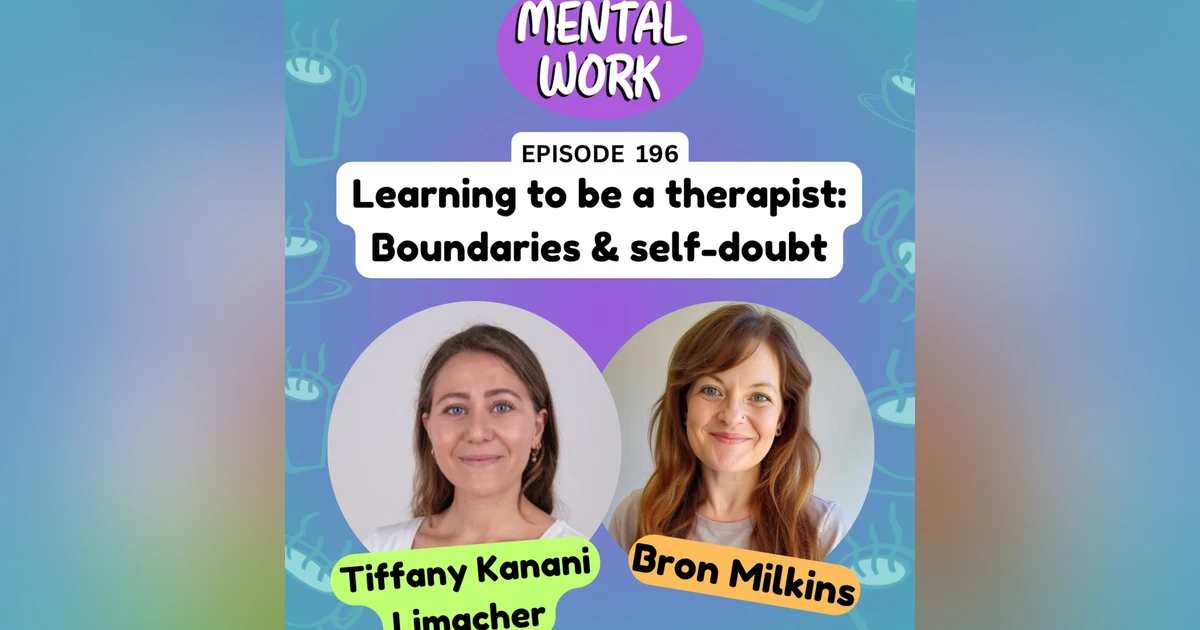
Bron is joined by Tiffany, a licensed psychotherapist based in Switzerland, to chat about the emotional realities of starting out in therapy and what it’s like working in mental health on the other side of the world.
They chat about:
👉🏽 Why personal therapy helped Tiffany become a better clinician
👉🏻 Feeling like you’re “drowning and swimming at the same time” when starting therapy work
👉 How comparison and perfectionism can fuel early-career self-doubt
👉🏼 The differences between Australian and Swiss mental health systems
Guest: Tiffany Kanani Limacher, Licensed Psychotherapist
THE END BITS
Mental Work is the podcast for psychologists about the realities of working in mental health, with an early-career focus. Hosted by psychologist/researcher Dr Bronwyn Milkins.
Support the show by buying me a virtual coffee ☕🍵
Have a question, episode idea or just want to say hi? DM Bron on Instagram, leave a comment on the Spotify episode, or email mentalworkpodcast@gmail.com
Apply to be a guest / YouTube (with captions & transcript) / Website
CREDITS
Producer: Michael English
Music: Home
Commitment: Mental Work believes in an inclusive and diverse mental health workforce. We honour the strength, resilience, and invaluable contributions of mental health workers with lived experiences of mental illness, disability, neurodivergence, LGBTIQA+ identities, and diverse culture and language. We recognise our First Nations colleagues as Traditional Custodians of the land and pay respect to Elders past, present, and emerging. Mental Work is recorded on unceded Whadjuk Noongar boodja.
Disclaimer: Mental Work provides informational content. Mental Work is not a psychological service and being a listener or guest does not establish a therapeutic relationship. Content should not be considered a replacement for professional consultation or therapy. All views expressed are personal, subject to change, and do not represent those of any affiliated employer, service, or organisation past or present. Efforts are made to ensure accuracy, but opinions may not always align with fact. Listeners are encouraged to thoughtfully assess the information presented and report any inaccuracies or concerns via email. Further information can be found here.
See omnystudio.com/listener for privacy information.
[00:00:04] Bronwyn: Hey, mental workers. You're listening to the Mental Work podcast, the podcast about working in mental health for early career mental health workers. As always, I'm your host, Bronwyn Milkins, and today we're talking about something many early career mental health workers experience, which is the emotional toll of
starting out in therapy. Our guest today is also located in Switzerland, so I also thought we'd take the opportunity to discuss what it's like delivering therapy in Switzerland and differences in similarities in approaches compared to Australia. If you've ever wondered what therapy looks like on the other side of the world or want some reassurance that you're not alone in feeling overwhelmed by starting to deliver therapy, then this episode is for you.
Our guest today is Tiffany. Hi Tiffany.
[00:00:47] Tiffany: Hi, or as we usually say in our language, hoi!
[00:00:50] Bronwyn: Hoi.
[00:00:53] Tiffany: Yeah. Hi, um, so yeah, as you heard, um, I am from Switzerland and I'm a licenced psychotherapist, currently working in an outpatient clinic. Um, but I'm also undertaking a further study now in emergency psychology. But that, that's gonna take a while. So, um, but I'm really excited to, to, uh, yeah, go that, go that further path.
[00:01:18] Bronwyn: Awesome, and I'm already immediately interested in emergency training. So I guess the first thing I wanna ask you is what does training look like in Switzerland? Like how do you become a licenced psychotherapist?
[00:01:31] Tiffany: Mm-hmm. So the regular thing is that you kind of study psychology. It can be five to six years depending on if you have to, uh, take an exam again, 'cause sometimes you fail and then you just take it again the next year, so it just like kind of pushes out.
And after that, you can actually decide if you wanna be a licenced psychotherapist or if you just wanna stay like a psychologist after your master's degree. Um, so if you would just stay after the master's degree as a psychologist, you, you can work everywhere, but you always have to be, um, dependent on a, on a working environment like a clinic or a, uh, outpatient clinic. So, but if you wanna go the psychotherapist way, um, it's up to six years again, so in total you'll be studying around 12 years.
[00:02:30] Bronwyn: Wow.
[00:02:31] Tiffany: Yeah, it's uh, it's a, it's a long journey. Yeah, but it can, you can also just do it for four years, depending on how quick you are, so the usual is, is between four and six years.
[00:02:45] Bronwyn: Okay, so can psychologists do therapy? It sounds like there's psychologists and then there's psychotherapists, but psychologists can do therapy too? They just have to be in like a, in a, in a business or organisation?
[00:02:59] Tiffany: Exactly, exactly. And if you're a licenced psychotherapist, you could also, uh, open up your own outpatient clinic, kind of, so that's pretty cool.
[00:03:10] Bronwyn: Yeah, that's really interesting. We don't have that here in Australia. We have like psychologist is the regulated term. So that means that our profession, you have to abide by quite a strict set of ethics. But psychotherapist, anybody can call themselves a psychotherapist here, it's not a regulated term. So yeah, you don't have to do any training to be called a psychotherapist here.
[00:03:33] Tiffany: Oh, wow. Not here in Switzerland. It's so structured and regulated, and also like during your postgraduate training, you, you have to, it is like it, it includes theoretical coursework, clinical hours, supervision, and also personal therapy for up to 100 hours that you actually have to go to therapy by yourself. Um, so it's it's a big, it's a big one!
[00:04:01] Bronwyn: That's so interesting. And that's one thing I wanted to ask you about because it's come up on the podcast before when we've been talking about international qualifications, but it sounds like it's a requirement to have your own personal therapy in your course, is that right?
[00:04:15] Tiffany: Exactly. It's mandatory and it's part of the psychotherapist training here in Switzerland to just kind of develop self-awareness and building emotional resilience. 'Cause I, I really think our job is emotionally draining at some point. And, uh, I think it's very important that you kind of know your own history and how you react on certain topics to just be kind of a therapist who listens and not the one who wants to be, wants to get therapy kind of.
[00:04:50] Bronwyn: Totally, and like what's the, like what's the general view of having to get your own therapy amongst, like you and your peers? Are people like, oh my God, I can't believe I have to do this, or are people like excited for it and grateful for it?
[00:05:03] Tiffany: that's a very good question. I think sometimes it can be a bit mixed because, um, so the thing is, like in Switzerland that has changed a bit, how you get to a psychologist and to get therapy. And so the access of therapy in Switzerland is like through your, uh, GP who kind of refers the patients to us, or you can privately pay the sessions, that that's something we also have. Maybe that's because it's in Switzerland and a lot of people they, they really wanna like sometimes spend their money on, on therapy.
But also like since. Um, 2022, uh, Switzerland has actually included a system, uh, where psychological services are, uh, paid by the health insurance if prescribed by a doctor, and then you just, um, go from there. And so we have a lot of people that that just come sometimes to just see what therapy is, which is like a really great thing. 'cause then you can really open up what is psychology, what is therapy? And uh, some people they really, really need it. So it's a bit of a mix, I'd say.
[00:06:22] Bronwyn: Yeah, no, that makes sense. So in Australia, I would say our dominant, therapy that we use is mostly cognitive behavioural therapy. Like, that's the main one we get taught at university. And I think after we graduate, we branch out. So like there's EMDR therapy and schema therapy, um, I guess there other dominant approaches. What do people gravitate towards in Switzerland?
[00:06:47] Tiffany: I also did CBT, so it's, uh, so that's a prominent one. But we also do like, uh, psychodynamic and psychoanalytic approaches or even systemic therapy, there's a lot of that. But also like humanistic and gestalt therapy. So those are like just the four main ones, and a lot of my colleagues, they studied in one of those branches. And, uh, but yeah, it's, it's very different actually, if you talk to, talk to them.
[00:07:19] Bronwyn: Okay. That's interesting. And what are you, um, do you have one that you specialise in?
[00:07:24] Tiffany: Uh, yes. In the cognitive behavioural therapy.
[00:07:27] Bronwyn: Oh, awesome.
[00:07:28] Tiffany: Yeah. So very similar,
[00:07:31] Bronwyn: Yeah, no, but that's interesting for us, if we wanna do like psychodynamic or psychoanalytic therapy, it's a pretty specialised path and there's not many training providers in Australia, so it's a pretty niche one. Yeah, it's pretty niche.
[00:07:42] Tiffany: Wow. Okay, okay.
[00:07:45] Bronwyn: Mm.
[00:07:45] Tiffany: That's so different. Not here... It's, I mean, the cognitive behavioural therapy, it's a, it's, it's the one that most of the institutions they kind of offer to study. Um, but also the other ones, I, I do have actually a lot of people that it's like pretty mixed at my workplace, so, uh, yeah. Yeah, so pretty cool.
[00:08:08] Bronwyn: Yeah. I was just interested, like did you find it useful to get your own personal therapy? Like do you think, 'cause it's not a requirement here in Australia, we don't have to have our own personal therapy as part of training, so I am just really interested in like, do you think that's an important part of your course ?
[00:08:25] Tiffany: I would say a hundred percent. Um, just because, you know, you're starting off as this newbie, as a psychologist, and it can be pretty overwhelming. And let's be honest, we, everyone has their rock sack and everyone has things that, that they might react towards more than other people and I personally think it, it's actually a great thing that to just, you know, recognise your own, um, patterns, knowing when do you flip, when, when do things just come a bit too close? And it's a great, it's a great way to, to kind of get to know yourself a bit better. Um, so yeah, I'm, I'm actually a bit conf-, uh, I think it's really sad to hear that you don't have to do that, 'cause I think it's such a gr- it's such a big part, you know?
[00:09:24] Bronwyn: No, me too. I think, um, we've had a few conversations on this podcast about it, um, with a few other people and the psychologists who I speak to, we all talk about how it's really valuable to get your own therapy and I think it would be good if it was included in our courses because like you say, it really does help you, uh, identify how you react to things in your own patterns. Um, and you get to know what it's like to be, uh, like receiving therapy, there's so many benefits.
[00:09:53] Tiffany: A hundred percent. Yeah. And you know, like, um, it also, it also helps you to experience being the patient as well. You know, sitting on the other side, 'cause that, that is a different feeling. And you know, every time when you, I remember when I went to my own therapy, like personal therapy, it was like sometimes I actually didn't know what I, what topic I wanna discuss. And then you just kind of go there and you feel like really bad 'cause you don't have a topic 'cause, you kind of know, like it would be great if you would have something to discuss or to to talk about. So that really helped me to kind of be more chill with my, my own patients to just be like, Hey, that's okay, like we'll figure it out kind of, and
[00:10:43] Bronwyn: Yeah. That's really, that's really interesting. I guess I wanna understand a bit more about, um, where you work. So you work in an outpatient programme, what does that look like exactly? Because I guess I have an idea of what it looks like here, but I, I'm wondering if it might be different for you.
[00:11:00] Tiffany: Yeah, so I was actually googling this, um, words 'cause uh, in, in Switzerland, uh, we call it 'praxis' or, uh, I work in an ambulatorium, which is very close to a praxis. Um, and I googled it and it said it's an outpatient clinic. So I'll, I think I'll just, uh, explain. So it's actually just people come for an hour or 75 minutes, for their therapy, and then they kind of leave again, so it's like in and out.
And, um, so where I work, I usually see a lot of people a day, that's kind of also the regulation at our office. Um, but it's kind of like seven to eight people sometimes. Um, it can be really tough, yeah, but, but I, I really sometimes enjoy it. It depends on, it depends on my mood and if I was able to kind of shut down after work, um, but yeah. Does that kind of...?
[00:12:08] Bronwyn: Yeah, it does. It's, um, so we usually see, like, I'd say the average is five patients a day would be like, pretty average across all our services in Australia. Um, some people see more because they just wanna see more clients per day. Um, but I'd say five max six. Um, so is seven to eight pretty standard in Switzerland?
[00:12:31] Tiffany: No.
[00:12:32] Bronwyn: Okay!
[00:12:33] Tiffany: I, I, um, well, I, I'd say we're on the higher range of, of how many people we should see. I mean, in total, you just have to kind of, um, be able to, um, have seven hours of therapy each day. And you know, sometimes you kind of overbook, 'cause sometimes people, you know, cancel or, or they're sick, and then you kind of lose those hours and then... yeah, it's, it's like in the system where I work, it's kind of like, uh, built up like that, that it always should, should be seven hours. I mean, nothing happens if it's less, but they would prefer you to have seven hours a day, which means that sometimes you kind of overbook yourself and... that's, that's the thing that, um, that I uh, also still have to learn is limit myself, you know, to be available, 'cause I think that's a bit of a disease of every psychologist to be available all the time, like a firefighter and running around, but it's like five to six patients, I would say very similar to Australia.
[00:13:48] Bronwyn: Okay, sure. So I wanted to shift to, I guess, starting to deliver therapy. Sometimes it can be really overwhelming when you're first learning to deliver therapy and you're getting in the room with like six, seven clients a day. What was that experience like for you in the beginning?
[00:14:05] Tiffany: Uh, I always had a visual in my head, like a picture of how, how I felt. It's kind of like you're drowning and swimming at the same time. I don't wanna like, uh, make people scared or anything, but it, you, it is overwhelming and I, i. personally think it really helped to have my own personal therapy, my supervisors next to me, kind of, to help me out to get through this phase.
Um, but also at the same time, it made me really resilient towards seeing a lot of people and being able to, to know that I will find the way that that fits me, but also fits the people that, that come to me and trust me .
So in the beginning it was a bit a, a back and forth of emotions and, um, and, and also maybe a bit of self-doubting sometimes, like, is, is this, is this really what I wanna do? Or, or is will it ever like, will it ever change or will it just stay that way to just feel that way drowning and swimming at the same time? Um, but yeah, I'm happy to say that that has definitely changed and, uh, to the good. And, uh, you, you learn to swim, I'd say.
[00:15:28] Bronwyn: What do you think made it better so that you were drowning less, like what helped?
[00:15:33] Tiffany: I often kind of felt pressured to like do it right. Um, and then especially if you're in group therapy, like your personal group therapies and, and then you just hear other people talk about how they are doing it and then you kind of compare and then you just like, shit. Like, I'm not doing it like that! Well then something is wrong with me or like, I'm not doing it right.
So, so that was definitely at the beginning, but over time I learned, I learned how to deal with that and to not like, have the perfect techniques... that it's more about like being there for the person and, and listening and, and, and feeling them... and like interventions, they're great, um, and they can help definitely, but, in, in the end, it all comes down to relationship and how we are in, in this in-between together in this room, and that kind of made it easier for me to, to kind of lift this pressure off and, and also allowing to do mistakes, you know?
[00:16:41] Bronwyn: Mm, you said that in a really beautiful way. I really love how you expressed that. Yeah, like that idea of, um, it's like we, we put so much pressure on ourselves to have these perfect techniques, but in the end we realise like, hey, we're building a relationship here. Um, and that is, yeah, that's... Like the techniques are good, like you said, um, but it's like the relationship is ultimately what's important and we know how to do that.
[00:17:07] Tiffany: Exactly, exactly. And, and that's just, it's such a great feeling if you get to that point of just, feeling not to do it right all the time and just be in this flow and, and just trying things out as well. Like be open to just try and, and don't, don't work, uh, with a rule or like a plan. Just, just kind of be, be with the people. Just, yeah. It's usually, it's usually the, the, the most important thing in the end.
[00:17:45] Bronwyn: Yeah, absolutely. Yeah, and it's like, I really like getting personal therapy as well because it's like, like if I asked you what do you remember from your personal therapy, you probably wouldn't say to me like, oh, I remember when she did this great technique, and it was the technique that I remember most of all. It's like most of us aren't going to say that, we're going to say, oh, she was listening and she was attuned to me and she understood me, right?
[00:18:08] Tiffany: Exactly! And, and for me it was also about like, oh, I got a yummy cup of coffee to drink during... It was just like those simple, simple relationship things like this intimacy, kind of like just through being and, and just being human and not being the one who's like a teacher in front of them. So yeah, definitely.
[00:18:33] Bronwyn: Yeah, and so something else I think that can come up during, I guess early career is a risk of overworking and crossing your own boundaries. You spoke before about how sometimes we can do that, but I just wanted to hear a little bit more about what overworking might look like and any patterns you've noticed in yourself.
[00:18:52] Tiffany: Mm-hmm. Mm-hmm. Yeah, often in the beginnings, I, I, I've noticed also looking back now, like kind of taking on too many clients. Which honestly hasn't really changed, but, um, so that's definitely something I'm still kind of figuring out, um, 'cause sometimes it, like nowadays I, I kind of know how, how I have to deal with it, which wasn't the case in the beginning. There always just like, oh God, overwhelmed. Um, and next to that I also kind of sometimes skipped breaks or, you know.
I once read, read something about like. You're like in this high stress level of, of life when you kind of have crumbs all over your, um, PC and, and computer tabs and stuff. And there was actually a moment where I just saw that and I was like, oh God, like you should, you should, you should, yeah, you should take breaks.
And um, and also like, it, it can be so emotionally heavy, some cases. And it, it's just so important to, to just recognise your own limits, you know, to, to really, um, feel into yourself, tap in and, and just feel and see like, is this something I can actually do? Or is it just something I do because you kind of just have to, or someone tells you, you have to, uh, or should see the people that have been, uh, kind of given to you.
So, yeah, that was definitely something in the beginning where I was just like, my God, like how do you, how do you cope with everything? So, um, yeah, I, nowadays I'm really aware and protective of my time and energy and, and just making sure, like those are like fixed things, um, to really, look out for. For example, like, as, like in my personal therapy, um, my therapist told me about like, you know, psychology can be really tough and, you know, therapy can be really draining at some points, and it's so important to make sure that you, that you at least have those one or two days in a week where it's just for you. It's about self-care and listening to your, to yourself and just do what, what, what kind of gives you energy again. And then the rest of the days you just plan as you kind of do or meet friends and stuff. But really just have those blocked days to just kind of, get, get normal again and stay grounded, kind of, and that, that actually really helped. So I really focus on that most of the time to just have those wind down hours and days
[00:21:52] Bronwyn: And do you find that helps?
[00:21:54] Tiffany: A hundred percent. Like, uh, what I, what I could really recommend is find, find something where you can just also lay out the emotions 'cause they think we are holding so many emotions at once, and sometimes I, I, I feel like it's not, sometimes it's not, um, you're not capable of kind of letting them out a certain way and then they kind of get stuck in you.
Um, so I really recommend to find something that, where you can just let it out and just, just, ugh, be there, but don't think about work, but still like, process the, the emotions and, uh, yeah, for me that's definitely playing, uh, football, so yeah. And I can really recommend it. I know it's not for everyone, but there are like women's teams, so, um, yay.
[00:22:48] Bronwyn: . That's so cool. Yeah. And I can just like, 'cause I was thinking as you were speaking, I was like, I really enjoy dancing. Um, and so I take like a dance class every week and it's such like a great way to like, get it out there. And I'm imagining like, you kicking, like it'd be, it'd be soccer in Australia, I think your football is.
[00:23:05] Tiffany: Soccer, yeah!
[00:23:06] Bronwyn: Yeah, yeah. Um, but it's like kicking the ball and like having teammates and having fun. Um, that's a perfect way to translate emotions and get it out there.
[00:23:15] Tiffany: Exactly, exactly. And wow, dancing. Yes, a hundred percent. It's such a nice way of just feeling your body as well, and just...
[00:23:25] Bronwyn: Totally, and I've found that, yeah, having those hours for yourself is really important. I found that really effective for me as well. So like, because I do research and clinical work and on non, on nonclinical days, I do not check the email of the clinical inbox. So it does not come in, and I've found that that's very effective, 'cause otherwise I will look and then I'll see something and I'll be like. And then I get the emotions of that, so I'm just like, no, it doesn't exist to me.
[00:23:56] Tiffany: Yeah. And that, and that's such an important point, right? Because it all comes down to have limits, have boundaries, stop yourself of overdoing the things or make, or wanting to be everywhere, but kind of nowhere at the same time. So, uh, yeah.
[00:24:13] Bronwyn: Mm. Um, I wanted to ask you about, um, inner critic as well. So this can be a big thing when we're starting out. We often judge ourselves and like you were saying before, like, oh, am I doing it right, maybe I'm not cut out for this... Um, I just wondered if that's changed for you over time.
[00:24:32] Tiffany: Yes, yes. I'm way more easier with myself and my, like this, this critical voice in me, kind of just got got to the point where I'm just like, well, that wasn't nice or like, Tiff, that could have been better, but hey, I've learned something, let's do, let's not do it again. So kind of more like taking it from a humour side, I'd say that really, that really has changed. Um, and I'm happy about that 'cause I, I can really see it in like early career psychologists that that's something they, they are sometimes struggling with and it's like very normal, you know?
And, uh, it, I think everyone went through that and some might still go through that, but, um, I think with humour you can, you can also bit laugh it off sometimes and make it a bit more easier on you. It's not that you just push it away, but it's just seeing it as, "Hey, I'm human. It's, it's normal. I, I do, I I'm not perfect. And, and that's perfectly fine", you know?
[00:25:45] Bronwyn: That's a really nice way of putting it. So one thing we talk about on the podcast. Pretty regularly is this idea of niching. So it's like that you might see one particular presentation, like you only see adults with depression or something, and that can help reduce, I guess, mental load and, and focus your trainings and stuff. Is there like an area or presentation of interest to you, or do you see everybody?
[00:26:09] Tiffany: Mm-hmm. Well, my main focus is on depression and anxiety disorders, but they usually come with everything else as well. You know, those usually you just don't have just one, but usually have a pack. I always, I always view it as like having a, um, a bouquet of flowers. and it's just like all the different flowers in one. Um, which, which makes it so interesting, I think our work. But usually my main focus is on those two things that I just mentioned. Um, and, uh, yeah, but what I really find very interesting. I don't know how it's in Australia, um, 'cause usually we're like two, two years behind you guys, but-
[00:26:59] Bronwyn: Oh, okay!
[00:27:00] Tiffany: We're... yeah, with movies and stuff, but, but um, now, like at the moment we have like this, this trend where a lot of psychologists are like ADHD, uh, di- like diagnosing, ADHD and, and ASS, like autism spectrum, disorders and then you're just like, well, literally everyone has that. And uh, I don't know how it in Australia, but I think that's, I, I'm, I'm actually not, so I don't know how to, what I should think about that trend, 'cause it, it has become a trend, especially with things going viral.
And also with trauma, you know, a lot of people are using the word trauma, which is in psychology, you know, like I, I personally think it's like this, it's, it's too easy used in just, um, and I think it's way deeper, 'cause in the end, yes, everyone could have a trauma, you know? But I, I think the, the wording is, is a bit, yeah, I'm not so satisfied about that.
[00:28:08] Bronwyn: Yeah, I mean, yeah, lots of interesting things in there. So I think with the trauma, you know, it was really interesting, I went to a lecture maybe two months ago now, and it was about this idea the researcher called concept creep. Um, and the idea is that like the word trauma might've started out meaning something, and like when trauma first came in, it was in the DSM three and it trauma was like what war veterans experienced.
And then the concept creep is that it's gone out from what war veterans experienced to everything else. And it's really good because then we can pick up like, you know, emotional neglect and physical violence as, as trauma, but then it's spread out even further. And then it's like, um, I didn't get the sandwich I wanted at lunch. That was traumatic... so, yeah.
Yeah, so it's like. Yeah, so that's something that I think like people are writing and and researching here in Australia. And then with the ADHD, I definitely, because I started like in 2017, so that's when I started as a psychologist and I definitely noticed an increase... I think the first time I noticed that I was like, Hmm, a lot of people are coming for ADHD was about in 2020. Um, and maybe that coincided with the pandemic, I don't know. But here in Australia, we're pretty much thinking like people have missed out on diagnosis. So we're just picking up more people who should have been diagnosed. But like, I think it's taken a few years to kind of get to that point.
[00:29:34] Tiffany: Yeah, yeah. And you know, it's also like with the diagnosis, I, I... ' cause people are able to come via their, um, GP and it's paid by the, uh, the insurance, the health insurance, and yeah, it's like this system where you kind of have to give a diagnosis.
[00:29:55] Bronwyn: Yes.
[00:29:56] Tiffany: Uh, I honestly sometimes have a hard time. Um, but I, I don't know if that's just me or if it's with others as well, but I, I think it's. really hard.
[00:30:08] Bronwyn: It's pretty hard here as well. So we have something called Medicare. Um, and with medicare we have to give a diagnosis for them to access the government payments for the session. And so it's pretty difficult because sometimes GPs will refer for depression anxiety, but somebody doesn't actually meet the criteria for those conditions. So like it puts a bit of pressure on the therapist to be like, well, if I don't diagnose them with depression, anxiety, they won't get the money. Yeah, is that similar to you?
[00:30:35] Tiffany: Yeah, yeah, yeah. We like, um, so how it works with us, it's like you can come 30, 30 times to therapy.
[00:30:44] Bronwyn: Wow, that's really good. We only get 10.
[00:30:49] Tiffany: It's a lot. It's like, it's like this new system where you could just, you can come for 30 sessions in total, and then on at the 30th session, we usually have to write a report for your health insurance, and there we have to include a diagnosis. Um, and then the insurance decides how many times after the 30 sessions you can come again. And usually it's like up to one or two years again of just regularly each week you can have therapy. Um, so it's a lot of therapy you can actually get. Um, but yeah, after 30 there you definitely have to have a diagnosis, kind of.
[00:31:30] Bronwyn: Yeah. So do you find that you see clients for like many years, or do you find that people go away and come back or...
[00:31:38] Tiffany: Mm-hmm. Uh, I'd say it's pretty mixed. Uh, I do have a lot of, uh, patients that I, that I kind of walk the journey. It's, uh, I think it's around two years now and it's such a nice... I really like them and it's like, nice, having them around and, and also trusting me kind of in, in what we do. And, uh, but I also have people that are very, like, they got very good again and, um, they feel healthy enough to just walk, walk their journey by themselves, and we usually just have like check-ins, like every three or six months to just see how, how is it going, and just very easy paced.
[00:32:25] Bronwyn: Uh, I wish we had that. It's literally like a huge political issue here with like, we only get 10 sessions of, um, government funded therapy, and like for years our professional associations have been lobbying the government to increase that. Um, because we're like, we can't even deliver like, you know, standard cognitive behavioural therapy for like trauma or something with only 10 sessions.
[00:32:48] Tiffany: Wow. Wow, that's that, wow. That's a lot of pressure I, I assume, wow.
[00:32:55] Bronwyn: Yeah. Yeah, it's like It's I think it's one of the, one of the worst things about doing therapy here in Australia. 'cause at the outset of session one, you have to be like, okay, we've got 10 sessions, or like, you'll need to pay out of pocket, yeah.
[00:33:10] Tiffany: Yeah, it's like a factory kind of. It's like baking and then you're like kind of throw them out. Oh God, okay, well, no, God, I mean, it takes me like 10 sessions almost to kind of build a relationship.
[00:33:29] Bronwyn: Oh my gosh. Totally, absolutely, yeah.
[00:33:32] Tiffany: Wow, oh...
[00:33:35] Bronwyn: Tiff, I wanted to ask you, um, if you had any other thoughts or advice for early career clinicians that you just wanna get off your chest and let them know?
[00:33:44] Tiffany: Yeah, definitely. Oh, first of all, just breathe. You're okay, everything is normal you're going through. And really just set clear boundaries, and I guess that's a thing that can take years speaking of myself. And really find a good supervisor who kind of supports your clinical growth, but also like emotional regulation and just is there for you if, if shit hit, hits the fan, kind . ,
[00:34:17] Bronwyn: Yeah.
[00:34:19] Tiffany: Just take breaks seriously, listen to your body. Actually just, just, just listen to whatever you also teach your patients 'cause it applies to us as well and we kind of tend to forget. And, um, yeah, just, just be curious, learn as much as you can and want to learn and, and just practise self-compassion throughout your whole journey and, and just, yeah, have fun.
[00:34:51] Bronwyn: What would you say the most rewarding aspect of your work is?
[00:34:55] Tiffany: Oh, there's so many things. Um, I think I, like the psychologists are really... ah I think it's really nice if we get to this point where we activate emotions. And I think that's such a beautiful, beautiful setting where you kind of hold and feel and, and, experience emotions together... That's such a reward for my, for my therapy as as well.
Um, but also seeing that people get better and it actually, it helps if you are also willing on, on kind of doing a bit of work, 'cause it's not just the knowledge, it's also the change that has to be applied at some point. And I think if, if you see that happening, it's such, it's such a nice, I don't know, also the, the vibe in the therapy, it just changes and it's such a nice feeling to see and, and yeah, to see people become better and, and healthier and, and more aware... it's really nice.
[00:36:02] Bronwyn: Wonderful. Tiff, I think we're coming to the end of our conversation. What do you hope that listeners would take away from it most of all?
[00:36:10] Tiffany: Yeah. I think to not have all the answers... to, to just ride on this wave of uncertainty and, um, also just having your support system and, and looking out for yourself. I think that would be the most important thing to really get back to yourself, breathe. And, yeah, most of all, I really want, want early career psychologist to, to, to have fun as well, you know, to to, to not see it as a burden, uh, yeah. Oh, it's such a big topic, yeah.
[00:36:52] Bronwyn: It is a huge topic, but it really speaks to me as well. You know, something I'm actually working on right now is even after years, it's still like I'm trying to let go of needing to know the answer and instead being curious together about what solutions and options could be and just being comfortable with being curious together. Um, but yeah, it's, so, it's, a great, it's a great bit of advice and it's, yeah, I think something worth working on.
[00:37:18] Tiffany: Mm-hmm. Definitely, and, and just be a team.
[00:37:21] Bronwyn: Yeah. Well, thank you so much, Tiff. It has been so lovely speaking with you. It's, it's so great to connect across the hemispheres and we, uh, we, we got our time zone correct. Both of us were like, what time zone are we? Where do we meet? What time is it? Are we actually, you know, I tried Chat GPT as well to help me work out the time zone and I still didn't really understand and we're both just like, oh my god. Um, so yeah, it's so good that we could work out the hour and I'm so glad that you, you could come on. Thank you very much.
[00:37:52] Tiffany: Well, thank you so much on having me and, and yeah, just, uh, feel free to reach out or anything and, um. I'm happy to help if ever, if anyone from Australia ever wants to come to Switzerland to work here, to not just visit the Alps in the snow and the chocolate. So, uh, yeah, it was a pleasure, thank you.
[00:38:18] Bronwyn: Yeah, no worries. My pleasure. If people wanna learn more about you or get in touch with you, where could they find you?
[00:38:24] Tiffany: You can find me on LinkedIn. It's, uh, Tiffany, oh, lime Macer as we call it here. Uh, like um, it's L-I-M-A-C-H-E-R
[00:38:37] Bronwyn: Yep.
[00:38:38] Tiffany: Or e- even like via email, like it's, um. 'T' and then my name, Limacher, the one that I just
[00:38:48] Bronwyn: Yeah.
[00:38:48] Tiffany: kind of told you, um, at, uh, GMX.Ch (t.limacher@gmx.ch) and yeah, I'm, I'm always open and enjoy connecting with other clinicians or, or just people having questions or, or wanting to discuss something that I said. So just go for it, I'm open.
[00:39:09] Bronwyn: I bet you will get somebody contacting you because there are a lot of psychologists here who love travelling internationally, who like have dreams of being nomads and then they can go do therapy elsewhere. So I reckon you will get at least one or two people reaching out, being like, yes, Switzerland's for me, I want the chocolate, I want the therapy.
[00:39:28] Tiffany: Yes, then I'm your girl!
[00:39:31] Bronwyn: Yeah, well thanks so much again, Tiff, it was lovely speaking with you.
[00:39:36] Tiffany: Thank you. Thank you so much.
[00:39:39] Bronwyn: Listeners, if you enjoyed this episode, please follow Mental Work and make sure you share the episode with somebody else. I'm Bronwyn Milkins. Have a good one, and catch you next time. Bye.


