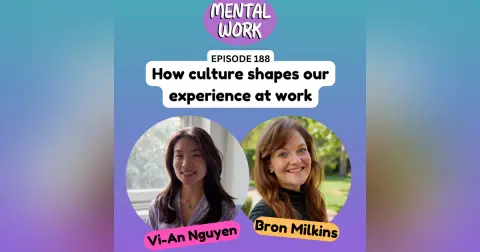
Bron is joined by Vi-An Nguyen (Organisational Psychologist and Founder of An Tâm Psychology) to talk about how culture shapes both our own experiences and those of our clients, and why conversations about culture and work matter for the clients we support.
They chat about:
👉🏽 Why discussions about culture and work can feel uncomfortable but necessary
👉🏾 The common workplace tensions faced by people from culturally diverse backgrounds
👉🏻 The pressure to assimilate versus staying authentic at work
👉🏿 How family expectations and concepts like filial piety can influence career choices
👉🏽 Practical ways early-career clinicians can sensitively explore culture with clients
Thanks Vi-An for this important and informative conversation!
Guest: Vi-An Nguyen - Organisational Psychologist passionate about culturally responsive mental health and Founder of An Tâm Psychology
LINKS
- Vi-An's psychology and coaching practice, An Tâm Psychology
- Vi-An's LinkedIn
THE END BITS
Mental Work is the podcast for psychologists about the realities of working in mental health, with an early-career focus. Hosted by psychologist/researcher Dr Bronwyn Milkins.
Support the show by buying me a virtual coffee ☕🍵
Have a question, episode idea or just want to say hi? DM Bron on Instagram, leave a comment on the Spotify episode, or email mentalworkpodcast@gmail.com
Apply to be a guest / YouTube (with captions & transcript) / Website
CREDITS
Producer: Michael English
Music: Home
Commitment: Mental Work believes in an inclusive and diverse mental health workforce. We honour the strength, resilience, and invaluable contributions of mental health workers with lived experiences of mental illness, disability, neurodivergence, LGBTIQA+ identities, and diverse culture and language. We recognise our First Nations colleagues as Traditional Custodians of the land and pay respect to Elders past, present, and emerging. Mental Work is recorded on unceded Whadjuk Noongar boodja.
Disclaimer: Mental Work provides informational content. Mental Work is not a psychological service and being a listener or guest does not establish a therapeutic relationship. Content should not be considered a replacement for professional consultation or therapy. All views expressed are personal, subject to change, and do not represent those of any affiliated employer, service, or organisation past or present. Efforts are made to ensure accuracy, but opinions may not always align with fact. Listeners are encouraged to thoughtfully assess the information presented and report any inaccuracies or concerns via email. Further information can be found here.
See omnystudio.com/listener for privacy information.
[00:00:05] Bronwyn: Hey, mental workers. You're listening to the Mental Work podcast. The podcast about working in mental health for early career mental health workers. As always, I'm your host, Bronwyn Milkins, and today we are talking about the intersectional culture work and mental health. Navigating work and mental health can be challenging, but when you add culture, identity, and family expectations into the mix, it can add a whole other dimension.
In this episode, we unpack our cultural and intersectional factors, shape people's experience in the workplace, and explore how we as early career mental health workers can better support clients and ourselves in these complex places.
Our guest today is Vi-An Nguyen. Hi Vi-An.
[00:00:43] Vi-An: Hi, Bron.
[00:00:44] Bronwyn: It's so lovely to have you on the podcast. Could you please start off by telling listeners who you are?
[00:00:50] Vi-An: Sure thing. My name is Vi-An. I'm an organisational psychologist, which means I focus a lot on wellbeing and performance and how it impacts individuals, teams, and organisations. And I started my career in management consulting, focusing a lot on leadership and organisational development before I moved into community health spaces.
And now I'm self-employed in private practise, helping individuals through counselling and coaching, looking at how we can thrive, not just in a professional setting, but really looking at how all these factors come together; work, gender, family, and how it impacts our overall health and wellbeing.
[00:01:35] Bronwyn: Amazing. I'm interested in how you became interested in the intersection of cultural work and mental health, and I wanted to ask you as well, you started out in management and then went to org psych, how did that come about?
[00:01:48] Vi-An: Oh, well actually it was doing org psych and starting out in management consulting before I transitioned into counselling,
[00:01:57] Bronwyn: Uh, I got you.
[00:01:58] Vi-An: Yeah. But yeah, I can talk through the journey a little. I guess throughout the psych journey, I was always interested in positive psychology and just from information sessions and things like that. I thought that org psych was a great opportunity to apply positive psychology principles, like focusing on areas, like employee wellbeing, how to manage stress, how to thrive at work, and things like that.
So I was always interested in that positive psychology aspect, and um, it was through the masters where I did placements, um, you know, in different. Organisational development teams, management consulting firms, that I got exposure to the different topics. And I was seeing how we looked at, you know, how can we get the most out of employees, as in help them be their best self? How do we enable leaders to also be their best self and have that positive impact as well.
And as I was learning more about engagement and a good company culture. I kind of realised that to be your best self at work, you can't really just talk about the workplace. There's so much that depends on everything that's going on outside of work as well. And kind of in my own professional personal development journey, I was kind of looking at my own cultural identity and trying to see how does that fit into my work identity as well. And it was quite hard initially to kind of find people that were able to have these conversations, like talk about how it all comes together and talk about how other people's, you know, cultural identity or background impacts their work wellbeing as well.
So I started trying to find, you know, more settings to, to have these conversations. And a little reflection there is, you know, within org psych and HR related topics, there's a lot of, you know, diversity, equity, inclusion kind of roles and projects, and all of that really excited me as well. And I kind of noticed the projects that I was working on liked to celebrate wins, and I think this is maybe a cultural thing for Australia as well, i, I remember a few years back when Scott Morrison was the Prime Minister, he made this comment that Australia is the most successful multicultural country in the world. And I feel like the psychologist in me was like, where is the data that backs that claim?
[00:04:38] Bronwyn: Of course. Yeah.
[00:04:39] Vi-An: Yeah, and, but I think that kind of attitude was quite present in the workplaces where we love to celebrate, you know, diversity wins, but when I wanted to find people to talk about what could we do better or what areas are we lacking, it was almost like there was a lot less appetite to focus on areas of development.
So that kind of pushed me more into the community health space, where, um, I found some other health practitioners that were really looking at cultural competence and that side of things beyond just having resources in different languages, like how do we really engage different communities? Um, and then ultimately led to being self-employed to kind of try and create the space for myself and like-minded others.
[00:05:31] Bronwyn: Sometimes we need to do that. We just need to have the innovative spirit and the entrepreneurship to be like, look, I need to carve out this space and I'm gonna do it.
[00:05:39] Vi-An: Yeah, which is kind of scary. But I do feel inspired, you know, with your podcast as well, I was like, oh, this is great. There are so many topics that I'm really interested in, and here it is, someone started it.
[00:05:49] Bronwyn: Yeah, thank you! You mentioned just before that. I guess we like to think in Australia that, yeah, we are a successful multicultural nation, but then you mentioned that there seems to be a disconnect between that and what you encountered in the workplace. What do you think are some of the reasons why we have less of an appetite to talk about the intersection of culture and work?
[00:06:11] Vi-An: It's definitely, that's the question I've been thinking for a long time.
[00:06:15] Bronwyn: Yeah.
[00:06:16] Vi-An: Yeah. I do think there's an element of general discomfort avoidance, you know, and there's theories that are popping into my mind. Um, there's Erin Meyer, a researcher who looks at different, uh, cultural dimensions across countries, and she also draws on the Hofstede's Theory of Cultural Dimensions, yeah. And I, I will try not to get too theoretical, but I think one example is looking at the collectivism versus individualism, you know, dimension, where in Australia, we're generally quite an individualist culture, uh, the dominant culture is focusing on, you know, what's best for me as an individual, whereas many other countries have that more collectivist dominant culture, which focuses on uh, the needs of the group, um, not just putting your own needs as the priority. And so I'm, I've been wondering if that plays into, how we, what topics we wanna focus on, you know, wanting to celebrate the wins, maybe wanting to avoid some discomfort as well. But yeah, I'm still figuring it out.
[00:07:32] Bronwyn: Yeah, no, there are lots of reasons and I love that you brought up that model. I remember seeing it a few years ago and it has like other dimensions like time orientation and things that are different between cultures and I remember thinking, wow, this is a really great understanding. So you are working now, I guess, are you working in consulting? Like is that the main thing that you do?
[00:07:51] Vi-An: So now it's my private practise, An Tâm Coaching and Psychology. It's mainly one-on-one counselling, coaching. And a few ad hoc workshops, so that's kind of like, I guess a consulting type branch is still alive, but not the bulk of my day-to-day.
[00:08:08] Bronwyn: Wonderful. And from what you've observed, and maybe personally as well, what do you think are some of the common workplace challenges that people from culturally diverse backgrounds might face in Australia?
[00:08:18] Vi-An: A golden question again, something I think about a lot and I saw it a lot when I was working in the corporate setting and now that I'm in private practise, I really hear quite a lot of detail of, um, different POC, people of colour adults, who really are facing these issues.
So if I kind of draw on the themes of what I've seen, a lot of it comes back to those dimensions that I just mentioned, like individualism versus collectivism. You know, another one is related to power distance, where some other countries have more distance between, you know, perceived authority and seniority, whereas Australia is generally, um, I guess corporate Australia is generally on the other end of a bit more egalitarian, like not needing to feel like you're on such a different level to your seniors or juniors.
And another dimension is around communication. So, uh, again, Australia generally has more of this like direct, um, explicit communication style where you say what you're thinking, um, and, and you know, people kind of operate in that way, whereas a lot of other cultures are more implicit or high context, which means that they read between the lines rather than saying how you feel. There's a lot of like interpreting cues and things like that.
So if people are from these different cultures that you know are quite different to the dominant working style in Australia, whether it's the communication, um, how you talk to your peers and your leaders and what you prioritise, you know, group needs or your individual needs, you can kind of see there's a lot of differences already to just kind of get on the same foot as majority of people.
[00:10:14] Bronwyn: It really highlights how complex it is. Whenever I think of culture, I always think there's so much to learn in this domain, and as soon as you start talking about it, you just realise like how diverse it is. But also I'm thinking in my head, like, this is of course all different for people who might be second generation, or migrants first coming here, or English is a second language, and people who have multiple cultural identities, like it's also different and complex.
[00:10:41] Vi-An: Oh, definitely, yes. But I think that's such a great point that it's different for everyone, you know. Like the First Nations experience is going to be completely different to someone who is a first generation migrant, you know, starting all over again in a new country. But I think that recognition that everyone is at a different starting point for many reasons, um, that that's a very common struggle as well.
[00:11:05] Bronwyn: It really highlights how important these conversations are and I guess like, it, it highlights a bit of empathy for me why people might be hesitant to have the conversations 'cause they feel like it's too complex. But I guess like you being passionate in this space, you feel like it's, it's really the necessary to have these conversations.
[00:11:23] Vi-An: Definitely, and when I first started asking the questions, I think , I saw that people viewed it as a difficult topic to talk about and they only want to talk about topics that they feel confident on or something. But I had lots of leaders, coaches who would say to me, oh, Vi-An, I don't want you to think that this problem or this issue is about race or culture or gender. And so it just felt like I don't have... I want to talk about it, but I and I, I want some support, but it's really hard to find people who are willing to step into a conversation where, yeah, we're both learning together.
[00:12:02] Bronwyn: Yeah, but yet like culture and gender shape, how we view the world and how we interact and all those domains you were talking about, like it's deeply embedded in who we are and how we show up at work and in the world.
[00:12:12] Vi-An: Exactly, very hard to avoid.
[00:12:16] Bronwyn: Yeah, totally. So you mentioned the domains and how people and different cultures may be , high or low on these domains, or just have different qualitative experiences... how does that translate to some common workplace challenges that people from culturally and diverse backgrounds may face?
[00:12:32] Vi-An: This is a very common kind of topic that I, I've experienced... peers, clients, and I think a really common example is the topic of being assertive or speaking up. So I think again, to do with this current dominant individualist culture in Australia, there's a bit of this expectation of like, if you want something, you need to speak up and ask for it. Um, so quite a bit of responsibility on the individual.
And, for people who have different cultural backgrounds, whether it's Indigenous or migrants from other countries who have more of that read between the lines type of style of communication, um, I think it can be quite a jump to go from, you know, trying to speak with your actions to then saying like, I have this issue and I need help in this way, or I think I deserve this promotion because of these things that I've done.
I know for myself, my parents were refugees from Vietnam and they did, um, complete their education in Australia and start working, so they have that kind of experience as well. But they still taught me, you know, let your hard work speak for itself. Like you don't need to toot your own horn or, you know, as... tried to take up so much space in that way.
But I did find once I started working, that was not the message that was being encouraged. It was like, if you want to succeed and be seen and get promoted, you really do have to let people know what your achievements are. You know, document them, express them. So I was like, oh, I'm so torn with what I'm supposed to do, and I think that's a common struggle as well. If it's not natural to you to speak up like that and now it's, this is what success means.
[00:14:29] Bronwyn: Could you just describe for us, like what's the approach there? Is it, is it saying to Yourself. I need to adapt to what the predominant culture is or has that come with a sense of loss of what your parents have taught you with, it sounds like, you know, great love and uh, like what's that like? I'm sorry, I'm not phrasing that very well!
[00:14:50] Vi-An: No, I, I hear what you're saying. I think there's, you know, pressures to either conform or like, what does it look like to adapt in a healthy, authentic way, right? And yeah, I think a very common example, and sorry if this is a bit theoretical again, but I know, you know, in a lot of like male dominated industries, a lot of times when they're trying to have more gender diversity and there's the first few female leaders and things like that, sometimes when you really engage with like the first ever female leader in this male dominated space. It turns out their style of leadership is kind of exactly the same as everyone before them, which suggests that they did indeed, you know, assimilate and conform. And so there's not much diversity of thought or actual style of working.
And I think same for me personally, I felt like pressures of, I need to be different. Like I need to speak up more like practise being assertive because that's what I'm seeing around me, and I think I'm also introverted as well, so there's all these kind of clashing elements. And um, and so it felt unnatural, and to kind of add to that, I got this negative feedback of like, okay, Vi-An now you're speaking up too much and you need to, um, like remember when is the appropriate time to speak? So then it kind of felt like, well, how am I supposed to win? And how do other people do it so naturally?
[00:16:24] Bronwyn: Yeah, I, I can completely imagine that situation. You're like, I'm doing the thing, and then they're like, stop doing it.
[00:16:30] Vi-An: Yeah, yes... So very just confusing to navigate until, until I found someone that helped me feel like I wasn't alone. But before that feeling like, oh, it's just me, I'm the problem... That was quite, um, demotivating.
[00:16:45] Bronwyn: Thank you for sharing that. And I guess these echoes what other people might experience in work settings as well, like I'm sure your experience is not uncommon, really. I'm wondering like what do we think is missed in our approaches when it comes to supporting people of colour in work settings?
[00:17:03] Vi-An: I think it's pretty similar to the point we kind of just mentioned. There is this expectation that the onus is on the individual to bring up issues, and maybe that works in some settings, but I think the missed, um, piece of information is that people are not going to speak up if the environment is not safe to do so, and if there's very clear evidence or a history of people being punished for speaking up.
So it's that I think misalignment between, um, the personal responsibility of bringing up issues versus actually there should be a responsibility to create a safe environment in the first place to allow this kind of honesty and focusing on the issues that are repeatedly happening. Yeah, I do, I think that's really common and probably ties in with the whole discomfort avoidance as well.
[00:18:01] Bronwyn: Yeah, absolutely. But there is an obligation for workplaces to be psychologically safe, like that is hugely important. I literally attended at my own workplace yesterday, a meeting where they were talking about company culture and they did a little survey and you could scan the QR code and then say what your one word is what we need to have like a thriving workplace. And I remember from this little word cloud, common words were safety, support, um, and those are the two main things that were coming up. So feeling safe to bring up issues and feeling supported when you need to do things. And it sounds like for people of colour that safety is really crucial.
[00:18:39] Vi-An: Definitely, oh, I have worked with so many clients and also faced it myself, where even if it's a company that has a good culture, like reputation wise, you know, it's known for having a supportive open culture and... but when you raise a problem of like, oh, I'm, I think I've observed this microaggression, or there is this policy or procedure we have that could be more inclusive, I've seen a lot of people get punished for actually speaking up.
And I've also been in a situation where, you know, it was really encouraged to speak up all the issues that we had as people of colour in the workplace, but there was no safety and people after the meeting sent complaints into HR. Like that was, didn't feel like a very comfortable to speak and felt like being pressured to just like say what's wrong, but, and then come up with the solutions ourselves as well.
[00:19:37] Bronwyn: it sounds like everything was wrong in that circumstance
[00:19:41] Vi-An: Yes.
[00:19:43] Bronwyn: On reflection, yes. Yeah. No, and it's, I guess like we're laughing about it, but it, it is like a real, it is serious, and I'm sure it was really awful for you and your colleagues at the time.
[00:19:54] Vi-An: Yes. It's kind of surreal when you walk into that kind of meeting and it's like, who is this really for? And I'm trying to figure out how much to share as well, but again, it was a great workplace, and that's the confusing part. The way that I was invited into the meeting was like, Vi-An, we'd like you attend for diversity's sake, but please don't be offended by this.
[00:20:17] Bronwyn: And like, again, I don't think that would be an, sadly an uncommon thing, and it, it sounds like it reflects what you are pointing to at the start of our conversation with some discomfort that people may have around having conversations about culture and work, um, and trying to communicate direct dynamics around that to try and control the situation, um, and then perhaps ignoring the individual in front of you in trying to do so and then creating a rupture. It just sounds like cascade of things that leave the person of colour feeling unsafe and alienated.
[00:20:51] Vi-An: Yeah, I think you've described it pretty well what usually happens, and you know, because of my private practise work, I do support a lot of people who have work cover claims. So it's kind of like this exact issue has escalated where there's been, um, either an injury, or worse kind of scenarios happening and they're no longer able to work. But yeah, it's, it's just this, this problem of not being able to speak up and facing retaliation getting worse and worse.
[00:21:24] Bronwyn: Absolutely. Is there anything else that you feel like we're missing in mainstream approaches when it comes to supporting people of colour in work settings?
[00:21:32] Vi-An: It is such a big question. I, oh, actually there's so many places where it could go.
[00:21:37] Bronwyn: Solve all problems!
[00:21:41] Vi-An: Hmm, I think, um, you know, we kind of mentioned, having a safe environment at, as your workplace was kind of having those discussions, like, yeah, it's really important to have a supportive and safe place to speak up. I think there is something about taking a step back to look at the, the different lens, like the systems that we are in as well. So really taking an intersectional look. It's something-, it's basically what I talk about all the time. Let's see how work, culture, gender, all comes together. But I think that view would even benefit a lot from, rather than, yeah, zooming in on the symptoms or just like the individual, but taking a step back at like what are the patterns that are happening in the workplace? Is this happening in other workplaces as well? And, yeah, and can we address the root cause rather just the individual symptom?
[00:22:42] Bronwyn: I love what you just said because it sounds simple in theory. It's like, oh, we, we just need to take a systems level perspective, but it's actually really powerful in practise because when we don't take a systems level perspective, we can conclude that, for example, somebody in the workplace is being lazy or they're not performing well, or we may conclude negative things about them. But if we look at a systems level and we look perhaps at like power and privilege and um, I guess culture and gender, those, that intersectional lens, you can come to quite a different conclusion that might be more fair and accurate to the person.
[00:23:20] Vi-An: Definitely. I think another example of that is. During 2020, I remember a, a news piece about PWC one of the big four, and it was basically that a senior HR leader was putting on like a trivia, but offended a lot of people when they dressed up as like a Wuhan bat as the costume, and then saying like, oh, but it's just a bit of fun, there's no harm, harmful intention. Although a lot of people complained and they were offended by the way that it was kind of laughed at, or, you know, made fun of when it was a, a deeply serious time and issue and the history behind making fun of, you know, this kind of cultural group as well. So I think a lot of people, um, the organisational response, again, this is just in the media, was kind of saying like, oh, don't worry about it. It was just that individual, just that HR leader or something.
But I think with the systems lens, you can kind of see what would've needed to happen for that to, to allow that situation to happen as well. There's a broader culture of maybe microaggressions and letting things go and being like, oh, don't worry. I'm sure. That person didn't have harmful intentions. So yeah, there's kind of deeper levels to how this actually happened.
[00:24:45] Bronwyn: Absolutely. That's such a powerful point as well, and I've often thought about that with disability. My sibling has a disability and sometimes when they've encountered situations like with one person from a workplace, and it's been quite negative and not disability friendly and disability discriminatory, I've often thought to myself, this can't be the only person at the workplace because the attitudes behind it, surely to allow this person to think that that was uh, permissible and acceptable. There must be something going on behind the scenes there in that culture.
[00:25:16] Vi-An: For sure, yeah. Just that other layer of like, let's not focus on just the individual, the culture, all of that, yeah.
[00:25:24] Bronwyn: Yeah, 100%. Such a good example.
I wanted to ask you before about Phil or Piety, because I had a, I had, um, I actually had a guest on last week and we were talking about culture and schema therapy. She brought up filial piety, and I thought it was so interesting. She was talking about it in the sense that like, um, she, she was Chinese and she was talking about it, that Chinese folk, like if you get them in therapy, they don't wanna, uh, even though they might be angry with their parents, they don't wanna say that at all. So it might take like six months and you might say you're frustrated and they'll be like, um, so she was talking about that in that sense. But I guess I was interested in like how family expectations and piety might influence somebody's like work relationship.
[00:26:06] Vi-An: Yeah, filial piety and family expectation... It actually, it really does have a huge impact on work. It probably, the impact begins with career choice as well, and, in, in terms of filial piety as a kind of Confucian principle... So basically China and countries that have had the Confucian influence spread, so lots of East Asia and some of Southeast Asia, um, there is that expectation of needing to kind of pay respect back to your parents, um, and almost like putting them on a pedestal or it's kind of your life's important mission to make sure that you pay back your parents.
And then the kind of immigrant family story in Australia for many people whose parents moved to Australia and had to start again, there's this kind of pressure of, well now in order to pay back your parents, you kind of need to, meet their expectations, and it might be finding a job that's stable essentially. And the bonus is if it's prestigious, then you can lift your whole family out of, you know, a risky situation, whether it's like low SES or better standing in the community. So then stability and prestige are kind of these values that might impact your career choice.
Um, so I think that's how it can come up in terms of, yeah, people from these cultures, um, navigating work and, and, if there's so much pressure to do what makes your parents happy, and people do end up doing these jobs, whether it's like lawyer, doctor, but if you're not super passionate and it wasn't your, you know, deep, internal choice of career, you can, um, I can imagine just how much inner conflict and turmoil that leads to as well.
[00:28:01] Bronwyn: Yeah, such a, such a good way of describing that. And I can see from what you've described, the potential consequences if somebody say, doesn't have a passion for medicine, but they feel like, yes, I need to do this for several reasons... Um, and yeah, that could lead somebody wanting counselling, to really explore that and manage that.
And I guess that leads us nicely into how early career mental health workers might start to sensitively explore cultural and work related issues with clients. And I'm thinking, in particular, mental health workers who don't share the same cultural background as their client, um, and I guess like maybe you could speak to first, like what it would be like in that situation, how we can avoid bringing our biases and preconceptions about culture to that conversation.
[00:28:48] Vi-An: I think it's one of those things that will sound simple in theory, but in practise is another game. But I think you kind of said it in, the question is when you do acknowledge what your own story is like your positioning in society, your privilege, like what's normal for you, and you can take that systems lens, like take a step back and see how maybe you've either benefited or what your life experience is, then you can kind of start to imagine, okay, not everyone comes from this same story and have curiosity about other people's experience.
And I think there are so many ways to ask gentle questions about people's different experiences, whether it's with their family expectations related to work or whatever it is, but remembering to focus on the curiosity rather than judgement or assuming that everyone's got it, like similar to you.
[00:29:49] Bronwyn: Yeah, exactly. Could you give us a few examples of questions you might ask clients to open up conversations about culture, and I know it'll be different for every client depending on their cultural identity, but maybe just some general starters.
[00:30:02] Vi-An: Yeah, I think asking about family is a pretty standard way to start, but from there you can also ask about what are some traditions or norms or expectations within your family, and so you can kind of just start with that unit, and maybe you extend that to, and how would you describe the cultural expectations. And for me, I actually am quite explicit, um, at the beginning to ask about what is a client's ethnic background, um, and, uh, there's research you can do to make sure you're using the right phrasing. You know, like in a nutshell, some people ask like, what's your nationality, but that refers to passport, not cultural background. So yeah, asking about ethnic identity, um, cultural identity or background using different words that maybe sit with what you're asking, um, that can be also a gentle way to start, and see what the client's appetite is to talk about it and then, kind of, gently ask more there. But yeah, I do think starting with family is a nice way to ease in.
[00:31:14] Bronwyn: That's a really great question and it's something that psychologists are very familiar with, so I think it'll be reassuring for listeners to hear. It's like we can ask more questions or different questions when we get that family assessment. And I do that quite explicitly with clients as well. Like in a first session they might share what they're coming to see me for and then I might say that like family is very important to a lot of people, is it okay if I ask you a few things about your family, um, and then that's great conversation opener.
[00:31:41] Vi-An: Yeah. Oh yes. You've phrased beautifully, so exactly that.
[00:31:45] Bronwyn: Yeah, yeah. But yeah, exploring culture further within that, and I'm sure it's been your experience as well, but with me, when I've explored people's, um, ethnic background with some, they're usually very happy to talk about it and I guess explain things. And then I can go away as a psychologist and make sure that I do a bit of research so that they don't have to spend an exorbitant amount of energy having to educate me about their cultural background.
[00:32:10] Vi-An: Oh yes, I, the kind of individual responsibilities so, um, I think role modelled very well by you. And I think the other thing I would add is that it's, yeah, our responsibility, like all practitioners of all backgrounds, I know I have lots of- I'm Vietnamese Australian and I have lots of Vietnamese Australian clients, but I have to always keep it in check and still not assume that just because we've got the same cultural identity that things are going to be, their experience is gonna be the same as mine, or know how they're feeling or anything like that. So still the same thing about approaching with curiosity, recognising differences, and, yeah, keeping that, um, keeping that in check, like, yeah, don't make assumptions.
[00:32:58] Bronwyn: Yeah, that humility as well.
[00:33:00] Vi-An: Mmm.
[00:33:00] Bronwyn: So Vi-An something you've been talking about throughout this conversation has been this word intersectionality. I'm wondering how clinicians can get better at understanding the compounding impacts of things like race, gender, and class in workplace distress. I, I know it's a big question as well. It's like, as I'm saying it, I'm like, yeah, that could be a podcast topic in itself... um, but it seems to be an area that you are particularly passionate about, so I wonder if you can give us any insights into that?
[00:33:26] Vi-An: I think there is so many resources available on this now. So it's really great that if you, once you start even just the Google search, there will be a lot, um, out there, you know, so many great books that you can start reading as well.
For some reason, the framework that comes to mind,,, there's a, there's an article that I look at a lot, I heard about it through Shapes and Sounds, which is an Asian Australian mental health organisation, but it's about radical healing in communities of colour, and it draws on principles of, um, liberatory psychology, black psychology, and intersectional psychology. So, uh, I don't know if this is helpful to say, like just even if you start the Google, there is so much out there. Um, yeah, maybe I should give a book recommendation, but...
[00:34:17] Bronwyn: I'd love to hear one, but it sounds like that article is a great place well, and I'll make sure I look that up and link to it in the show notes.
[00:34:24] Vi-An: Yeah. I'll share it with you.
[00:34:25] Bronwyn: Oh, thank you. Yeah, no, but that sounds great as well. And I think like for people just starting out in this space, like you say, Google is a good recommendation and then you can go gently with what you're exploring and notice what's happening for you and notice what's showing up. Um, yeah, that's a really cool approach.
[00:34:41] Vi-An: Yeah. Can I add something as well?
[00:34:42] Bronwyn: Yes, please.
[00:34:43] Vi-An: So with the updated competencies for psychologists there is a emphasis on cultural competence as well. So because that's part of our responsibilities, like competencies as psychologists, there's actually so many professional development webinars on this as well. And I learned a lot from one of your guests, so shouting Dani oh, it a- Avril as well. I've watched and, and learned, um, yeah, so there's so many resources within, you know, the psych PD space as well.
[00:35:19] Bronwyn: Yeah, no, it's so true. Yeah. I, so, so it was Dani who's, um, PD you had a look at?
[00:35:26] Vi-An: Yes. Project Horizon was place that I, I did some peer supervision and, yeah.
[00:35:33] Bronwyn: I love Daniella's work. Um, and I'll make sure I link to it as well because I think her podcast episodes were fantastic. Um, but yeah, Avril does a lot of work as well in decolonizing psychology. Um, and yeah, there is so much great PD out there for psychologists on culture. It's a, it's a great space actually right now with these passionate people in it.
[00:35:51] Vi-An: Yeah, I'm glad I'm, oh, yes, the important conversations. I am like, I can't get enough.
[00:35:56] Bronwyn: Yeah, absolutely, 100%. Vi-An, this is such an area that you are passionate about and I wanted to ask you, what would you change most about workplaces to be safe for people who are from culturally diverse backgrounds?
[00:36:11] Vi-An: I think it's, I'm struggling to not sound cheesy, but I can't do it, so it's gonna sound cheesy. So, really, there's so much, um, discussion in the diversity, equity, inclusion, you know, practises, but at the end of the day, just being more open to different approaches, and I think being more open, so being more diverse, being more inclusive, it really will unlock a lot of opportunities. And this is for all the different intersections, basically. So you know, not just preferring to work for, um, places that are really similar to you or work with people that are the same as you, but really seeing how you could learn and add value with different styles of thinking and that includes people from different cultures, abilities, genders, just kind of having that openness that it's okay to be different. I really think it comes back to that because so many places feel like you have to be like this in order to succeed, and we've got, you know, 90% of the company is like this model of success, but having that openness, it's okay to be different, I think that would unlock so much.
[00:37:31] Bronwyn: I don't think that's cheesy at all. I think it's really beautiful and I, it brings to mind like, I think there was a few studies, it must have been a few years ago when I saw this, but it was looking at the performance of Boards who were relatively homogenous, I guess, in culture and maybe age and gender, and then the performance of boards who were more culturally diverse or diverse in gender. And I think those, diverse Boards outperformed the homogenous boards on several dimensions. And so I think there's pretty robust and consistent evidence that having different ways of thinking, having different people leads to better outcomes. So it's not only like a nice human thing to do to value difference, but it's like it makes sense.
[00:38:15] Vi-An: 100%. I think diversity in all aspects of life, um, there's only benefits from it, you know, I, so yes, the business case is there, we just need to do it.
[00:38:27] Bronwyn: Exactly, exactly! I wanted to ask you as well, Vi-An, there might be some early career folks who are listening who are themselves, people of colour, they come from diverse backgrounds, and maybe they're trying to find their voice in the workplace, and I'm wondering if you have any advice to them.
[00:38:41] Vi-An: Yeah, this is the tip that was basically tried and tested with myself is find people that you can really trust for support. I think going on this journey, figuring out what you want to do in your career, what you wanna get out of your career, it seems like it is this individual journey with, you have to figure everything out yourself, but I really feel that you don't have to do it by yourself. And so finding people that you can trust, you can confide in, and who are happy to support you... I'm certain they exist, maybe it takes a little bit of kind of putting yourself out there to find the right people to talk to. But yeah, creating your support network is so valuable, I'd start there.
[00:39:28] Bronwyn: Thank you. We're coming to the end of our conversation. What do you hope that listeners will take away from what we've spoken about today?
[00:39:35] Vi-An: My biggest hope would be the, taking a step back to look at the bigger picture. I think I'm going to generalise here, but a lot of psych students who then become early career psychs, um, generally have, you know, high anxiety or anxious about lots of the, it's, it's fair, there's a lot to be anxious about, but, um, and so that means it's easy to get really focused on, you know, certain aspects like achieving, achieving results and all these things.
But taking a step back, and this is at any stage of the journey, if you are in your first full-time workplace or even if you're studying, still being able to zoom out and, yeah, basically take that systems lens, practise that critical evaluation, which is a skill that we have to practise anyway. Um, I think that is the biggest, uh, takeaway or skill that I would love to encourage.
[00:40:34] Bronwyn: It's really considering the whole person within their context.
[00:40:38] Vi-An: Yes, exactly. And start with yourself.
[00:40:41] Bronwyn: Yeah, no, beautiful. Um, Vi-An if listeners want to learn more about you or get in touch, where can they find you?
[00:40:48] Vi-An: So probably Instagram and my website are the easiest places to see more and get in touch, which is An Tâm Psychology on Instagram and antampsychology.com.
[00:41:01] Bronwyn: Wonderful. I'll make sure that I put the links to those in the show notes. And I just wanted to check, are you a supervisor or are you open for new clients?
[00:41:09] Vi-An: I am both open to new clients and a supervisor, so feeling very ready to have conversations with new people.
[00:41:16] Bronwyn: Excellent, that's awesome. Vi-An, thank you so much for coming on the podcast. I really enjoyed this conversation today. I feel like I learned a lot from you, and so I feel like listeners will also learn a lot.
[00:41:27] Vi-An: Oh, thank you for the praise and the stage to have these conversations. I'm very energised by seeing more and more of these chats, so thank you so much, Bron.
[00:41:37] Bronwyn: No worries!
Listeners, thank you so much for listening. You've been listening to the Mental Work podcast. I'm Bronwyn Milkins. Have a good one, and catch you next time. Bye.


