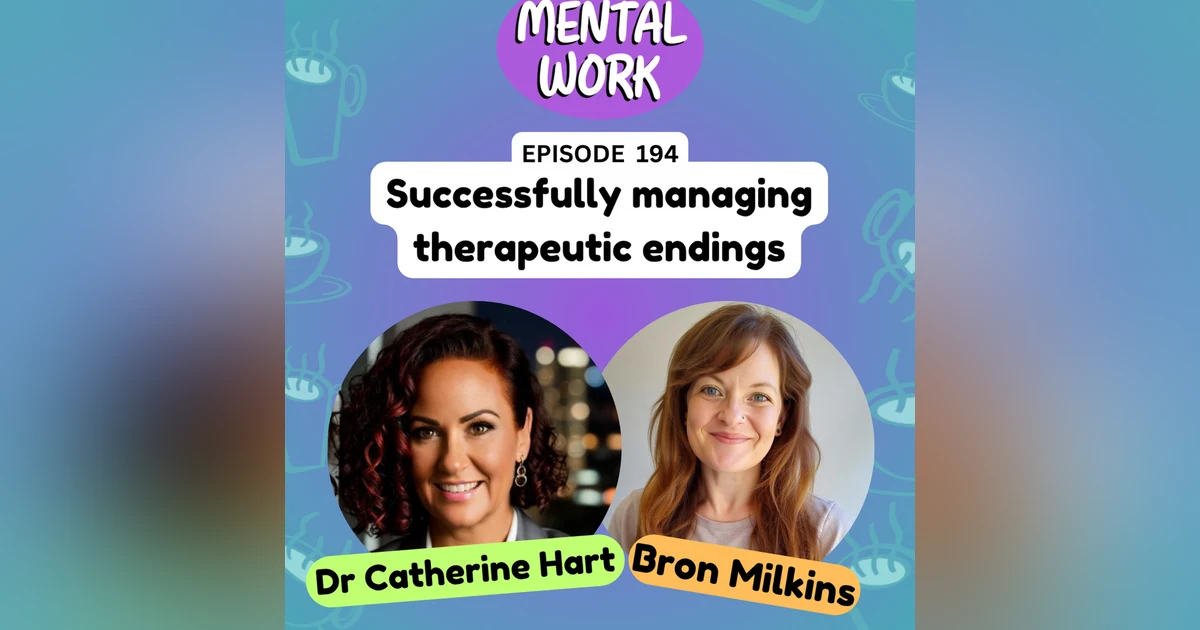
Bron is joined by Dr Catherine Hart (Clinical Psychologist) to unpack one of the most overlooked but clinically significant parts of therapy: therapeutic endings.
Catherine shares how recent large-scale clinic closures prompted her to reflect on how little training clinicians receive on ending therapy, despite how emotionally complex and ethically important it is. Together, she and Bron explore why endings can stir up attachment wounds, countertransference, and grief for both clients and clinicians.
They chat about:
👉🏽 Why therapeutic endings are often neglected in training and why it matters
👉🏻 The difference between planned and unplanned endings (and why unplanned endings can increase risk)
👉 How to prepare clients for endings from the very first session
👉🏿 What ethical, “good” endings actually look like, including transparency, collaboration, and continuity of care
👉🏾 Managing strong client reactions like anger, distress, or withdrawal
👉🏼 What to do when clients suddenly drop out or “ghost” therapy
Thanks as always Catherine for this informative and engaging episode!
Guest: Dr Catherine Hart (Clinical Psychologist, Director of Succoris Psychology and Succoris Psychology Partnerships, Private Practice Business Coach)
LINKS
- Catherine's psychology practice, Succoris Psychology
- Catherine's on-demand course, "DBT Launchpad: Build & Run a Successful Program"
THE END BITS
Mental Work is the podcast for psychologists about the realities of working in mental health, with an early-career focus. Hosted by psychologist/researcher Dr Bronwyn Milkins.
Support the show by buying me a virtual coffee ☕🍵
Have a question, episode idea or just want to say hi? DM Bron on Instagram, leave a comment on the Spotify episode, or email mentalworkpodcast@gmail.com
Apply to be a guest / YouTube (with captions & transcript) / Website
CREDITS
Producer: Michael English
Music: Home
Commitment: Mental Work believes in an inclusive and diverse mental health workforce. We honour the strength, resilience, and invaluable contributions of mental health workers with lived experiences of mental illness, disability, neurodivergence, LGBTIQA+ identities, and diverse culture and language. We recognise our First Nations colleagues as Traditional Custodians of the land and pay respect to Elders past, present, and emerging. Mental Work is recorded on unceded Whadjuk Noongar boodja.
Disclaimer: Mental Work provides informational content. Mental Work is not a psychological service and being a listener or guest does not establish a therapeutic relationship. Content should not be considered a replacement for professional consultation or therapy. All views expressed are personal, subject to change, and do not represent those of any affiliated employer, service, or organisation past or present. Efforts are made to ensure accuracy, but opinions may not always align with fact. Listeners are encouraged to thoughtfully assess the information presented and report any inaccuracies or concerns via email. Further information can be found here.
See omnystudio.com/listener for privacy information.
[00:00:05] Bronwyn: Hey, mental workers. You're listening to the Mental Work podcast, the podcast about working in mental health for early career mental health workers. As always, I'm your host, Bronwyn Milkins, and today we are talking about therapeutic endings.
Ending therapy can be one of the hardest parts of our work, whether it's a planned ending or something unexpected like a service closure, it can stir up strong emotions for clients and clinicians.
In this episode, we're going to unpack why endings matter, common challenges and strategies to handle them with care and confidence. Here to help us is our guest today, Dr. Catherine Hart.
[00:00:35] Catherine: Hi, Bron, how are you?
[00:00:37] Bronwyn: Yeah, I'm well, thanks. How you going?
[00:00:38] Catherine: Good, thank you. Yes, very excited.
[00:00:41] Bronwyn: Good. It's so nice to have you back. Could you please bring us up to speed and remind listeners who you are?
[00:00:46] Catherine: Sure. I'm Dr. Catherine Hart. I'm a clinical psychologist. I'm a board approved supervisor, and I'm director of Succoris Psychology Group.
[00:00:56] Bronwyn: Awesome. And this topic of therapeutic endings, why now? What brought your attention to it?
[00:01:02] Catherine: Well, it probably was prompted a little bit by the closure of the Ramsey Clinics, Ramsey Health Clinics. I think they closed around 17 clinics across the country from memory. And it sort of got me thinking about this again, it, it just seemed, I mean, it seemed so sad and it seems like such a shame. And I was thinking about not only the clinicians and the upheaval, but the clients as well. And I just wonder, I don't know what's happened with those closures and how that's been managed, but I wonder how clients have been left and how they've been managing that.
Um, so it sort of brought it to the front of my mind again, but I've always been curious about, you know, we talk so much in our training and just generally, I think, about starting therapy with somebody, making sure that everything from when, when they walk through the clinic door and sit down in your clinic room, we think about everything to do with building rapport, starting a relationship. I don't think we spoke at all when I did my clinical training about ending therapeutic relationships or what happens. And I often wonder if it's a bit of a parallel that sort of happens in our society. I feel like we don't really talk about relationships ending if it's not like a big abrupt blow up somehow. I dunno that we talk about friendships sort of fizzling out and how we talk to people about, "Hey, you know what? I dunno that this meets my needs anymore. Maybe I'm gonna just see you less often", or actually, do we ever talk to our friends about, "I don't think that we are gonna be friends anymore". We just ghost them, or they ghost us or.
I don't know that we really talk in our society about how to end any kind of relationship well, whether it's leaving a job, leaving a relationship, leaving a friendship, and I just wonder if there's a bit of a parallel with the therapeutic relationship in that we don't talk a huge amount about how do you end relationships well. So I'm curious about that.
[00:03:01] Bronwyn: It's such a good point. Firstly, on the training, same, I didn't get much information at all. I remember a chapter recommended to us during my training on ending therapeutic relationships, and that was one chapter, um, interesting, but maybe not enough and not in practise. And then like you said, the societal view, I completely agree, we don't talk about it enough. It just seems to be broadly accepted that we ghost each other or friendships peter out, but surely we shouldn't be repeating that in therapy. Like we have an opportunity to, I guess, make that different and make that an- a good ending, right?
[00:03:34] Catherine: Sure, and to model to our clients, this is how a, a relationship can end in a really healthy way. Um, even if there's been a rupture, we can still repair this and end this in a healthy way, and they can take that forward into their lives with them.
[00:03:49] Bronwyn: Totally. So I mean, we've got that societal view, which might make it challenging for us to end therapy well, for clinicians. Do you think there's any other reasons why therapeutic endings can feel so challenging for clinicians and maybe also clients as well?
[00:04:05] Catherine: Yeah. Well, I think it depends on a couple of factors. I think it depends a lot on why is the ending happening as well, and is that planned or not? I mean, if it's, we know from the evidence base that if it's an unplanned ending, it, it's actually really, really difficult for clients to be able to tolerate that and manage that, and it can escalate risk and all sorts of things.
I think there's, I think there's a huge amount of attachment related material that gets brought up in endings, whether that's planned or unplanned. And of course an unplanned ending has more potential to open up an attachment wound, I guess, for the client. So not only are they navigating a current ending of a relationship, but then they're also trying to potentially process what's an old attachment issue as well. So they're maybe experiencing feelings related to their childhood, and those relationships as well as their relationship to their therapist. So there can be some real complexity in how clients are able to process that and manage that.
And of course, we are not exempt from that either. We might have our own counter transference stuff that gets raised when a client abruptly finishes, um, therapy or even just finishing with clients, even if that's a positive thing, we can have our own, um, uh, reactions to that.
And of course for the clinicians, it can really depend on why that ending is happening. So if you are a clinician that's maybe become, um, incapacitated through ill health or you're having to retire, or there's a big difficult life transition that's happening for you and you are dealing with your own sense of grief and loss and transitioning, then you are having to navigate all of that as well as hold space for your client who's potentially really distressed by an ending too. So there's this whole sort of mixture of stuff that's in the room and not always really clear to unpick whose stuff is it actually?
[00:06:02] Bronwyn: Well, when you say it like that, it's not surprising why it's so challenging. Like this topic can be so challenging for clinicians to navigate, and I think it's really important, given what you said, it can bring up a lot of stuff for us and for the clients and bring up a lot of old attachment wounds or even, you know, a lot of clients come to see psychologists because they've had grief or loss or abandonment or difficult relationships that have ended poorly in the past, and of course, this ending could also bring up some of those same feelings.
[00:06:30] Catherine: Totally, yeah. It can really, um, yeah, trigger whether you look at that from whatever modality you're using, you know, it's, it's going to create the same pattern, the same loop that's, that's coming up for people. Sometimes that's just a felt sense of abandonment or rejection that they can't necessarily name, but um, it can really stir up some old stuff.
[00:06:51] Bronwyn: Yeah. Maybe this is a good time to point out, because something I've seen online, you know, you just read stuff online, right? And you just see posts and something I've seen online is kind of to the effect of like, well, that's their stuff so they can deal with it and we don't need to be concerned about that as clinicians. Just wanted your perspective on that from an ethical lens..
[00:07:09] Catherine: Oh, that feels really hard to hear. So that's saying it's the cl, it's the client stuff. So suck it up basically.
[00:07:18] Bronwyn: Yeah. So look, we are gonna cancel therapy. Therapy is done. Um, they can manage that.
[00:07:24] Catherine: Wow. that sounds really unethical. I mean, that doesn't sound morally right or ethically right. And I think this probably ties into the, the new code of conduct that's coming into force, um, which I think is much clearer in our obligations as- as psychologists. In particular around how we manage endings. And it's very clear you need to re make sure that your endings are planned, collaborative, um, they're transparent, they're respectful, that you are providing some continuity of care, that you've got some space to do some emotional processing for clients who will have a whole range of mixed emotions.
And so, actually, I don't think that is going to fly, that kind of attitude because I think we are professionally obligated to actually ensure that that stuff is our problem. That is what we need to be ensuring we are, um, protecting our clients from. So that doesn't sit well at all, yeah.
[00:08:22] Bronwyn: Yeah, and I think that's what I was kind of getting at as well, and I'm glad you brought that up because it's like their psychological welfare is important to us as clinicians, so we need to be considerate of that and anticipate the effects of our actions on our clients.
[00:08:37] Catherine: Yeah, totally.
[00:08:38] Bronwyn: Yeah. Cool.
[00:08:39] Catherine: Yeah, it's quite outrageous. I'm shocked.
[00:08:42] Bronwyn: Yeah, just wanted to clear up a, a potential misconception early, so it's like, we need to be concerned about this. It's not a, a 'nice' to be concerned about.
[00:08:50] Catherine: No, and I don't actually think you could not, I don't think you could get away with not considering this because of that code of conduct, especially saying you need to make sure that you are holding a safe ending for your clients. That you are providing everything that they need as within your, you know, within your remit to ensure that it's, it's safe and um, transparent.
[00:09:13] Bronwyn: Nice. So we've got a few elements of a healthy and ethical ending in therapy. So we've got transparent, collaborative, planned, those are like the best ones. Um, are there any other elements that we missed in that?
[00:09:26] Catherine: Uh, I think that idea of continuity of care is super important as well, with, with the Code as well. So making sure that wherever possible you can provide the client with a referral. You can, um, maybe talk to and, and create a handover with another clinician wherever possible, or you can provide notes with the client's consent to make sure that there is a plan for what's going to happen when I've, I'm no longer your therapist. Um, and that that's collaborative wherever possible as well.
[00:09:56] Bronwyn: Yeah, awesome. How can clinicians prepare clients for planned endings from the beginning of therapy? And I'll use an example for this one, which I think would be common and encountered by listeners. Let's say they're on a placement, and so that has a definitive start and an end. So they're at a placement in a private practise. How could people in this situation prepare clients for planned endings from the very beginning of therapy?
[00:10:19] Catherine: Yeah. And I, I think that's a really good way of looking at it too. Um, if you've ever sought legal advice around a psychological issue, my, my, um, experience anyway has been the lawyer will ask you, what have you done to mitigate this risk from day one? They're not necessarily interested in what's going on now, they want to know, okay, well what were all the steps that you put in place to avoid this problem happening? Because this problem isn't just cropping up now. It's cropping up because of a number of things that you have done or not done in your past, uh, practise.
And so I think it's really important from the very start of therapy, like you highlight to let clients know, however you want to do that in your own terminology, but I, I tend to say something like, look, my job is to do myself out of a job here. I don't think that we will need to be in therapy together forever. Or, you know, letting them know that, hey, you might outgrow my skillset here. There might be times when I can no longer help you and it will be time to refer you to somebody else. Or even suggesting, you know what, I might not. I might realise that I actually don't have the skills here to help you, or you might realise that you're not getting what you need. We're not clicking from the start so that it's clear that you can have that conversation early on.
And that also is helpful when clients, clinicians sometimes say, I've got this client and they just keep coming back and coming back and coming back, and I don't really know why and I don't really think I'm doing anything useful, but I don't know how to tell them that we need to end therapy. And so that can be really tricky feeling like, I don't know how to, how to stop working with this person in an ethical way. So if you say, if you signal it early on, Hey look, we might get to the point where therapy's no longer useful or I'm not the right person for you, you've already set that in motion with the client, that they've got the expectation of, okay, this might not be forever.
[00:12:17] Bronwyn: Yes. Yeah, I think that's really awesome. I read, uh, look, I can't remember the title of the book exactly, but very early on in my training, I read a book that was solution-focused therapy and it was like 101 solution-focused questions pretty much like cut into categories. And I always remember like these two questions, which was like, how will we know that therapy is progressing and how will we know that therapy can end? And I always use those questions in like my first or second session as well. Like as you say, to put that in their minds that therapy can have an end, and how will we know this is going well or not so well, and when it can end.
[00:12:49] Catherine: That's perfect. That's perfect. And I would always encourage people to have a regular assessment phase or reviews points through their, through their work as well, like you're saying. So you might do, um, you know, you might do a mental health questionnaire, you might do a, a therapeutic alliance questionnaire regularly. And again, you've got that data, then that will suggest, okay, yes, we're still our relationship's good, and we're still, you're still making progress in therapy? Okay, there's an indication that we can review our goals, but carry on. But equally, if you feel like things have stagnated, you've also got evidence as to, "Hey, look, you say the relationship's great, but you're actually not making any improvements here". So, that gives you another way of discussing, look, I don't think that we are doing much work here and either we're gonna have to shift the goals or we need to think about a referral or, or ceasing having a break for a while. So it gives you a really nice way to have that conversation, I think.
[00:13:44] Bronwyn: It sounds like from what you're saying, you think it's better to raise these issues directly with the client. Obviously in an empathetic and non-judgmental way, but better to be direct than kind of let something linger on.
[00:13:53] Catherine: Totally, totally. Because I think that's when you then end up with the clinicians who are seeing. People pass the best before date. They're just seeing somebody and they're not really enjoying it. They don't really feel like change is happening. The client, there's something else perhaps going on with the client around the attachment or the reasons for coming to therapy, but it's not really doing, you're not doing a great amount of work or good work and that doesn't give the clinic the client a great experience of therapy either. And often clinicians are saying, I don't really want to keep working with this client. I don't feel like I'm doing anything, or I don't really know what the goals are. It's just limping on and on and on.
And, and I think that's especially useful when you're working with somebody with who's, say, going through work cover or TAC, they've got an external funding. Source because sometimes those clients seem to just be coming to therapy just because they've got the funding and they sometimes believe that, well, if I stop this therapy, they'll withdraw my funding, or they'll think I'm okay to go back to work, or there's some other sort of, um, uh, secondary reinforcement to coming to therapy, but it's not really about them doing the work in therapy.
[00:15:06] Bronwyn: That one's a really tricky situation, 'cause I was just thinking in my head like, they might not wanna share with me these secondary reasons. Like if I come, if I stop seeing you, I'm afraid that they might take away my funding. So even if I talk with them directly about therapy, like it might just not get brought up. Do you have any like secret ways of like eliciting that secondary gain information or is that just a tricky situation?
[00:15:29] Catherine: Well, I, I think it is tricky, but I think sometimes if you're doing that almost downward arrow technique with people, you might get to that core of, okay, I, you know, I, I'm not, I'm not gonna be believed or I'm going to be, you know, left here, I can't cope if I'm without this. But, um, I think that's when it's useful to have those regular reviews because you can almost put in the structure of saying to the client at the very start, okay, every 10 sessions, for example, we will have a review and we'll see how you're going and would redo your questionnaires.
And yeah, sure, somebody might just fake bad on the questionnaires, but you've got more of an opportunity to say, okay, I think we've done our bit of work now. I am gonna write back to this funding authority. I'm not going to suggest that they withdraw your funding, but I'm gonna say, Hey look, we've probably done what we can do and here's some other supports that this person could benefit from now that are separate from therapy perhaps. So again, you've got the regular review points, you've got the points at which you can have the conversation, and it's not a shock to the client if you say, look, I think we I think we finished what we can do here.
[00:16:32] Bronwyn: Yeah. Um, I really like regular review points as well. And maybe I'll just add in that you can also hold... even if you say to the client, I'm gonna do every 10 sections, you can also review earlier than that as well. So something that I've done is I've said to clients like, I'm just doing a review of everybody with the progress questionnaires, so is it all right if we review your progress today, or I wanna make sure that you're getting the most out of therapy and that this is useful for you. Is it all right if we have a look at your goals today and see where we're at?
[00:16:58] Catherine: Lovely. Yep. Sounds great.
[00:17:01] Bronwyn: I wanted to ask you as well, with students on placements, do you reckon there's value in saying to clients, from the first session, something like, as you know, I'm a student on placement, um, we're going to be ending in six months. Are you aware of that? How do you feel about that? That kind of thing?
[00:17:18] Catherine: Definitely, definitely. Because again, we know that when there's more notice, when there's more collaboration, they understand what's going to happen potentially, that this is however many sessions or however long a period of time, they, they have that choice about how much content they bring to therapy, they can control that. They can control how invested they become in that, in that therapeutic alliance. They have a little bit more autonomy over the sessions themselves and what's happening in them. Um, and it actually leads to better outcomes when the clients know that that ending is predictable.
[00:17:53] Bronwyn: I agree. So with planned endings, clients can still have a lot of feelings about that ending. Do you have any tips for managing client emotional reactions to endings? Like let's say it actually does trigger some upset, anxiety, anger?
[00:18:11] Catherine: Yeah, totally, totally. And and it's really understandable, isn't it? Because like we've touched upon already, clients can, it can really dredge up a whole load of attachments stuff for clients. It can be some really mixed emotions that sometimes that's hard for clients to really work through and understand that there's all these different parts of them feeling all these different things. Um, and maybe they haven't had a huge amount of autonomy and control in, in relationships ending before, or, you know, they, they're hugely, um, triggered by feelings of abandonment or rejection.
And it, it can often come out as being really angry and hurt with their therapist. I've had some clients say some terrible things to me about endings. Um, you know, when I've gone mat on mat leave or things and I've said to them, look, I'm gonna need to take a bit of time off. It's been really, really difficult for clients to, um, articulate that.
But I suppose as clinicians, we understand that there's the surface level behaviour and then underneath that is actually really what is where that's coming from. And so that, that anger, let's just say, is a product of probably just feeling very hurt, very rejected, very abandoned, a lot of loneliness, a lot of, oh, here we go again. Somebody else just leaving me or, or whatever it is for the client.
So I think as therapists, we just need to be able to take that step back and react to what's underlying this. There's a very hurt part or there's a very scared part. How am I gonna cope without my therapist or how, you know, somebody else is leaving me, trust, all of those things. So just responding to that underlying stuff, I think is crucial rather than responding to the, oh, my client's just blasted me about going on leave... how, how rude.
[00:20:00] Bronwyn: Yeah, absolutely. Something I say to myself is like, this is not about me. It's about what the situation represents to them. So like I kind of just like repeat that to myself as a mantra because it's difficult, it can be really difficult when, like, how you describe some situations, like it can automatically elicit feelings in you, which is like, oh, how rude of them. Like that's so, so rude and so awful of them to say those things. So you really have to remind yourself.
[00:20:25] Catherine: Especially when you've had a really great relationship with somebody and then they tell you to get f-ed and, and a really, you know, I, I would never, you wish, never did anything good for me anyway, it was all useless. You know, it can be really hurtful!
[00:20:37] Bronwyn: It can be, it can, totally. I think talking openly with clients about these feelings, like, I've said to clients like, you may feel nothing about this, you may feel something, you may feel a lot of feelings about this, and I wanna hear them all, and I want to talk about all these feelings.
[00:20:53] Catherine: And we know from the evidence base that that is a really great predictor of having a healthy therapeutic ending when the clients can have those mixed feelings acknowledged and a space is held for them to have all of those feelings. And we are not reacting to that, that's really healthy ending for clients.
[00:21:09] Bronwyn: Awesome. Let's talk about unplanned endings. So you mentioned right at the start that we're going through something in Australia with the Ramsey Health Clinics closing. It also put me in their shoes as well, because a few years ago when the Ramsey Health Clinics were started up, I got an email invitation to join the Ramsey Health Clinics, which I declined, but I was like, oh, wow, I could have been in this situation.
[00:21:31] Catherine: Yeah. I wonder how it's been for clinicians as well. It's, it sounded like it was quite sudden. I'm not sure how much planned notice they got, but it, it sounds pretty sudden.
[00:21:39] Bronwyn: Yeah, it does sound really sudden. So, okay. It's unexpected for the clinicians and it's unexpected for the clients. What are some of the best practises for navigating situations where say you only have like a week or two. Not saying this is Ramsey's situation, but let's just say you only have a week or two before the therapeutic relationship does have to end.
[00:22:01] Catherine: Yeah, I mean in those types of situations it's, it's really tough for everybody, isn't it? Because your clinic clinicians are dealing with shock and their own stuff as well when it's a closure of a service or the, you know, the service structure is changing perhaps. So there's big, been big organisational changes, funding changes, withdrawal of funding. Um, so the clinicians are having to deal with their own sense of loss and grief and shock and, and transition, as well as supporting a client with, um, dealing with a week's notice.
I mean, in practical terms, I don't know about your diary, but I've got some clients that I wouldn't see in a week, I would only see once a month or, you know, you've got a full diary. You wouldn't probably get through everybody unless you'd seen them for a month and had a month's notice to, to work through everybody. So logistically how you, how do you even contact everybody and let them know? Um, it's very tricky and, and you have to just do as much as you can to be able to provide some kind of continuity of that care. Which again, can be difficult in some organisations because they'll say there's a restraint on your trade or you're not allowed to contact clients because they belong to the service. Again, there can be a conflict between what's said in the code of conduct and then what the organisations want you to do.
So they might need to navigate that as well of saying to them, Hey, look, these clients need to be contacted and they need to be given an email address or an address for them to be able to come and contact their clinicians again, or linking them in with other services that we know can take them. So that's a lot of work to do. In a week, it would be very difficult.
[00:23:38] Bronwyn: Yeah, absolutely. It's, yeah, there's an emotional turmoil and then like as a clinician, you're trying to find a new job as well. And then managing the client's emotions and the ethical procedures as well. And then, like you say, there might be conflict with the workplace. Like they may say that we're just gonna, uh, send out an email to all the clients to tell them or something, and you're like, ah... um, so I guess documentation from the clinician's perspective of their ethical decision making processes is important.
[00:24:04] Catherine: Of course. Absolutely, yeah. And, and that's again, another thing that's really clear in the Code now as well is document everything. Document the conversations you've had. If you've sought legal advice or supervision around this, document it, what's your rationale? How have the clients responded if you have been able to get in touch with them? Have there been risk issues raised? And wherever possible, what are the, um, things that you're putting into place to try and deal with that, mitigate that, but very tricky.
[00:24:31] Bronwyn: Very tricky. Any other tips or, or mistakes that clinicians might make that we could avoid?
[00:24:39] Catherine: Well, I, I think it comes back to that, start off your conversations early with clients about what may happen. But, and, and when it's an organisation, I guess it's, there's a lot of lack of control for everybody, but clinicians can also make sure that they're not bringing this on either.
So if you know that you've got a big holiday coming up, or you've got a big health issue that you're needing to deal with, or you are feeling really worn out and heading towards burnout, it's probably not a great time to be taking new clients on... to then be telling them, actually, I don't have another appointment for you for three months or I'm actually gonna need to decrease my caseload and take time off or something.
And again, I think that's trickier when you're a contractor because you tend to have the sense of, no, I need to take on as much work as I can now, while it's okay and 'cause I dunno what's gonna happen to tomorrow to me. But you do have to bear in mind that the, the client's wellbeing is your responsibility there as well. And you need to be able to provide continuity of care for them. So it's just not a great idea if you know you're, you're gonna be in hospital having a big surgery to start taking on new clients right before that.
[00:25:45] Bronwyn: An excellent point. I reckon this is a situation that when you practise, everybody's gonna encounter it, and that is when a long-term client suddenly terminates all future sessions. Like I think every clinician would be able to point to one instance in their career, and I think this can feel really confusing. It can bring up a lot of big feelings for the therapist. They're like, should I reach out to discuss like, what went wrong? What did I do? How can we manage our own emotions in this situation?
[00:26:11] Catherine: Oh, that's a really good question. It probably relates back to what we talked about before around understanding that the behaviour that we are seeing, whether it's ghosting or not coming back, DNAing is there's probably something underlying that that's going on for the client. Probably at one end it's, it's a passivity where they've not felt able to say, this isn't working for me, or, I'm not enjoying this, and they just haven't been able to be assertive enough to, to talk to, to you about what's really going on and what they need. And so, again, that would've been something we could have worked on, but they haven't been able to talk about it. Um, maybe it's that they have dealt with conflict like this previously. They've gotta avoid an attachment or they, they tended to just sort of, you know. Avoid, step away from potential conflict. They don't wanna have a conversation. Um, or if they, you know, they, they're not enjoying therapy, not finding it useful. They've, I mean, who knows what can be going on for our clients, whether it's just financial or practical issues with them.
But I think we have to just be able to step out of ourselves. It's, this is not about us. We did the best we could with the information we had and the client, what the client was telling us, and if the clients drop out of therapy, we have to be able to just take a breath and see, okay, well which parts of that do I think maybe I had a hand in? What could I have done differently? Um, maybe that's deliberate practise around, okay, well actually that first session needs rejigging. It's not building enough rapport. If it's every second session, clients are not coming back, or if it's at the sixth session, they, they're not coming back, okay. There's something about that that I can look at for myself as a clinician and improve on.
But ultimately being able to separate what's, what part we have in that, from the part that the client has, they have autonomy to not come back if they don't want to, and they don't have to tell us about whether they're coming back or not. And so we have to just be okay with not knowing, dealing with the uncertainty of, I don't know if they're okay or not. I don't know what's happened, I have to sit with that.
[00:28:16] Bronwyn: Oh, that's hard, isn't it? No, I don't, I don't! I'm like, the, the trigger was like, we have to be okay with not knowing. And I was like, ah, yeah...
[00:28:25] Catherine: But I wanted to know!
[00:28:26] Bronwyn: Yeah, exactly. I wanted to know! Um, but it is, it is sitting with that feeling because like you said, there is a shopping list of reasons why this could have happened and the client might not even be aware of it itself, like the, the reason. So like I'm thinking for people who have a history of trauma, for example, the reason why they discontinue might be that the relationship, therapeutic relationship got closer and then that scared them off, like it was not tolerable, that level of connection and they might not be aware of that themselves.
[00:28:55] Catherine: Totally. This, this feels like a parallel to when I was groomed or when I was in these really toxic relationships. And yeah, it, it can be really difficult to comprehend for, for us and clients.
[00:29:09] Bronwyn: Absolutely. I wanted to ask what you thought about this, because I've seen differing opinions, so I just wanted to hear what you thought. What do you think about reaching out to the client to be like, hey, I just wanted to get some feedback on like, why you cancelled. Yes, no?
[00:29:23] Catherine: Oh, tricky. Really tricky to to know. I, I personally, I'm doing feedback questionnaires with my, with clients every single session, and so it probably wouldn't seem abnormal for them to be sent a questionnaire saying, "Hey, how did, how was that last session"? because that's common practise.
If it's not common practise, that would feel really weird. And I guess, I guess what I mean is that, uh, hopefully my clients have learnt enough about me and how I respond to feedback that that's really safe. So they can give me a feedback, in fact, usually I just say, only give me feedback if it's crap. Like I don't care if it's good, I, I just need to know the bad stuff, 'cause that's the helpful bit.
So my clients probably know that they can give me feedback on, hey, that session didn't feel right, that didn't meet my needs, that missed the mark, and I will take that on, and I will listen to that. And so if they're wanting to end therapy or not coming back, then hopefully they feel a bit more able to say to me, "why".
But if they haven't been able to do that with do with their clinician all the way through therapy, then why are they gonna feel able to do that now at the end, uh, I just don't think that they're gonna give you anything useful anyway, so why bother?
[00:30:42] Bronwyn: I completely agree and I think like it's, it's probably like the next deliberate practise skill on my list to work on getting feedback better, 'cause I've kind of dipped in and out throughout like my career. And I think it's a really difficult skill because people have such difficult histories with giving people feedback. Like, quite often people have given feedback in good faith and then it's been thrown in their face. So how do you know that your clinician's not gonna do the same thing even if they say, I'm open to feedback? Like, you don't know if you can trust that. So I love, I love your approach of doing it every session.
[00:31:15] Catherine: I don't know if you've actually, in your personal life, been in this situation, I know I have many, many times where, I don't know, haircut or something, and you're sitting there and you're going, I really don't like this, it's really terrible. It's not what I asked for. And they go, how was that? How are you doing? You're like, yeah, it's great, thanks so much, and then pay them and leave.
[00:31:32] Bronwyn: Literally like, it just triggered a memory. I got like fake eyelashes. And I didn't know at the time that I was allergic to the glue. So I sat through a fake eyelash application session being allergic to glue, like in pain, and I was just like, that was great, thank you so much!
[00:31:48] Catherine: Here, lemme pay you for blinding me!
[00:31:51] Bronwyn: And then had to like take them off as soon as I got home.
[00:31:54] Catherine: Oh dear. Yeah, exactly. So you know, it's tough to give-
[00:31:58] Bronwyn: Yes, it is really tough. It's totally tough. So I completely emphasise. So you use, it sounds like you're using the feedback informed treatment approach.
[00:32:07] Catherine: Yes, I, I do try. Uh, it's making me think too about my own therapy and, um, I don't know if my therapist listens to this, I hope not! But you know, there, there was, there long period of time went past because we hadn't booked our next appointment in. And I just left it and left it and left it and left it. And it was only when they reached out and said, oh, hey, you know, if you still wanna come in, let me know because otherwise I'm gonna close your file kind of thing. And I went, oh crap, I'd better book back in, but I was able to do that.
And so I think the reaching out thing is slightly separate from the feedback thing, but I think. Probably worth just touching base with somebody if they've not booked back in or you've not seen them for a while, just to check, do you, do you still want to come in or not, and how are you going? Just as a check in, um, and probably just as a way of being able to discharge clients that actually are no longer active so that you've not got that kind of risk sitting on your file, but as a check-in, I think that's pretty reasonable to do and probably quite a nice thing for clients to know, "Hey, my clinician is thinking about me and does wonder where I am".
[00:33:12] Bronwyn: Yeah, I've actually, that's a standard part of my practise. I think it's like two weeks, and I used to have, um, like an automatic thing set up in my practise management software that would send a text being like, Hey, just checking how you're going, if you'd like to rebook, here's the link, sort of thing. I've never gotten negative feedback and in fact I've got positive feedback about that. "Thanks for the reminder".
[00:33:31] Catherine: Yeah, perfect. Yeah it's nice, isn't it?
[00:33:34] Bronwyn: Yeah, totally. Catherine, we've covered a lot today. Is there anything that we haven't covered which you reckon listeners would benefit from hearing?
[00:33:42] Catherine: Um, it's prob- it's probably implicit in what we've talked about. Um, and it's just the, just the role of, uh, support, supervision, talking to a more senior clinician, perhaps, getting, getting support around endings, because sometimes I think it can be really tricky to navigate. I actually really am struggling with this client. What's the reasons for me struggling with this client? Do I need to refer them on or not? Do I, is it something I need to work through? Is it, and, and navigating that's tricky sometimes. So, um, I think supervision, of course, is super important for us to be able to get in relation to endings, or even an unplanned ending when a client has left and we need to deal with some of our own stuff as well.
[00:34:26] Bronwyn: I also emphasise the importance of supervision. I was just trying in my head to mentally calculate how much supervision I've dedicated towards ending, and I reckon it's at least 30 hours that I've spent talking about endings. 'cause I've had multiple workplaces. I've closed my own practise, and that's either been advice on how to manage specific clients, manage emotions, manage my own emotions. Um, so yeah, I feel pretty good about it now, but it's actually been a lot of work, which I feel like has been really important, but also helpful.
[00:34:54] Catherine: Really amazing that you've dedicated that time to it.
[00:34:57] Bronwyn: It's just important and it's like, I just feel like you can't get around it.
[00:35:01] Catherine: I wonder how many other people have though. I, I think it gets, it gets left as a sort of secondary thing.
[00:35:06] Bronwyn: Yeah. Um, but yeah, I had to get really comfortable with talking directly about their feelings as well. So literally being like, I wanna hear about the anger. Tell me about that. Okay, they might not wanna share it now let's check back in, in like session two about what's, what's showing up for you now, 'cause it can change as well as they approach the end. Um, so yeah, it's been really good. Love supervision for endings.
[00:35:26] Catherine: Yeah. Good job.
[00:35:27] Bronwyn: So what do you hope that listeners will take away from our conversation today?
[00:35:32] Catherine: Um, I think recognising the importance of therapeutic endings as really kind of clinically potent, uh, moments, um, that if we can have planned collaborative endings, that's going to protect client outcomes, client satisfaction. Whereas the opposite heightens risk of distress and disengagement, so it's super important. Um, that the best lever of reducing those premature terminations and making those endings constructive is the therapeutic alliance and shared decision making throughout, so start from the start with that.
And ensure that you've got clear communication, written plans, continuity of care, um, you're doing transfers, handovers, all those kinds of things, wherever possible to avoid that real sense of abandonment. I've actually got a plan going forward and I know what's gonna happen from here, make it really clear.
[00:36:28] Bronwyn: Beautiful. Catherine, if listeners want to get in touch with you or learn more about you, where can they find you?
[00:36:35] Catherine: So they can go to succoris.com.au, our website, or they can find me on LinkedIn. I'm always, um, pestering on LinkedIn and hovering around on LinkedIn, so that's the best place to find me probably.
[00:36:47] Bronwyn: And could you just tell listeners, I've seen you advertise like a DBT course that you've created. I think listeners would actually be interested in that. Could you just tell us a bit about it?
[00:36:54] Catherine: Sure. I'd love to thank you. Um, so the DBT Launchpad... it's really designed for any DBT clinician who has done training but then has got a bit stuck and thinks, okay, I'm, I'm maybe dipping in and out of some DBT stuff, but I haven't really been able to put a full programme together, don't really know where to start, maybe they're standalone clinicians or they're in small practises and they need a bit of community support and they need a bit of structure to maybe create content that's relevant for their, um, client group.
So I'm helping people develop their own DBT services, whatever their environment they work in, and linking them in with other clinicians so that if they need co-facilitators or support, there's, they're all in one place.
[00:37:40] Bronwyn: That's really awesome. I think that's really needed, 'cause like, yeah, having done DBT training myself, it's like you get, you gain a lot... There's a lot of info, but it's like the implementation is like a whole different question.
[00:37:51] Catherine: Yeah, totally. And that's what people tend to say to me. "I do bits and bobs, but I don't really know how to do a whole thing" or how to take bits from it and still be, uh, evidence-based.
[00:38:01] Bronwyn: Yeah, exactly. Awesome. Um, I'll pop up those links in the show notes. Thanks so much, catherine, for coming on the podcast.
[00:38:09] Catherine: Thanks, Bron. See you soon.
[00:38:11] Bronwyn: See you soon.
Listeners, thank you for listening to this episode. If this episode gave you some ideas for handling endings in your practise, do follow the podcast, it means that episodes drop in your feed. Leave a rating or review and share it with your colleagues. I'm Bronwyn Milkins, have a good one, and catch you next time, bye.

Clinical Psychologist
Catherine is a Clinical Psychologist, Board Approved Supervisor, APS Clinical College CPD Co-ordinator and Director of Succoris Psychology and Succoris Partnerships. Succoris Psychology currently operates three clinics across Australia and prides itself on providing a range of accessible services to clients, as well as creating great team cultures for staff to be a part of.
Succoris Partnerships offers psychologists a unique opportunity to build their ideal private practice in partnership with the experienced Succoris team.


