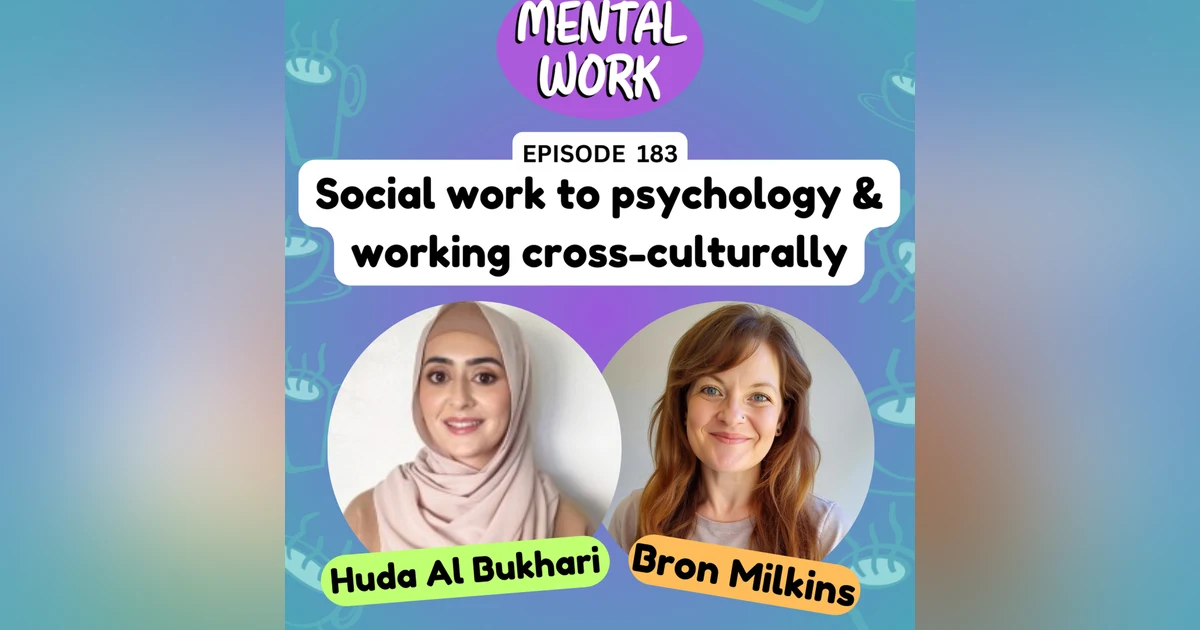
Bron is joined by Huda Al Bukhari (clinical psychologist) for an early-career listener story that spans social work, clinical psychology training, and practising across Australia and Abu Dhabi!
They chat about:
👉🏽 What it was really like to move from social work into psychology, including the fear of "not making it"
👉🏻 Managing the intensity of a clinical psychology Masters, including what helped
👉🏿 Moving overseas in the middle of a Registrar program
👉🏾 What it's been like working cross-culturally with children and adolescents in Abu Dhabi
👉 Practical strategies that Huda uses to stay grounded and avoid burnout
This episode is a reassuring reminder that early-career paths are rarely linear, and that flexibility, reflection, and support matter. Thank you Huda! 🥰
Guest: Huda Al Bukhari, Clinical Psychologist
LINKS
- Huda's Instagram where she shares educational videos for parents: @guiding_youngminds
- Huda's LinkedIn
THE END BITS
Mental Work is the podcast for psychologists about the realities of working in mental health, with an early-career focus. Hosted by psychologist/researcher Dr Bronwyn Milkins.
Support the show by buying me a virtual coffee ☕🍵
Have a question, episode idea or just want to say hi? DM Bron on Instagram, leave a comment on the Spotify episode, or email mentalworkpodcast@gmail.com
Apply to be a guest / YouTube (with captions & transcript) / Website
CREDITS
Producer: Michael English
Music: Home
Commitment: Mental Work believes in an inclusive and diverse mental health workforce. We honour the strength, resilience, and invaluable contributions of mental health workers with lived experiences of mental illness, disability, neurodivergence, LGBTIQA+ identities, and diverse culture and language. We recognise our First Nations colleagues as Traditional Custodians of the land and pay respect to Elders past, present, and emerging. Mental Work is recorded on unceded Whadjuk Noongar boodja.
Disclaimer: Mental Work provides informational content. Mental Work is not a psychological service and being a listener or guest does not establish a therapeutic relationship. Content should not be considered a replacement for professional consultation or therapy. All views expressed are personal, subject to change, and do not represent those of any affiliated employer, service, or organisation past or present. Efforts are made to ensure accuracy, but opinions may not always align with fact. Listeners are encouraged to thoughtfully assess the information presented and report any inaccuracies or concerns via email. Further information can be found here.
See omnystudio.com/listener for privacy information.
[00:00:05] Bronwyn: Hey, mental workers. You're listening to the Mental Work podcast, the podcast about working in mental health for early career mental health workers. As always, I'm your host, Bronwyn Milkins, and today we have an early career listener story for you.
In this episode, we're hearing from somebody who has crossed borders, disciplines, and cultures on a path in psychology. If you've ever felt unsure about your next step or wondered what it's like to practice internationally or switch paths midstream, then this conversation will be full of insights, honesty, and encouragement. Here to help us out this topic is our special guest today, Huda Al Bukhari. Hi, Huda.
[00:00:39] Huda: Hi. Hi, Bronwyn.
[00:00:41] Bronwyn: It's so nice to have you on. It's, it's a pleasure.
[00:00:43] Huda: No, it's a pleasure to be on here. I've been a fan for such a long time.
[00:00:47] Bronwyn: Oh, it's, it's so weird for me to hear that. It's like I have a dual thing inside of me, which is like, I hope lots of people hear the podcast, and then I'm like, I hope nobody hears the podcast, kind of thing. Maybe you can start us off by telling listeners who you are.
[00:01:00] Huda: So I am a clinical psychologist, recently endorsed with AHPRA, about a month ago, which was really, really exciting. Um, and I am currently working with children and adolescents in Abu Dhabi.
[00:01:11] Bronwyn: Wonderful, and congratulations on the clinical endorsement. I know it's such a long journey, so it's a big achievement.
[00:01:17] Huda: Thank you. Thank you, Bronwyn.
[00:01:19] Bronwyn: So let's start off with your early career story. Where did your studies begin and what shaped you to want to take on psychology as well?
[00:01:27] Huda: Yeah, so before, um, becoming a psychologist, I was actually a social worker. I worked at a community mental health center, so I was managing a caseload. Um, so chronic, um, and severe presentations, so, you know, individuals who were diagnosed with bipolar and schizophrenia.
During those two years, I developed such an interest in mental health, like a deeper interest, and I learned so much working in such a multidisciplinary team. I just started to gain this passion, which is such a cliche thing to say that like this passion for wanting to learn more about mental health and wanting to learn how to provide interventions. So I was actually quite scared. I had a lot of these like, oh, should I, should I not? And I remember speaking to a lot of people, um, and I said, no, I'm gonna take the journey of like studying psychology. yeah, it all started from there.
[00:02:23] Bronwyn: I'm really curious about the jump from social work to psychology because I'm interested in... did you feel like there was capacity to be interested in mental health and stay with social work, like you could have gained further training from there? And I guess I like, yeah, that was the end of the question.
[00:02:40] Huda: Yeah, so as a social worker, I was doing a lot of like counseling, like micro counseling skills, supporting people, but it was a lot of working with people on a systemic level. So working with them in terms of supporting them with housing, supporting them with their needs. So I really wanted to delve deeper into the therapies, which I know that if you do a lot more training, you can work as a therapist, as a social worker, but I actually wanted to go through the entire process and see where it leads me. So I think I wanted to kind of expand my knowledge and expand my skills in those areas, and see where it goes.
[00:03:13] Bronwyn: That makes a lot of sense. So you did a master of clinical psychology, yeah? And I'm wondering like, what was that like for you having already had a previous profession beforehand and lots of experience? Like, did you find the content really easy or was it, was it all new or a bit of, of a mix?
[00:03:29] Huda: Honestly, I was terrified if I was-
[00:03:30] Bronwyn: Really?
[00:03:32] Huda: Extremely terrified, 'cause when I left social work, I was in this position of like, am I gonna make it? Because we know with psychology, there are a number of hoops that you jump through and you're never guaranteed to make it to the end. So I actually did a post-graduate diploma in psychology, then I got into honors and then I did the masters. But even though I had a good background about mental health issues, um, a good, like, I had clinical skills, I wouldn't say it was easy, it was actually quite a tough road, because there were so many theories that were involved in psychology. A lot of, you know, um, you know how exams are like, they're so tough. and. They really do try and choose the best of the best. I was terrified, but at the same time, honestly, I had this thing where I was like, I need to believe in myself and I need to try really hard and see where it takes me.
[00:04:21] Bronwyn: And what were the factors that got you through, because I completely empathize with it being frightening. What do you think helped you along the way in studying that, that master of clinical psych?
[00:04:31] Huda: I think a good support system, to be honest, if I didn't have that support system, I think it would've been really hard. Master's program is so consuming, um, in terms of time and energy and there's a lot of requirements. So, you know, you're with your placements, your thesis, your subjects', so many, so much going on. Um, I've had to even take breaks from work during that time to be able to focus on studies. If I didn't have like a supportive family and supportive like colleagues, I reckon it would've been way harder than it, what, what it is.
[00:05:02] Bronwyn: Yeah, totally. That makes a lot of sense. I'm curious, what was your master's thesis on?
[00:05:08] Huda: Oh, it was about pregnant women experiencing body image issues, it was so fascinating. It was quite complex, but I learned so much about it, 'cause I, I, I've never had babies, don't have babies, so I didn't know that this is what pregnant women experience. But a lot of pregnant women, I learned, experienced so much body image issues during pregnancy and post and like understanding the different factors that led to that was so insightful that now I have like a deep appreciation for women out there and the pressures that we carry.
[00:05:42] Bronwyn: That's so interesting. It's very coincidental as well. I was listening to someone present their research just the other day about a parenting program for new mothers. And one of the things that came up as really prominent was body image issues. And I was just, I wasn't necessarily surprised, but it, um, I guess it was a little surprising that it was like a core thing.
[00:06:03] Huda: It, it's, it's really a core thing. And when I was reading all these research and I was looking into it, it made a lot of sense, 'cause you know, you, you're used to your body in a particular way, and then throughout the month your body is changing, the hormones are changing, and then you get things like stretch marks or you might get cellulite and then you, and now with access to social media, you see, like, um, a lot of these influencers who jump back to being their pre-baby weight, and in reality, that's not the case for most women out there. So the pressure is so real. Um, and it's so hard, and I can see how much that would weigh on a woman. and I don't know, like, I was just like, man, it's, it's really rough for, you know, mothers.
[00:06:43] Bronwyn: Yeah, absolutely. That's a really interesting project and a lot of insight. I'm interested as well, like my understanding of social work, and I've got a few mates who are social workers and there's a big focus on systemic level interventions, so like at the level of families and communities, and also a big focus on social justice. I'm wondering like how that professional lens influenced or kind of tied into the clin psych training... Did you see overlap or were there, were there differences?
[00:07:13] Huda: I do see an overlap, or I feel like I have transferred a lot of skills to my clin psych, which I think was so beneficial to be honest. Now when I work with a person, I just don't see the person as the individual and they're alone. I, I, I just can't seem to, I always start to think about a person in layers.
So I think about, okay, what's going on for them? What's their family situation like? Or what's their partner like? What are their financial situation like? You know, I just think about all these questions because I understand how different factors can actually impact and affect a person. I don't just see depression or anxiety, so I, I actually see the layers of that, which I guess there are pros and cons. I guess the pros of that is that it gives you an in-depth understanding of a human and, um, rich knowledge, but at the same times it can make it more complicated. So I kind, yeah, I kind of see the, yeah, see both sides, but at the same time, I think it's, it's made me a better clinician, I think.
[00:08:16] Bronwyn: And throughout your training as well, like I know you do the clin psych degree and then you do at least two years of practice to gain your clinical endorsement. Where did you do your clinical endorsement? Like what area were you practicing in?
[00:08:28] Huda: Yeah, so I did, um, my registrar program, so half of it was in Sydney and half was in Abu Dhabi, which was so complicated. So when I was here in Sydney, I was actually working with a, at a private private practice in Lane Cove, and then I moved to working at a community health center, along with a private practice, but I was working across the lifespan, so with children, adolescents, and adults.
But when I moved to Abu Dhabi, I just focused, I was in a CAMHS team, so I worked with children and adolescents, and I realized that I actually love the little ones a lot. Um, and I do enjoy my work with them a lot more than adults, even though I'm quite good with adults, but there's something about working with children that ignites such a positive feeling in me. Like I enjoy the sessions, I walk out feeling, I dunno, like, like younger are coming out. Um, which I think before working with children, I was a little bit more serious. I think they really have brought our side to me that was more playful and young.
[00:09:33] Bronwyn: That's really beautiful to hear. It's so exciting, I think, in our work to learn different things about ourselves and we might not have thought those things were, were within us, but the work really brings it out.
[00:09:44] Huda: It really, really does. I was actually one of those people who, um, when I was doing my master's program, I was that student in class being like, there's no way I'd work with children, like, they're terrifying. Like, what would you do and how would you work with them? Um, and it's so interesting when I did my placement with children, I realized how well I connected with them and I didn't realize I had those skills or knowledge until I actually put myself out there, and just started learning as I go and I said, oh my gosh, I can't believe I actually like work with- working with them more than I work like working with adults. So
[00:10:20] Bronwyn: Yeah, and it's such a good demonstration as well of how we can, I guess, create beliefs about a client population before we've worked with them. And sometimes we're like, oh, I won't work with them at all, but then when we get into it, it's like the best thing. And that was totally the same with me with older adults. It's not that I didn't have negative attitudes towards older adults, but I was like, no, I can't see myself working with them. I love working with older adults.
[00:10:43] Huda: Oh my gosh. I love that. That's amazing.
[00:10:45] Bronwyn: Yeah, but it's similar to what you are describing. You're like, hey, like kids are great.
[00:10:49] Huda: It's honestly, it taught me just never assume, just, just try it out.
[00:10:54] Bronwyn: Yeah, totally. So one thing you mentioned in that, which was is quite a big thing, is that halfway through your registrar program you moved to Abu Dhabi. Um. Have you, have you lived there before or..?
[00:11:09] Huda: It sounds like such a risk, right? You're like, you just dropped your registrar program and went overseas!
[00:11:14] Bronwyn: Yeah.
[00:11:16] Huda: Yeah. I look back, I'm like, wow, okay, I can't believe I did that. So yeah, I did. I flew out halfway and I, one of my supervisors there is an Australian Board-approved supervisor, so I was un- under the impression that she'd supervise me and that I'd continue my registrar program there, and that there wouldn't be any issues. But there was a lot of issues, please don't drop your registrar program and go overseas
[00:11:39] Bronwyn: Okay. So did you actually have to, did you actually have to do that? So did AHPRA not let you do your program overseas?
[00:11:45] Huda: They were like, "no"!
[00:11:47] Bronwyn: Oh, okay.
[00:11:48] Huda: And I'd already like settled there and I was like, oh crap, no. Um, so they said that you're a out of jurisdiction, so you can't actually complete the registrar. And I was like, oh, damn it. Like, do I have to come back now? Um, but luckily I met another Australian, uh, board approved supervisor there, she was amazing. She was one of my biggest supporters in Abu Dhabi. Um, she actually was the one that advocated for me. She reached out to AHPRA told them the work I was doing 'cause she was working with me, told them that a work I was doing, um, said that, you know, it's equivalent to a registrar program, um, and it's really unfair if I don't actually get the endorsement. So they gave us a solution and we applied and got approved.
[00:12:35] Bronwyn: Oh, that's amazing. That's a really good outcome.
[00:12:37] Huda: Yeah. So I was, oh, I was uh, I was like, I'm so lucky. Like, wow, I just thought I had to come back and complete the registrar.
[00:12:45] Bronwyn: Yeah, if I would've thought the same thing in that situation, I guess like as an early career psych, you're just like, oh, okay, they've said, no, I'll just come back and move to the country again.
[00:12:56] Huda: And she was like, you don't have to do that, I need to have a chat with them. And she read a letter and she was like a go-getter. She was like, no, we, we need to speak to them. And she then supervised me and she actually wrote like a whole letter explaining like the assessments I was doing, um, the therapies and that I was meeting all competencies. Um, so there was no reason for them to say no, and thankfully they listened.
[00:13:21] Bronwyn: Oh, that's wonderful. It really speaks to the value of having like a, a senior supervisor and supporter who can really advocate on your behalf.
[00:13:30] Huda: A hundred percent. It, it, changed everything for me.
[00:13:32] Bronwyn: I'm really pleased to hear that, because otherwise that would've extended your program by like some time.
So I dunno anything about like how mental health works in Abu Dhabi, what is, is there any differences or like, is there any considerations?
[00:13:45] Huda: There are a lot of differences and I had to learn on the go. Um, so in terms of like providing therapies and assessments, it's the same. So it's standard evidence-based practice all the same.
It's in terms of culture, there was a lot of adapting. So the culture there is very different to here. And I think like one of the examples is working with children, adolescents, we expect that parents would come to the session. But Abu Dhabi are very lucky in the sense that they are, they're a very wealthy country, so they have a lot of support. So whether that's nannies and drivers.
Um, so what I realized early on is I'd go to the waiting room and I'd meet my little kid and I'd say, no, where's mom or dad? Um, and they'd be like, oh, they're not here, they're at home. And so I would say something like, oh, so who brought you in? Um, and it would be like my nanny or my driver. So I remember being taken back at the start going, oh, this is a bit different.
Um, so yeah, just I had to learn very early on that I needed to contact families, actually educate them about why it's important to have parents with their children, um, in session, why it's there. It's so important for them to actually be involved in the work and the therapy., and I've just learned that it's quite a progress. So there's been a lot of cultural differences.
[00:15:08] Bronwyn: That's really interesting and it's, uh, it's definitely learning cultural competence in practice, right?
[00:15:13] Huda: Literally.
[00:15:14] Bronwyn: Yeah, yeah. Um, what were some of the key lessons, particularly working with kids and teens, that came from your experience there? Because you worked with kids and teens here in Australia and then in Abu Dhabi, right?
[00:15:26] Huda: Yeah.
[00:15:27] Bronwyn: So what were some of the like cross-cultural learnings and I know you spoke just then about the challenge with kids coming on their own. Were there any others?
[00:15:36] Huda: Yeah, so I learned I had to be more flexible. So over here, you know, we learn CBT, so I, I work from a CBT framework, there's structured session, yeah, sometimes we might deviate, but there are like structured sessions that we kind of like go with. That doesn't work overseas. So once they see structure, um, you immediately get disengagement, um, especially with, um, the locals or the Middle Eastern population.
So what I've had to learn very early on is to be more flexible in my approach. A lot of these kids like hands-on things even after my teenagers, or they like having therapy that is more conversational, more fluid, very laid back. So what I had to learn is that I needed to just go with that, but uh, apply my CBT strategies in a very subtle way, to be able to get the results.
And one thing I learned as well is that, actually, doing therapy overseas takes such a long time because you know how we provide activities between sessions so that they can learn the skills and they can adapt them, and there's like that practicing component... that doesn't really happen, um, despite me educating families and children or adolescents about the importance of that.
So I've just got... I just had to come to a place where I was like, you know what Huda, you need to be flexible and adapt and just work with what I have. And just to be fair to them though, mental health in those regions are quite early. There hasn't been there for long. There was a lot of stigma for such a long time and I think that's starting to get better. So it's kind of working with the system and hoping that with time things improve and there's more awareness.
[00:17:23] Bronwyn: Stigma was like, I wanted to ask about, 'cause I feel like in Australia, like, you know, there's still a bunch of stigma that exists, but we hope with our awareness campaigns that that is lowering a little bit. What is the current state of how people perceive mental health in Abu Dhabi?
[00:17:37] Huda: I honestly expected it to be worse, but a lot of people are more like, are receptive to seeking support, more than I expected. Um, but I did notice that, for example, um, we call them the locals, um, so the Emiratis, they are more, um, I feel like they're becoming more educated and aware and they're more open to work, but I have noticed that stigma to be more present in other Middle Eastern populations. So for example, that might be Jordanians,, Lebanese, um, so other, other, other countries, they- the, the knowledge and awareness is growing, but it's a little bit slower.
[00:18:17] Bronwyn: That's interesting. It sounds like it was really interesting working overseas.
[00:18:21] Huda: Oh yeah, it has been. I've learned a lot about clients, about the work, about myself, but honestly I've enjoyed it so much.
[00:18:28] Bronwyn: Throughout your studies in clinical psychology, what are some of the things you've learned about yourself? Maybe the top thing you've learned about yourself?
[00:18:36] Huda: I think... one thing I realized when I was studying clinical psychology is that I was trained to become a perfectionist.
[00:18:45] Bronwyn: Oh.
[00:18:46] Huda: Ah, and I, you had to be a perfectionist to a particular degree to be able to get the marks and get through. But one thing I learned, once I finished and I was actually on the job, is that that perfectionism actually works against you, and that you have to just slowly train yourself to let go and write that note... Don't have to read it, reread it a hundred times, save it, move on. Same with assessments. Give it a proofread. Just I had to slowly learn how to let go of that perfectionism, um, to be able to actually be a good clinician.
[00:19:21] Bronwyn: That's such a good way of putting it. I love the way that you've described it there, because I'm thinking like for myself, it might be, oh, I've got 10 GP letters to write today. I'm gonna be there for the next two weeks if I'm reading them a hundred times. So it is that gentle process of, of adapting to reducing that perfectionism.
[00:19:37] Huda: A hundred percent because, our work requires a lot where- and I think what matters the most is the client work, being there, being present. If you have a spelling mistake or grammatical error, you've forgot something, it won't be the ends of the world, is what I realized. Just letting that go.
[00:19:53] Bronwyn: And you mentioned earlier that your supports really got you through your degree. It sounds like you've had an excellent supervisor as well. I was just wondering, like could you say a bit more about the things that have helped you get through might be like external supports or things that you do personally that really help you?
[00:20:09] Huda: What I've learned, is I like a life work balance. So I've realized five days a week is not for me. I am more at risk of burnout if I do work five days a week. So what, what I've realized works best for me is to actually reduce my days to four days and have three days off. And the way I've managed that is I started to listen to my body. So yeah, becoming more in tune with my body, listening to my needs and figuring out what works and what doesn't work so that I don't burn out, because I've been there before during my master's program, and that was so ugly. So what I realized is I can actually work two days, do well, and then I have a day off, and then work another two days and then have a weekend off. And that way I'm balancing life and work and being able to reserve my energy, but also give back to, you know, society .
[00:21:00] Bronwyn: Again, I really love how you've described that, like that just listening to your body is so important and being like, okay, I don't wanna go back to where I was before when I was burnt out. So I need to take my body seriously.
[00:21:10] Huda: Yeah, because I realized that it, we, we were so used to just pushing and pushing and pushing, and then we crash. But when we crash, it's not like a day of two of taking rest, but it actually takes such a long time to get out of that and listening early on and honoring your body, is so important.
[00:21:28] Bronwyn: Absolutely. And this might be the answer to the next question that I had, which was what's something that you wish someone had told you when you were just starting out in your career?
[00:21:37] Huda: To be flexible and less rigid. I think, I think when I first started I was like, no, this is how things are meant to be, this is how CBT should look like this is, you know. And I had to really, learn that it's okay, not everything is textbook, life isn't black and white. It's actually shades of gray. Um, and humans are complex and unique in their own ways, and learning how to adapt and be flexible to each person, you, me, and is really, really important in the work, it's actually what creates that therapeutic relationship and what actually helps clients stay with you for quite a while.
[00:22:16] Bronwyn: I'm just thinking like, you know, you just, you described perfectionism just before and gradually releasing that, and I think that a lot of early career psychs, one reason why they're not flexible is 'cause they feel a lot of pressure to get it right. I just wondered whether that resonated with you and that's something that you've worked on?
[00:22:33] Huda: A hundred percent. And I think it goes together that, you know, like being so perfectionistic rigid, like, you know, um, which I think served its purpose at a time and that's okay because it helped a lot of, it helps a lot of us at early career psych to kind of get through. But it's really important. That when you get to a particular life stage, when when you're working, it's to actually figure out is it still helping me? Is it still, um, is it bringing, is, are there benefits? Do the benefits outweigh the costs or is it the, is it the cost that's outweighing the benefits and really having to sit down with yourself and reflect on that, and if it's no longer benefiting you, it's about really learning ways to, um, just let go of that.
And I think every person is different. So for me it was a lot of self-talk, and a lot of times, even just practical ways of doing things. So if I was to, uh, if I was going to read that GP letter again, being like, nope, that's it. I'm sending it, and really pushing myself to just do that. Uh, I think everyone has their own way of letting go, but that was one, one way that helped me kind of reach this level of being more flexible, less perfectionistic, more chill.
[00:23:43] Bronwyn: That's such a great way of describing it and really taking that space and time to reflect rather than just keeping on pushing through with something that might not be working for you anymore.
[00:23:52] Huda: Yeah, exactly.
[00:23:54] Bronwyn: So you've got in your clin psych registration, you've come through social work and you've come back to Australia now, um, have there been any moments where you did doubt your path and you were like, you know, maybe I should have stayed in social work?
[00:24:07] Huda: Interesting. Yes and no. Yes, in the sense that I realized working in psychology makes me more tired than I was when I was doing social work. It's, I didn't realize how exhausting it can be. But I do love my work more, which is so contradicting in a way. but I do enjoy the therapy work and I do enjoy the assessments. At times when I'm so tired, I'm like, oh, why don't I stay in social work? It was so much easier. Oh, I felt like it was easy. It didn't take out so much energy, or I didn't feel so tired so quickly.
But do I... if there's a part of me that says, do I ever regret it? No, I'm actually quite happy with where I am. I think a lot of the time I'm using my social work knowledge, um, to help me with my psychology practice. Um, but at the same time, I really enjoy my work. I think I, if when I say I had a calling, my calling was psychology.
[00:25:05] Bronwyn: Oh, that's really beautiful and I think like what I'm hearing as well really connects to something we've talked about on the podcast. It's one of my favorite episodes actually, where we talked about emotional labor and just that psychology brings this, uh, I guess, unique emotional labor that comes from this one-to-one work and attentive listening and attunement like during a whole 50 minute session. And it's not that social workers aren't using that emotional labor as well. It's just qualitatively different when you're doing systematic and like family based interventions... it's, it's, it's qualitatively different. So not less so any social workers, don't think that we're saying that you have an easy job.
[00:25:41] Huda: Social workers are amazing. They do a lot, but it's not a, it's not a lot with the face-to-face that, that kind of, like you was saying, the emotional labor. So there was a lot of behind the work scenes, writing that letter, advocating for them, making calls, which to me wasn't so exhausting, but sitting in a room for 50 minutes and like, if you see five to six clients, that's count the hours. Um, like you said, listening to the clients and just being present with them, even formulating while you go.
[00:26:06] Bronwyn: Yes.
[00:26:08] Huda: -takes up a lot of energy preparing for the next session. I realize that it's so emotionally taxing, but rewarding at the same time.
[00:26:16] Bronwyn: Yeah. Awesome. What do you love most about being a psych?
[00:26:20] Huda: Right now? Honestly, seeing change in, in the people I work with, I think that's the most rewarding. So when I hear a mom say, oh, like my child's so much better. They're more like, they're more, um, confident, um, they're less anxious... I don't know how to describe, describe how happy I get just hearing that feedback. Or even my child's, like when I see them in the therapy room and they're like, I'm not scared of that anymore... just hearing that, just I get so happy and I go, yep, the work I'm doing is so meaningful and this is why I'm here.
[00:26:54] Bronwyn: Oh, that's, that's so lovely. And yeah, I think that can resonate with a lot of listeners. Just even hearing, like you said, that line, like I'm not afraid of something anymore, can just mean the world to us.
[00:27:03] Huda: Yeah, because it's like, you know, our, our work is making a difference. Even if it's just one person, it's making a positive difference in, I'm honored to be part of that journey, so I think that's what makes me keep going back and doing the work I do and making that emotional labor, okay. To- you're able to tolerate it.
[00:27:21] Bronwyn: Yeah, absolutely. So one thing that is really common amongst early career psychs is that it's difficult to feel confident. It's like you're just starting out in this career. You're learning so much, there's so much to learn, and there's a lot of imposter syndrome that can come up, people have a lot of self-doubt. I'm wondering, um, what helped you to say grounded and grow your confidence, um, yeah, throughout this?
[00:27:43] Huda: I had a lot of imposter syndrome when I first started. I remember being like, am I good enough? Am I ready for this? Oh my gosh, are they trusting me to look after clients and like formulate and do all this stuff?
There were, there were a few things I did. Um, so one thing I I like about myself is that I'm quite reflective. So I noticed that quite early on that I was having these thoughts and I said, no, I need to do something about it. Um, so I did a few things. One of the things I did was, listen to this podcast, let's be honest, it really helped me. Yeah, it really helped. And I go, oh, like, it really validated a lot of things. It normalized situations for me. I'm like, oh my God, I'm not the only person. So listening to this podcast really helped me.
I listened to this, um, talk, it was about imposter syndrome by a few senior clinical psychologists, and um, I remember when I listened to that, uh, particular, uh, podcast, what they were mentioning is that the most effective work is done actually by early career psychs. Um, you see more treatment results than senior psychs. And the reason because is they're, they're fresh out of uni. They're doing a lot of training, they're really reflecting on their work, so actually they tend to see a lot more treatment results, um, than your senior, um, psychs because they, they're questioning themselves constantly. And so that gave me a bit of a boost as well. But one thing that also really helped is I created a document, I called it the achievements folder.
[00:29:11] Bronwyn: I love that.
[00:29:13] Huda: And I've had it for like now three years where I'll, I'll date it like 2024 and I'll say January, February. And under that I've got dot points so I'll write the client's initials and then a quote that they've given me, like a feedback. and I keep that installed, so every time I'm doubting myself, I actually open that achievements folder, I'll document and I look at it and I'm like oh, I've helped this person. I've helped this person, and it helps me stay balanced between, okay, yes, I'm struggling with this particular presentation at the moment, but at the same time I've been able to help others, so I'm not a failure. I know- I do belong in this job. It's just about, it's a journey of learning because psychology is a sea of knowledge.
[00:29:52] Bronwyn: That is such a powerful self intervention because it can directly help to contradict maybe the negative bias that we have about ourselves. It's like, like you said, we have a challenging client presentation and we're like, I'm a failure. I'm not cut out for this. And then reading out our journal can actually say, this client said I helped. This client said, I'm not scared. This client said it was a great session.
[00:30:12] Huda: Exactly, and even writing supervisor comments in there or particular opportunities I had, it all helps. And I think when we start to practice what we preach, it really helps and I think it really helps build that confidence and helps you get to a stage where you are not overly confident that you've got a sort of balance going on where you're reflective and question yourself when you need to, but at the same time, you trust yourself in the process.
[00:30:38] Bronwyn: And I love that statistic you brought up before about how early career psychs are more effective. We've had Aaron Frost on the podcast before talk about the same thing, and he said to me, which I also remember, 'cause I really love this fact because like you say, it really helps the confidence.
[00:30:52] Huda: I was listening to it while I was driving and I was like, I feel good right now.
[00:30:56] Bronwyn: Yeah. And yeah, Aaron Frost said that, um, psychologist, the research shows really consistently that they'll lose effectiveness like I think you said by 0.5 of an effect size every year or something. And I was like, that's nuts. And then he was like, yeah, that's why we need to do deliberate practice, et cetera. But I was like, that sounds really good for an early career psych though, 'cause we're awesome.
[00:31:15] Huda: Really helps boost confidence and it, but it also makes you aware that once you start to head towards those more experienced years is to continue that supervision, all that professional development, do that reflective practice so that you can continue being great in what you do.
[00:31:34] Bronwyn: Exactly. So how's your confidence traveling along these days and like your imposter syndrome?
[00:31:39] Huda: Much better, after applying all those tools and techniques and really working or working with what I had going on right at the start, much better right now.
[00:31:49] Bronwyn: That's so awesome. I'm really pleased to hear that. It's really, it's really nice to hear. Because it can just be such a drag when you're constantly like doubting yourself and over examining and analyzing yourself in a negative way, right?
[00:32:00] Huda: Yeah, and sometimes it's okay to just pause and go, you know what, this presentation is difficult. Doesn't- it doesn't say anything about me. I, I'm trying, or I'm doing my best. I'm gonna get supervision, but I don't have to be great at everything, and that's okay.
[00:32:13] Bronwyn: Yeah, like you're still learning as well. Like we're always still learning and growing.
[00:32:18] Huda: Exactly. Yeah.
[00:32:19] Bronwyn: And like one thing with, I guess, early career psychs that I like to emphasize as well is that a lot of our clients haven't had the opportunity to be listened to in the way that we listen to them, like with that attuned reflection and that gentle affirmation, and also curiously challenging them in line with their own values. So it's like, you know, even the listening can be such a powerful intervention.
[00:32:41] Huda: Exactly. Yeah.
[00:32:43] Bronwyn: Huda, it has been so lovely to speak with you and hear about your journey. Where are you heading next in your work or life and how has your early career journey shaped that?
[00:32:53] Huda: So I am actually flying back to Abu Dhabi in about a week. So I started a new job there, which is pretty exciting and nerve wracking at the same time. But I have decided to stick to children and adolescents and maybe young adults up to 25. so I'll be kind of, not specializing, but I'll be focusing on that area.
But I've also decided recently that, um, I want to start providing educational content to parents, um, about their children and teens mental health. And I've decided to use my bilingual skills to do that. So especially realizing that there's a gap in the Middle East in terms of mental health, education and awareness. So I've decided, I've, I've decided to create videos, um, and posting them on Instagram, um, and YouTube to kind of cater for that population.
[00:33:43] Bronwyn: Wow, that's so meaningful and helpful. That's awesome, well done you!
[00:33:46] Huda: Thank you.
[00:33:48] Bronwyn: Was that scary taking that step of doing videos?
[00:33:51] Huda: Oh, yeah. I, I felt so awkward standing in front of that camera and go, oh, this is so cringey! But then I think I've, so far I've received quite a positive response. I've had a lot of, um, Arab mums start following me, which is quite positive, 'cause it means that they're more open, um, and that they are listening and they are keen to be more educated. Some have asked me privately if I'll be posting more, um, videos... Um, that to me is great because it can help with that stigma and also misinformation, um, 'cause I've realized there's a lot of misinformation. I think that is universal, it's not just with a particular population or culture. I think there's a lot of misinformation out there, especially now with TikTok videos. Um, so yeah.
[00:34:34] Bronwyn: Yeah, no, I think that's great. Something we've talked about recently on the podcast is that, look, it's like, there's gonna be people giving parenting information... can we, as psychologists fill that gap and give them accurate stuff? So it's like, it's so good that you're out there. It's like somebody's gonna fill it, can we fill it with you? Yes!
[00:34:51] Huda: 100 percent. I think whether you're a counselor or a social worker, psychologist, or psychiatrist, we're all trained in this area and we can provide that information and we make sure that it's research based, it's evidence. And we are very careful with what information we put out there, and there are people out there who unfortunately may not have these qualifications and give information maybe with such good intentions, but may not be as accurate and the damage that can happen because of that is I often think it's a bit scary.
[00:35:20] Bronwyn: Yeah, me too. So, yeah, well, and congratulations. I hope you keep doing it. If listeners wanna learn more about you or get in touch or watch your videos, where can they find you?
[00:35:30] Huda: I am on LinkedIn so they can write Huda Al Bukhari to find me on LinkedIn. Um, I've created a YouTube, and an Instagram to post those videos, so it's Guiding Young Minds.
[00:35:42] Bronwyn: And finally, Huda, what do you hope that listeners will take away from our conversation today?
[00:35:47] Huda: If you wanna take a risk, I'd say take it, believe in yourself. It can be really scary. Um, you'll go through a lot of emotions and that's okay. But I think the only way for you to learn about yourself and your abilities and what you can and can't do is by pushing yourself and stepping outta that comfort zone.
And also, to just trust yourself in the process. The whole journey is a rollercoaster, whether it's, you know, going through psychology, the masters, post-masters, just being able to trust yourself and getting the right supports, um, will really help you get by.
[00:36:22] Bronwyn: Thank you so much, Huda. It's been a real delight to speak with you and hear about your journey. I've really enjoyed hearing your developments as well, like in your thoughts and things about yourself and your your self-care strategies were really good to hear, so thank you so much.
[00:36:36] Huda: No thank you, Bronwyn. Thank you for having me.
[00:36:39] Bronwyn: Listeners, if you found this episode helpful, please make sure you put in somebody else's ears, it's the best way to get the podcast out there.
That's a wrap. Thanks for listening to Mental Work. I'm Bronwyn Milkins. Have a good one, and catch you next time. Bye.


