
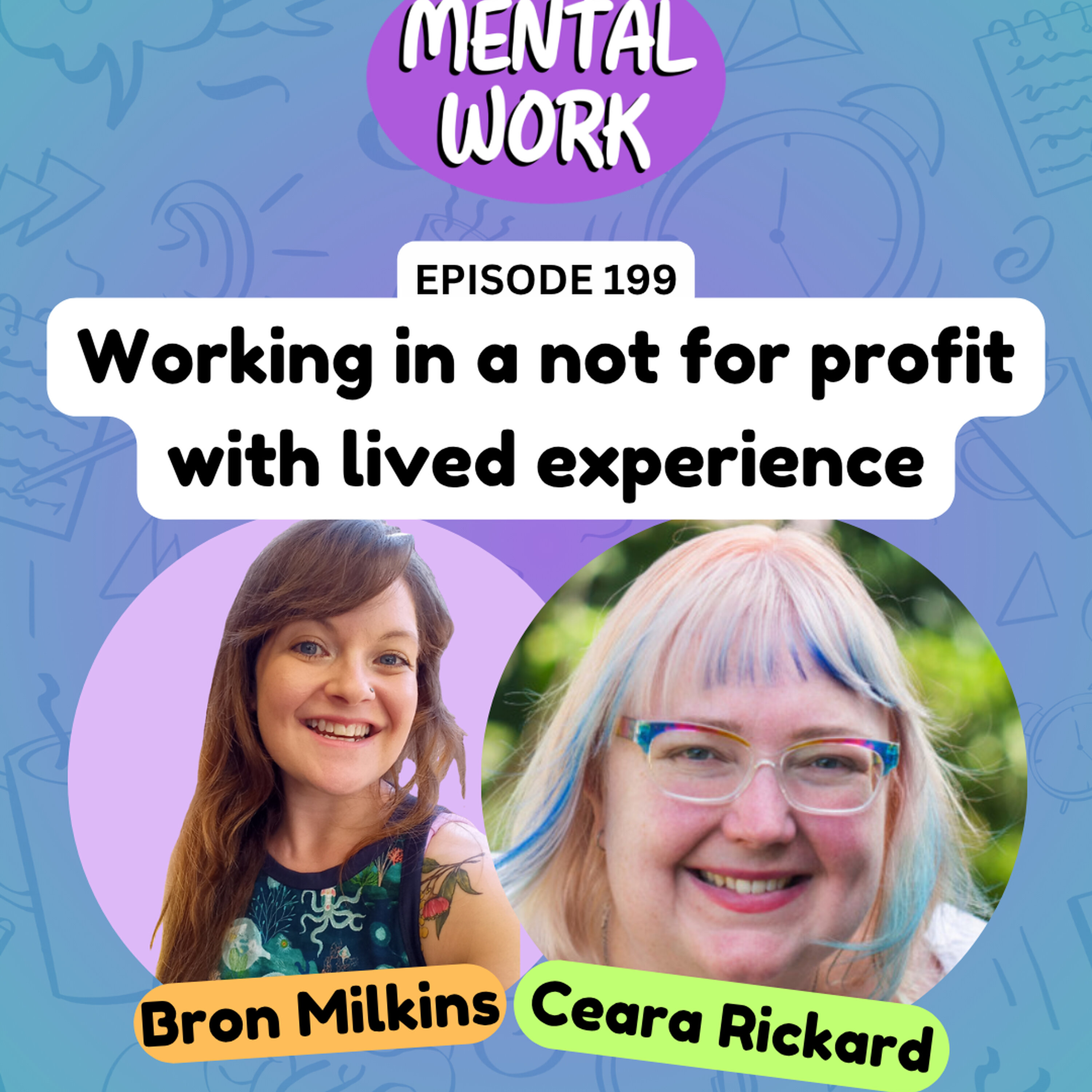
Bron is joined by Ceara Rickard (psychologist, Board-Approved Supervisor, and lived experience leader at Life Without Barriers) for a wide-ranging conversation about what it really means to be a psychologist. Ceara shares her journey to working proudly in the NGO and lived experience sector, and challenges the profession to grapple more critically with power, privilege, and human rights.
They chat about:
👉🏽 Why lived experience is a legitimate and powerful clinical skill, not something to hide
👉🏻 What a week in a large NGO actually looks like
👉🏾 Why viewing NGO work as a "stepping stone" is problematic
👉 The hidden hierarchy in psychology and why it can get in the way of therapeutic work
Guest: Ceara Rickard, Psychologist, Board-Approved Supervisor, and Lived Experience Leader
LINKS
THE END BITS
Mental Work is the Australian podcast for early-career psychologists about working in mental health. Hosted by psychologist/researcher Dr Bronwyn Milkins.
Support the show by buying me a virtual coffee ☕🍵
Have a question, episode idea or just want to say hi? DM Bron on Instagram, leave a comment on the Spotify episode, or email mentalworkpodcast@gmail.com
Apply to be a guest / YouTube (with captions & transcript) / Website
CREDITS
Producer: Michael English
Music: Home
Commitment: Mental Work believes in an inclusive and diverse mental health workforce. We honour the strength, resilience, and invaluable contributions of mental health workers with lived experiences of mental illness, disability, neurodivergence, LGBTIQA+ identities, and diverse culture and language. We recognise our First Nations colleagues as Traditional Custodians of the land and pay respect to Elders past, present, and emerging. Mental Work is recorded on unceded Whadjuk Noongar boodja.
Disclaimer: Mental Work provides informational content. Mental Work is not a psychological service and being a listener or guest does not establish a therapeutic relationship. Content should not be considered a replacement for professional consultation or therapy. All views expressed are personal, subject to change, and do not represent those of any affiliated employer, service, or organisation past or present. Efforts are made to ensure accuracy, but opinions may not always align with fact. Listeners are encouraged to thoughtfully assess the information presented and report any inaccuracies or concerns via email. Further information can be found here.
See omnystudio.com/listener for privacy information.
[00:00:05] Bronwyn: Hey, mental workers. You're listening to the Mental Work podcast, the podcast about working in mental health for early career mental health workers. As always, I'm your host, Bronwyn Milkins, and today we are talking about what it means to be a psychologist and how lived experience, non-traditional roles, and human rights frameworks challenge the profession to do better.
For early career psychs, it's easy to feel boxed into rigid pathways like clinical research or private practise. But in this episode, we're going to explore what it means to work in services outside traditional psychology roles and why a profession needs to engage more critically with privilege, human rights, and power.
Here to share this conversation with me is our guest today and our returning guest from early on in the podcast, Ceara Rickard. Hi Ceara.
[00:00:47] Ceara: Hi, hi. Good to be here.
[00:00:50] Bronwyn: It's good to have you back on the podcast. Could you please start off by telling listeners a bit about yourself?
[00:00:55] Ceara: Yeah, absolutely. Now, quite often on professional podcasts, people introduce themselves by talking about their profession or their qualifications, but I thought I might actually start by sharing some of my story as a human who also happens to work in this space.
[00:01:11] Bronwyn: Beautiful.
[00:01:12] Ceara: So when I was 15, I decided I wanted to become a psychologist. I told a friend of mine from high school whose immediate response was, "Ceara, don't you dare. You would be a terrible psychologist. You'd never been through anything. You wouldn't have the faintest idea about how to help someone".
And my response to that internally was, uh, essentially, "um, what?", because my friend didn't know it, but I'd actually been through quite a bit in my life. Um, I have a pretty significant trauma history growing up. Um, and I've had lots of other things. And of course I was neurodivergent, never realised. Um, so bullying, exclusion... my, um, adverse childhood experiences score, my ACE score is quite high.
However, I'd never told my friend about the things I'd experienced. I'd never told really anyone actually about the things I'd experienced. I didn't feel safe enough. So I took what my friend said, mentally dismissed it. I continued on focusing on getting a really high ATAR score so I could get into university.
Uh, fast forward to university and I spent much of my time at university receiving therapy for things that I struggled with, whilst studying subjects like abnormal psychology, where I learned all about how abnormal and broken I was. And that was actually quite painful and confronting. There was a feeling that, um, you know, we, we as psychologists or future psychologists will, you know, we're all mentally healthy and well, and we do therapy to people and we examine people because we're scientists. And there was often this sort of sense of, of underlying judgement with that and, and a bit of a separation between us and them. Uh, and I found that really difficult as a, as a young student, but I also thought it was quite ridiculous because I just saw us, all of us as, as humans. And, that attitude stayed with me.
And over time, it took a long time for me to get my psychologist registration, part of my experience is growing up in poverty, so really significant socioeconomic disadvantage from rural area, which meant that affording to study was difficult, so when I finished honours, I couldn't afford to go into a master's programme. I had people to support, I had to work to survive. Um, and I certainly wouldn't have been able to balance full-time work. And at the time there were only two year master's programmes. So it actually took me nine years after honours to start the next step towards general registration.
During that time, I'd actually already built a really amazing career, and found, found my passion, um, in the NGO and Community Services space, providing mental services for people who are really struggling. And so for me, when I became a psychologist, it made no difference to my day-to-day work other than the fact that if I made a diagnosis, um, it would be accepted and it gave me additional professional privileges.
But in terms of my fundamental approach to humans, that foundation actually came from my lived experience, which... I am a psychologist, so I also look at evidence and research and my foundational approach to being with other humans is, uh, solidly evidence based as well. So when I fast forward to now, and I've been a psychologist for a good few years, I'm a board approved supervisor and I work in a leadership role with a very large non-government organisation.
[00:05:14] Bronwyn: Wow, there's a lot to that. What a story, and I'm sure that there's more to that as well. But thank you for sharing what you have shared. I wanted to expand a bit further on lived experience, if I could. I was really struck by you saying that it felt, as you were studying that there was us and them, when really from your perspective, it was like, there's just us and we're in it together.
How has this shaped your understanding of being a psychologist, like what our role is? I dunno if that's the right question, but I guess your thoughts on lived experience and, and our roles?
[00:05:46] Ceara: Yeah, absolutely. I, I think for me it's, it's, informed how I approach people from beginning to end if I'm supporting someone. So it affects the language that I tend to use. So I don't generally call people I support 'patients' unless that's what they want to be called. Um, I usually just call them people or in youth mental health, young people, or families. I don't use a lot of, um, professional speak, even though I'm well aware of the language.
When I'm engaging with someone I tend to put the relationship first. It's more important to me than the quality of my assessment, the particular intervention I might select the way I might structure therapy sessions. I actually start with the relationship and I come from that very strong value space, which within my workplace, relationships coming first as one of our core values, which is part of why I love the NGO sector, right.
It also means that I feel an ethical obligation to hold my own lived experience safely and appropriately and carefully when I'm working with other people. So part of my scope of practise as a psychologist is actually having, uh, what's called 'lived expertise'. So to use one's lived experience in practise, whether that's doing therapy or developing policy or leadership or engagement research, which is something else I, I do sometimes I, I volunteer as a consumer consultant in cancer research. It's, it's about understanding and reflecting on one's own lived experience, but then also... lived experience of other people who may have similar experience, understanding community norms, community expectations, understanding how your lived experience might intersect with others lived experiences as well. It's about learning how to share stories safely and also about how to use one's lived experience effectively, whether that's in therapy or things like advocacy as well.
So it's a very specific skillset and it's not a skillset that we are taught in psychology. We're taught the concept of evidence-based practise, however, and there is ample evidence around, you know, what is helpful with the use of lived experience and what isn't. So I guess another hat that I wear in NGO spaces is a lived experience leader.
[00:08:42] Bronwyn: I am wondering, because I feel like with the traditional, air quote, training as psychologists, it's encouraged to disavow the lived experience part of ourselves. And I guess I use the word disavow quite deliberately because I do feel like we're encouraged to cut off that part of ourselves, whereas from you, you've embraced this part of yourself. And I just wondered, like, have you encountered difficulties in challenging that tradition and how have you done that?
[00:09:09] Ceara: Yeah, that is a huge question, goodness!
[00:09:13] Bronwyn: I do ask the difficult ones!
[00:09:15] Ceara: Yeah, there's, there's lots of difficulties with it. So where, where do I start? So I'll explain some of it with another story, because I like to think in stories.
So when I am connecting with other people in the lived experience sector as a human and as a person with lived experience who works in a professional role, we usually start by sharing our stories and sharing our values as humans. It's quite jarring to engage in the level of code switching required to communicate in psychology spaces about lived experience. In psychology spaces, there's a very strong culture of sharing your registration type, your years of experience where you might work in clinical practise. Um, it can feel a little bit like, um, you know, sharing your qualifications at 10 paces, right? And it, it can feel a little bit hierarchical.
So for me, I'm a psychologist with general registration. I have extensive clinical experience, I've had lots of clinical supervision, I've been a clinician. I know where I fit in the hierarchy, um, but that we kind of invent, it's not really a real thing, but, uh, it's, it's, powerful within psychology, and I think within psychology, part of the unspoken hierarchy is psychologists with higher levels of qualifications are seen as, air quote, better than psychologists with other qualifications. And then we're all seen as better than other allied health professionals. So counsellors, social workers, occupational therapists, speechies, uh, doctors, psychiatrists. Um, so we, we tend to see ourselves as better, um, sometimes than other professions.
And then right down at the bottom of the list we have, are seeing ourselves as better than, say, peer workers and better then the, the people that we serve, um, and I do use better as a term quite intentionally. You could replace it with stronger, more educated, more authoritative, more knowledgeable, more skilled... but I think it boils down to this idea that, um, you know, we, we separate ourselves from, from our humanity. And I think it's, it's a longstanding, uh, cultural concern and not just in psychology, it, it's present across the healthcare sector, we're certainly not unique.
Um, but it's something that really strikes me, particularly for psychology, where we know that if we are working as therapists, the, the mechanism through which we work is relationship, and it's quite difficult to form relationships that involve things like unconditional positive regard if you secretly believe that, that you are in some way better than the person you are working with.
[00:12:24] Bronwyn: Totally, absolutely. What I'm hearing is that a value of yours is that you don't see people as this hierarchical difference between them, you see us all as on the same level. Is that right?
[00:12:36] Ceara: Yes, broadly. I have my own internal biases as well, of course. So, I spend a lot of time also challenging myself and noticing if judgements are popping up because we're humans, we're we judge, that's how we ensure that we can be safe. So it's not that I'm free of judgement and, you know, running around singing kumbaya, I try to challenge, I try to challenge those judgments in myself though.
[00:13:04] Bronwyn: And I'm wondering if like, your extensive experience, like you said, it took you like 10, 11 years from honours to, I guess, gaining that general registration, um, and you worked that time in NGOs predominantly. Has working in that space influenced how you perceive yourself as a person with lived experience and the relationship between that and your clinical or, or psychological work?
[00:13:27] Ceara: Enormously. Um, especially considering the first six years of my career after university was in a publicly listed company where lived experience wasn't really thought of or mentioned. So I moved from that to the NGO space and immediately had the greatest culture shock of my life. Um, the, the organization's values driven, we had peer workers on our team. 12 years ago, which in peer work history, that was quite new.
[00:13:58] Bronwyn: Wow, that's super early.
[00:13:59] Ceara: Yeah. And we had very, a very clear vision about how we support each other, how we support the workplace. So it was quite strange coming from this very KPI driven, you know, numbers in, numbers out, you know, this many people return to work, et cetera, to working in the NGO space where we absolutely measure outcomes, but the measures are more psychosocial like, does this person feel their life is better? Have they achieved the goals that matter to them as opposed to the goals that we might've imposed?
I also found though that my workplace, um, Life Without Barriers has really great policy around supporting employees with lived experience. We have a lived experience strategy. We have a national lived experience work group for our mental health services, which I'm lucky enough to be able to Chair. Uh, we've got, um, co-designed workforce development policy guidelines that, um, myself and, and our work group drafted together.
So there, there's a lot of these things that involve active seeking out of lived experience. We design services by bringing people in who we have supported and seeking their active participation in not just surface level, oh, you know, satisfaction measures, but actually digging down with them into what is actually helpful and what do we need to do well, and what do we need to change.
Um, I think there's really close alignment, uh, in that approach to work with feedback informed therapy. So if you look at Scott Miller's work and his colleagues and use of things like the ORS and SRS, which those measures are designed for clinicians, so many of our services are not clinical in nature, some are, some aren't, but those are the types of things we focus on. You know, are we helping, are people's lives better? And we tend to rely on the person to tell us rather than making too many judgements ourselves.
[00:16:12] Bronwyn: I wanna come back to power in a moment because as soon as you say all these things, I'm like, oh, it just sounds like it's a great sharing of power and recognition of power and correcting the historical imbalances that have been there. But I wanted to ask you a bit first, more about working in an NGO.
Um, because it is, I guess like with psychologists, working in NGOs is not typically what we're told that we should work in. It's usually clinics, hospitals, um, yeah, I guess like where people are mentally ill and we're treating them. And so I just wanted to ask you what does a day or a typical week look like for you in an NGO and what's it been like for you?
[00:16:52] Ceara: Oh gosh. Work in NGO is, is really as diverse as the entire human services sector. So I could break it down by roles I've had, that might be, that may be more useful. When I was a clinician, I worked in an outreach service with young people, age 12 to 25, who were really doing a tough. Um, they fit in the severe and complex step of the step care model, the, the missing middle that Dr. Patrick McGorry talks about. So it was a youth enhanced service or YES programme. And we were one of the national trial or pilot sites for, for that new programme when it developed, uh, so we did a lot of close work with Orygen's Centre for Excellence.
[???] life in that role, when I had a full active caseload involved, getting up, driving to people's homes or schools, um, meeting people in parks. Uh, sometimes it involved walking with someone on the beach while they cried. Sometimes I cried too. Um, it involved a lot of thinking about people's safety and how to support safety given that, you know, very common for, for people in those services to have really dark and, and sometimes quite significant suicidal thoughts as well.
So in terms of caseload though, rather than, you know, a, a better access model where you get, you know, 10 sessions with funding, uh, our funding wasn't based on that. We had the ability to select the appropriate level of contact and support to achieve the goals therapeutically for the young person.
And, you know, we, we had a time limit, like we couldn't hold people for years. We, we usually had about a year. And, um, so what that meant for me in terms of like workload, small case load, fewer session numbers, but much more complex presentations.
[00:19:02] Bronwyn: Mm-hmm.
[00:19:03] Ceara: Also though a great deal of supervision and support. So in terms of our team structure, we did a lot of co-learning with, um, CAMHS as the tertiary mental health service. We had gosh, weekly, case discussion meetings where we would do intake and case reviews frequently. I had internal supervision every single week, often for hours, and this as a generally registered psychologist with quite a bit of experience in the space. Um, I also had my external supervision, and amazing professional development opportunities, uh, where the workplace, you know, we look at well, what is needed to support our workforce, to support people to do good work. So that meant being supported to attend conferences or to get, kind of, chunky trainings that certainly in, in private practise and contractor spaces, you have to stump up the money yourself. I'd be supported to, you know, go and do a full DBT accreditation or to go and learn about family therapy for weeks worth of workshops with practise and role play, um, or to learn the DNAV model.
Uh, so, you know, there's, there's a lot of benefits, but it's also quite, um, sometimes quite complex work because you are, um, essentially working in that role with people who might describe themselves as being stuck in a really deep, dark hole and they don't know how to get out and they need someone who can go into the hole with them and be next to them as they try to struggle their way out into the light.
[00:20:49] Bronwyn: Yeah, so, so quite involved work, emotionally, heavy work. I'm interested in how your roles have changed over time. In particular, I'm interested in the variety in the role, because I think that is something that a lot of early career psychs look for as they progress in their career. They may find that doing one-to-one sessions, like they just crave some variety, and I think you've been able to achieve that in your roles. Could you tell us a bit about it?
[00:21:15] Ceara: Absolutely. So, I've been in a position where I've done a lot of project work over the years, even when I was working as a clinician or just doing, um, frontline work or team leading. um, when there were projects that arise, given I work in a really big NGO, there's often extra things that I could get involved in. So for example, I might, uh, meet with a colleague to brainstorm a service that we might develop so we could put in a grant to provide the service and then get to learn all about how to write a good tender and how to design a service. Um, it might be that we won a service and I've done quite a lot of service development and implementation over the years where, you know, what tends to happen in the non-government space is organisations are awarded funding contracts and then they have to implement the funding contract.
[00:22:11] Bronwyn: Yeah. They have to do the thing!
[00:22:12] Ceara: Yes, exactly. And so sometimes what that can mean, and, and for me it's been really interesting timing because I have health struggles that, um, of course mean that sometimes I've not actually been up to going out to work clinically. So if I've needed a break, there's always been project work to keep me busy.
And so over the years, I got to do a huge number of things. So tender writing, um, delivering training, uh, providing consultancy support to, you know, people in other parts of the organisation. Getting involved in developing policies and procedures and guidelines and documentations. Um, and so what that means is that over time I gained this incredibly diverse skillset, particularly combining my interest in lived experience work and peer work as well, because I got to manage peer workers too and get training about that.
Uh, so in 2020 when I developed cancer and decided it was time to essentially pull the, the pin on doing really intensive therapeutic outreach work, um, with young people who'd often experienced a lot of trauma, um, all I had to do to land myself in another NGO role was to just pick up the phone, talk to a colleague and say, oh, you know, I'm ready to come back to work now, what have you got for me? And that meant that I was immediately offered a role doing quality assurance work because the person in that role is someone that I'd worked with on tenders. They knew my skillset really well, and they knew that I'd be quite good at that.
So then I spent a few years, um, mostly doing things like auditing and giving advice to services on, you know, how do you comply with mental health services that you do accreditation with? And accreditations is another difference between working in NGOs compared to, say, smaller private practise spaces, where in private practise environments, the regulation is the Psychology Board on individuals. But in big services, so whether that's in NDO or in tertiary services as well, there's also external accreditation bodies against standards that accredit entire organisations or service systems that look at governance policies, procedures, workforce service models, the way support's provided that, um, can be pretty complex, like it takes a lot of moving parts to get right.
Did that for a few years, and, uh, then another thing in the NDO world is that change is pretty constant because funding contracts come and go. Um, structures need to change and adapt because the human services sector is very large and complex. So it means there's constant changes, like for example, I'm sure many of your listeners would be well aware of how much the NDIS is changing.
[00:25:13] Bronwyn: Oh, yes.
[00:25:14] Ceara: Yeah. So multiply that by every sector. And that might give, that might give listeners a bit of a picture. So more recently I've shifted into a role where essentially I support our teams to deliver really good services and I design services. So, that involves a whole lot of things, it's actually really difficult to define my role. Like if I had an elevator pitch, it'd probably be, well, I'm just a fairy and I run around sprinkling fairy dust and make things shiny, uh-.
[00:25:50] Bronwyn: I love that.
[00:25:52] Ceara: Or I'm a unicorn. Um, but essentially it, it's really about working with systems and individuals. So a day for me now might be, for example, um, if there is a crisis on someone's caseload, I get notified through, you know, reporting processes because we have really good governance and lots of support. And I might be called into look at what has happened, um, or to support a team around how to respond or address something that's happened, or how to prevent things from happening in future. Or I might be invited to a team meeting to deliver a training about how to do advocacy, or I might be flown off to another state to deliver induction training to a, to a new team.
Um, I facilitate a community of practise. I, uh, am currently writing tender applications where I might be pulling together, you know, things like workforce modelling. Like if you have this amount of money and particular expectations from a, a model of care that, that a funding body is thinking about funding... um, I do a lot of work around, well, how, how does that work? What resources do we need to make sure that if we provide a service, it'll be a good service that doesn't burn out our employees, that respects lived experience that, gives people a positive experience of engagement with, with care and support.
[00:27:29] Bronwyn: Amazing. It sounds incredible. Early career workers might view NGOs as a stepping stone to something that they view as more successful. I think if you had to ask an early career psych what success looks like, they'd probably pull out that you are, uh, an owner of a big private practise. So I guess my question to you is, what keeps you in the NGO sector? Like what, what's a reason to stay?
[00:27:53] Ceara: Mm, yeah. For me, it is entirely about meaning, purpose, and values.
[00:27:58] Bronwyn: Mm-hmm.
[00:27:59] Ceara: So what I would suggest for people early in career... and really anyone, because I think it's just good advice all around, think about what matters to you and then do the things to enact the things that matter to you, so make them matter.
Um, so for me, I'm not particularly driven by, um, ideas of financial success. I mean, obviously I like to be able to afford to live, but you know, we live in capitalism of course. But for me, I don't really define success in financial terms because I see my worth as infinite. So, um, when I hear, for example, ideas of, oh, well charge your worth or make millions of dollars and that's how you're worth, I'm like, well, excuse me, I'm worth far more than that, 'cause my worth's infinite. And so that doesn't even come into the equation.
Um, so I think about, uh, what legacy I want to leave. Um, you know, li listeners who heard the last episode I was in, learned about how I have metastatic breast cancer, which is ultimately a terminal illness, so I'm going well, but I won't be here forever. So I think about, you know, that really classic question from acceptance and commitment therapy of, well, what would someone say at your eulogy?
And I don't really want people to say that I ran a successful, large business with high turnover that was really profitable. Um, I, I would rather people reflect on the human connections we made, or think about the things that I've done that might've helped to make their lives better or the world a better place.
And don't get me wrong, you can do that through running a successful private practise, and, um, you know, tho those two things are, are absolutely not incompatible. Like, I know incredible private practise owners who have absolutely very shared values, but it, it's really for me about recognising that there's more than one way to be successful.
For some of us, like as well, not everyone likes the idea of work in business. Like I'd be terri-, like if I ran a full-time private practise, I'd be terrible at making sure I stayed sustainable. Um, I know what to do given, you know, I plan workforces and services worth millions of dollars for a living. Um, but it's also not something I enjoy. So I also think about what brings me joy as well.
[00:30:30] Bronwyn: That's really beautiful.
[00:30:31] Ceara: Yeah, and the other thing I'm thinking about, like, I, I see a lot of, um, students and graduates thinking about Master's applications, and they really, really wanna be a psychologist as soon as possible, and what I notice is a lot of people put pressure on themselves to apply and get in really quickly and "will this job help me and will that job help me"? And for me, I, I can understand why, because I remember the pressure as well. There was a lot of pressure to achieve no matter what the personal cost. And I would encourage people on the journey to challenge that a little bit and maybe think about where that's coming from and if it's worth it. Like, nothing's really worth our wellbeing.
The other thing that comes to mind when hearing that, that question, that idea of, well, this thing's a stepping stone is, it actually, it feels really sad. Like I, I feel a, a heaviness in my chest when I hear that because I think about that idea of us and them again, and the people who you might be supporting, you're seeing them as them, you're seeing them as a, a vehicle for your own advancement, that's not okay.
[00:31:50] Bronwyn: No, it's a bit othering.
[00:31:51] Ceara: It's really othering And, um, you know, I, I think advancement and striving is great, and again, though, that idea of us and them, or if I'm a psychologist, I'm better than say a disability support worker, um, it's just not true.
[00:32:11] Bronwyn: Yeah. No, 100% agree. And yeah, it's like also that, that idea of I wouldn't wanna use clients or, or people who we work with as tools for like career advancement, that feels really yucky to me. And yeah, I just wanna see people's humanity and actually work with them in that space, and I'm sure that everybody who gets into mental health work or gets into psychology, like if you ask them what their values are, they would say the same. So yeah, it, like you say, it really is connecting, reconnecting with those values, that purpose, that meaning the eulogy exercise, great one.
[00:32:45] Ceara: Yeah, exactly. And it's, yeah, and most people who, who do see it as stepping stones, it that, I don't think that's usually congruent with their values because it's usually really lovely, lovely, lovely people, like the majority of of people who go through psychology study tend to be just beautiful humans. Um, but there is so much pressure to achieve and there's so much perfectionism within psychology and, and I think across health as well... but it's something I think to be resisted.
[00:33:16] Bronwyn: I agree. I wanna turn to a bigger question, maybe a bigger lens on psychology in Australia. And just a heads up, it's a big question, um, but, you know, we had a, a pre podcast interview kind of chat about things, and you mentioned that psychology in Australia hasn't grappled well with human rights or power, and I was wondering if you could expand on that.
[00:33:37] Ceara: Yeah, I think, I think I can. It is a very big question and I think it's a, it's a big thing to, to state as well. So I'd like to bring it back to how we are trained, and things that people going through training relatively recently, sometimes tell me about it. What they tell me, and there's lots of evidence through graduate outcome survey data and, you know, member feedback surveys within my volunteering, in the APS as well.
What I hear is that people experience their education psychology from the very beginning as ableist, elitist, and exclusionary. And this is a profession where we should be working to equalise power, but our systems and structures that support us to become psychologists and to remain psychologists can sometimes be really difficult to, to work with within.
Um, so when I hear feedback from students about, um, ableism or discrimination from study or in through, you know, through working, part of it I know is about the current state of the higher education sector in Australia more broadly. There's huge pressures on everyone. Um, and part of it, I wonder if it's about that exercise of power again.
So, you know, I mentioned people who are already registered in the hierarchy, but when I think about power within education, uh, every education provider is a gatekeeper. There's, there's a huge power disparity and there needs to be some, you know, you need to be able to evaluate students to ensure that they can go on to do good work, to do safe work to support people. But I think sometimes that exercise of power early on sets us up to think that we should also be exercising power in the way we work.
Something I find really exciting is that the competencies for general registration have been changed and those new competencies, or refreshed competencies, reflect a requirement that we must, as psychologists understand about concepts like health equity, and human rights, and intersectionality. And that's all about, that's all about power literacy.
[00:36:14] Bronwyn: Yeah.
[00:36:15] Ceara: And in the past, that hasn't been part of our competencies. So we've had a, a culture where there is a lot of, um, hierarchy, and, you know, in health systems, that's, that's pretty inherent. But also we are not always taught the tools to identify and name those factors. And I think with the new competencies now, every psychologist has to learn those underlying tools. Um, and similarly building reflective practise into the competencies, it means that we need to reflect on how we relate to power and what privileges we might hold, and also what disadvantages and how, how that affects who's seen, who's heard, who's understood, who makes decisions. And if we do that well, it could be transformative.
[00:37:05] Bronwyn: I completely agree. Mm, yes. I feel like it's, it's an exciting and, uh, exciting time, really, like to get those, that language into the competencies means that, like you say, we need to know about it and equipping us with that and being able to reflect on it and implement it in our practise, yeah, absolutely could be transformative.
[00:37:26] Ceara: Yeah, I think there's, there's a long way to go, but I think there's a lot of hope as well. Something I've noticed is that a lot of undergraduate psychologists now are doing topics that they might not have had available to them before through their studies. So, for example, I know a topic being taught at one of my local universities around race and representation, indigenous perspectives... that topic happens to be taught by a friend of mine from high school.
[00:37:52] Bronwyn: Awesome!
[00:37:53] Ceara: And, you know, she, she works in education, that's her background. But through, I guess, part of, part of universities thinking about how to ensure that people are getting exposed to those new competencies fairly early on, given, uh, the Australian Psychology Accreditation Council standards are, are in the process of being updated to reflect them as well, I think that it, it gives room for more creativity and I think it also gives room for more collaboration with other disciplines too, which, you know, that's certainly always been present in psychology training, particularly in undergraduate through to honours. But I think there's, probably a greater impetus and a greater, a greater awareness, um, or I would think there would be that, hey, this is actually psychology too.
[00:38:44] Bronwyn: Yeah. In that, in that impetus, I guess I also, I wonder how we will grapple with that, with the tension, because what I see is like collaboration, I think, can be threatening to some people. And they're like, if we collaborate, they're gonna muscle in on our territory or, or things like that, those kinds of thoughts. Um, what are your thoughts on the idea that like, we're transitioning to hopefully these less ableist, these less classist, um, more inclusive, um, practises, but about that tension as well?
[00:39:14] Ceara: Yeah, I don't think the tension's ever going to go away. Um, I think it's-, and it, it can be really tough to navigate, like that's, that's the space that I've lived in. And, you know, as a psychologist with lived experience of mental illness, of lived experience, of disability, of lived experience, of terminal illness, of poverty, of being in a rural environment, um, among other, you know, of being neurodivergent and, and more, it's really tricky because the way, the way to address it to collaborate really requires ensuring that, that, people who haven't traditionally held power, share power. And that is very, very difficult, particularly when systems have enforced structures of power for a really long time.
I think what it comes down to ultimately is about building relationships and about finding the commonalities that we all share, the values that we all share, the things that matter, and being able to find those common threads of connection. And I think if we do that, it can work. And sometimes it's really hard and sometimes it means that there'll be challenging conversations or, um, sometimes it can mean that ultimately systems and regulatory bodies have to step in with a bit of a stick to say, well, n- no, actually you need to, you need to co-design, you need to collaborate. And if you don't, there will be very negative consequences.
Um, I think that that, you know, generally for a system to change you from an advocacy perspective, change is most likely when there's internal pressures. So within psychology, that's psychologists saying, well, we wanna be included, we want, um, we want diversity in our profession. We don't want diversity to mean what endorsements people hold, we're talking about human population diversity. We want a diversity of training too.
It, it's also, you know, so that that's kind of a form of internal pressure. And then external pressure is around, you know, what other external forces might be brought to bear that then influence how the profession is shaped. So the competencies are one, but also in mental service provision in large NGOs, now we have new accreditation standards, which require explicit co-design in our processes. So, you know, for psychologists working in larger organisations, there's a lot of socialisation and a lot of training and a lot of impetus for that to happen because if you're not accredited, you do not get to provide services that are funded by quite a variety of funding bodies in the country.
So, yeah, like I think it's, it's tough and sometimes it can mean having to figure out how to tell your story in a way that is as influential as possible. So for me, when I'm doing advocacy, I look to figure out what is important to the person or body that I'm advocating to, what are their priorities? What are the, what are the hooks that I might use, right?
[00:42:37] Bronwyn: Yes.
[00:42:38] Ceara: And then I will draw on that knowledge in shaping whatever advocacy response I give. So if I were, for example, talking about wanting to co-design something with a really conservative body, um, within or outside of psychology, there's lots of conservative bodies with systems. And then, you know, and, and they might be pushback around, well, oh, this seems risky because it's new and we haven't done it before, and, you know, how would we do it, and it just seems all too hard. Um, if I know that a body is very risk adverse, then I might, for example, highlight the risk of not acting. If I know that someone is particularly caring about a particular issue because of values that they hold, I might think about how a change in position could actually be more congruent with their values, and then I speak to it.
And when it works, it works amazingly. Um, I've done a lot of advocacy from a lived experience perspective and, you know, I've made quite a few politicians cry by sharing my story in a way that was effective. And then they voted for things that I wanted them to vote for.
[00:43:57] Bronwyn: Woo-hoo. Nice work.
[00:44:00] Ceara: But it's, it's tough and it also requires a layer of vulnerability as well. Um, particularly if you're sharing lived experience. Like we know that people generally respond better when, rather than adopting say a position of, well, I know this because I'm really qualified and there's all this evidence, people actually respond better to the use of story. And the use of lived experience story is particularly powerful within that.
[00:44:26] Bronwyn: Absolutely, yeah. I used to train university students and how to share their stories of mental ill health safely so that they could help their peers feel less stigmatising attitudes towards mental ill health and go seek help. And yeah, there's a stack of research which shows that peer-to-peer interventions like that are quite effective and actually more effective than, as you say, this kind of position of expertise and being like, we know that help seeking is good. It's like it's way better to hear it from a peer who has been through it.
[00:44:56] Ceara: Yeah, absolutely. There's so much evidence and I, I love peer support, I love peer work, I love psychosocial supports, and just because something isn't a clinical intervention doesn't mean it's not deeply therapeutic.
[00:45:11] Bronwyn: Uh, 100%. Yeah, I, I completely agree. There are many ways to healing and to therapeutic outcomes and feeling that things are therapeutic, yeah.
[00:45:22] Ceara: Yeah, it's it's so amazing that, that students have had the benefit of that. Gosh, when I, when I, when I was a young girl, we didn't have those things.
[00:45:31] Bronwyn: Yeah, absolutely. Um, Ceara, this has been a really insightful conversation. I've learned a lot from hearing your stories and from listening to you, and just a lot of good insights, and it's been a real privilege to learn about your roles in NGOs as well. Is there anything that I haven't asked you, which you wanted to talk more about today?
[00:45:51] Ceara: I think that I would just like to leave a, a final reminder for people who are really struggling, um, through their studies, who are feeling excluded or bullied or who are, who are noticing the effects of classism, um, racism and various forms of social exclusion, because there are very, very many of them. I want you to know that you're not alone. There are those of us who are that little bit, you know, potentially further along the journey who have experienced similar things and we are fighting for you.
[00:46:33] Bronwyn: That's awesome. Yeah, and it's, it's definitely true, I do see a lot of fight and a lot of spirit in people who really want the best outcomes for early career folks and students, and yeah, I think that, yeah, there are people on your side.
So thank you for sharing that. Ceara, it's been a pleasure to speak with you. If listeners wanna learn more about you or get in touch or do supervision with you, where can they find you?
[00:46:54] Ceara: Oh gosh. I'm really easily found. Um, you can search my name on LinkedIn. I have a unique enough name that I'll pop up immediately. I have a website, which is just ceararickard.com.au because it's easy to find my name than anything else. Um, I am on various parts of psychology social media. I'm also the chair of the APS Division of Early Career Committee where we advocate part of being that sort of internal pressure to advocate for change and to try to shape what the APS does. Um, I'm also available via, um, even honestly, just Facebook's fine too. Just find me find a way to contact me and there's so many, just, just reach out to me on any of them.
[00:47:48] Bronwyn: Amazing. Well make sure I put the LinkedIn one definitely, and then I'll leave the others for people to Google and I'm sure they will find you. Thanks again, Ceara, for coming on the podcast.
[00:47:56] Ceara: No worries. Thank you so much for having me. It's been such a delight.
[00:48:00] Bronwyn: Awesome. Listeners, if you enjoyed this conversation, make sure you do share it with somebody else. Pop it in their ear, it's the best way to get podcasts out there. That's a wrap, thanks for listening to Mental Work. I'm Bronwyn Milkins, have a good one, and catch you next time, bye!


