
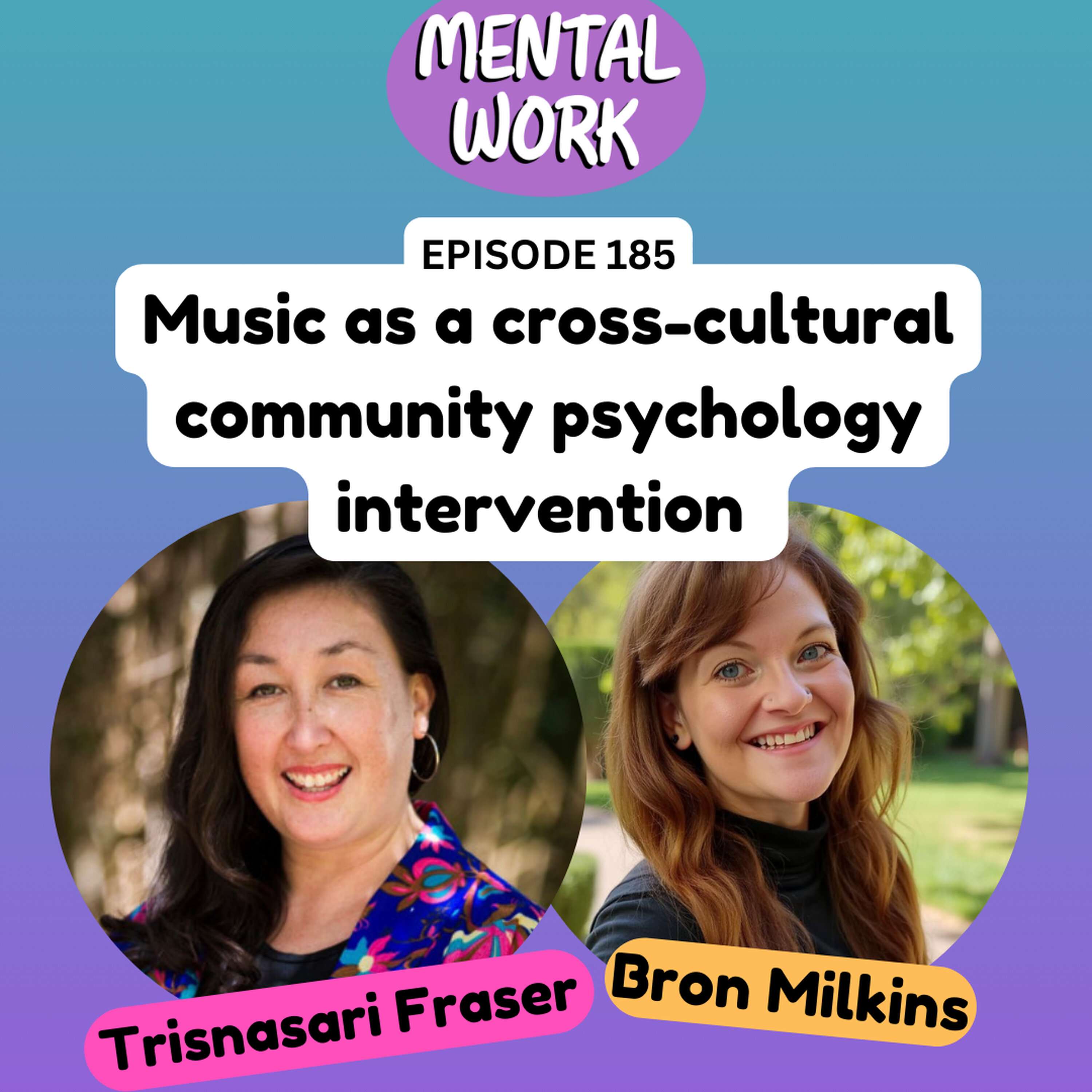
Bron is joined by Dr Trisnasari Fraser (Community Psychologist and researcher) to explore how sharing music across cultures can foster connection, build community resilience, and deepen cultural humility in mental health work.
We chat about:
👉🏽 Trisnasari's music-filled pathway from running a multicultural performing arts school to completing a PhD on intercultural music engagement.
👉🏻 Musicking as a social, community act that fosters belonging.
👉🏿 How music can help us hold both cultural difference and shared humanity at the same time.
👉🏼 How early-career psychologists can think beyond the therapy room and consider how creativity, music, and community participation can support healing, belonging, and sustainable practice.
Guest: Trisnasari Fraser, Community Psychologist and Postdoctoral Researcher
LINKS
THE END BITS
Mental Work is the podcast for psychologists about the realities of working in mental health, with an early-career focus. Hosted by psychologist/researcher Dr Bronwyn Milkins.
Support the show by buying me a virtual coffee ☕🍵
Have a question, episode idea or just want to say hi? DM Bron on Instagram, leave a comment on the Spotify episode, or email mentalworkpodcast@gmail.com
Apply to be a guest / YouTube (with captions & transcript) / Website
CREDITS
Producer: Michael English
Music: Home
Commitment: Mental Work believes in an inclusive and diverse mental health workforce. We honour the strength, resilience, and invaluable contributions of mental health workers with lived experiences of mental illness, disability, neurodivergence, LGBTIQA+ identities, and diverse culture and language. We recognise our First Nations colleagues as Traditional Custodians of the land and pay respect to Elders past, present, and emerging. Mental Work is recorded on unceded Whadjuk Noongar boodja.
Disclaimer: Mental Work provides informational content. Mental Work is not a psychological service and being a listener or guest does not establish a therapeutic relationship. Content should not be considered a replacement for professional consultation or therapy. All views expressed are personal, subject to change, and do not represent those of any affiliated employer, service, or organisation past or present. Efforts are made to ensure accuracy, but opinions may not always align with fact. Listeners are encouraged to thoughtfully assess the information presented and report any inaccuracies or concerns via email. Further information can be found here.
See omnystudio.com/listener for privacy information.
[00:00:05] Bronwyn: Hey, mental workers. You're listening to the Mental Work podcast, the podcast about working in mental health for early career mental health workers. As always, I'm your host, Bronwyn Milkins, and today we are talking about sharing music from different cultures to bring people together and strengthen communities.
As early career mental health workers, many of us are searching for ways to foster meaningful connection, cultural responsiveness, and belonging for our clients and communities. In this episode, we're going to explore how music can be a powerful, accessible tool for building empathy, promoting cultural humility, and strengthening communities, especially when we engage with music across cultural boundaries.
Here to help us out with this topic is our special guest today, Trisnasari Fraser. Hi, Trisna.
[00:00:47] Trisnasari: Hi Bronwyn. Thanks for having me.
[00:00:49] Bronwyn: It's such a pleasure to have you on. I'm so excited. Um, listeners will know that I really have a passion for music, so I'm really excited to talk about it.
[00:00:56] Trisnasari: Fantastic.
[00:00:57] Bronwyn: Could you please start us off by telling listeners who you are?
[00:01:01] Trisnasari: I am a community psychologist and a researcher. At the moment I'm working at the University of Melbourne, and I have two positions there. One is in the faculty of fine arts and music. Um, the work that I do there is convening a group called the Creativity and Wellbeing Research Initiative. And the other position I have is within, um, the School of Population and Global Health, and I work with, uh, researchers there looking into suicide postvention.
[00:01:33] Bronwyn: Wonderful. So you've got a varied set of interests, I guess.
[00:01:37] Trisnasari: Very varied, yes. My passion, like you, is absolutely music.
[00:01:41] Bronwyn: Yeah, it seems that music was the connecting force between everything.
[00:01:45] Trisnasari: Yes.
[00:01:46] Bronwyn: How did you become interested in music, like researching music and as a community psychologist, how did you get stuck into music as a community thing as well?
[00:01:55] Trisnasari: Yeah. Um, so I have a bit of a meandering pathway, um, but before I was a psychologist, I ran a, a business, it was a performing arts school and agency. Um, I co-directed with my amazing business partner, Andrea Makris, and we had a team of incredible performers and teachers who shared their knowledge of West African drum and dance, um, Egyptian, Turkish, Greek music and dance, Indian, classical Indian and Bollywood, and, um, flamenco.
So I did that for close to a decade and then, took a break to raise a family, and then I retrained as a psychologist- that- I did psychology as my first undergrad degree. So I sort of returned to that. And then after retraining as a psychologist, I did the community psychology masters. I was fortunate to get a scholarship to do a PhD, and it fell under an Australia Research Council Discovery Project that was called, it's a very long title, which-
[00:03:14] Bronwyn: They usually are!
[00:03:15] Trisnasari: I know, which I'm gonna try and remember. It was called Social Connect. Uh, social Cohesion and Community Resilience through Intercultural Music Engagement.
[00:03:25] Bronwyn: Awesome. Wow, so your path led you there and has music always been a passion for you, just like personally for you?
[00:03:32] Trisnasari: Absolutely. Yeah. I've always loved it, I've danced... um, I mean, you know, this is probably shared among many, um, kids, but I danced from when I was like three years old. The very first dance class I went to as a 3-year-old was at the local YMCA and um, I actually remember doing a little bit of intercultural sort of music engagement. I have a photo, where we were led by a Maori dancer so that was my first dance class. And then, you know, like a lot of young kids, I did ballet and contemporary and jazz and all of that sort of stuff.
But then, um, when I was probably about 18, I discovered Middle Eastern dance, so belly dancing. Um, and then I really just fell in love with that dance form. My own background is, uh, my mother was Indonesian and I have also learn some Balinese dance. So yeah, lots of different dance halls.
[00:04:36] Bronwyn: Yeah, it's a, it's amazing just hearing your culture and background intertwined with music. I was interested, you mentioned you had your business for 10 years and had people from all different cultures show you so much different music. What did you learn from being exposed to that?
[00:04:51] Trisnasari: Wow, I mean, I learned so much. It was quite an interesting journey actually coming through forms like classical ballet, and then coming to these forms where there was such different pitch and rhythm, and at the same time underlying these kind of superficial differences, they all have pitch and they all have rhythm, and they all have these elements of sort of social ritual. I learned a lot because it was about, okay, these are the various ways that we express ourselves culturally, but then what's common across these different forms?
[00:05:39] Bronwyn: Yeah, so it's a great way of connecting communities. And I guess that brings us to the intercultural music engagement. So could you just tell us what this term means?
[00:05:47] Trisnasari: Yeah. So we discussed this at length. Um, so part of the PhD project, I was also part of a, a larger research team, and yeah, we really discussed what was meant by this at length.
So what, what we came to was that, it's basically encountering other cultures through music and there's a musicologist, um, from New Zealand, Christopher Small, and he's quite famous for coming up with this concept of musicing, and so it's, um, it's sort of music as a verb, but particularly with an orientation toward the social. So it's music participation in all its forms, so including playing music, rehearsing, listening, but he even went further and included, you know, the roadies, the ticket sellers. So it's basically the way that music is often at the heart of so much social activity.
[00:06:50] Bronwyn: So how might this concept of intercultural music engagement be relevant to people who work in mental health, like either in their practice or in their community work?
[00:07:01] Trisnasari: I guess that it is the social aspect of it, I would say, that it is at the heart of, of so much of what we do with our communities. It is this amazing way to understand other people's cultures and experiences. It's an emotive medium,,. yeah, so there's lots of different ways that you could look at it, really.
[00:07:28] Bronwyn: Yeah, and one term in your research was this idea called Global Consciousness. What does that one mean?
[00:07:36] Trisnasari: Um, so global consciousness is this construct that's, um, explored in social psychology and it's quite nuanced. The way that it's been developed is it draws on ideas of, uh, like cosmopolitanism, like the, the belief that we're all, um, citizens of the world. Also this idea of, um, identification with all humanity, which is this ability to look beyond your in-group and include everyone within your in-group. The other angle is, is this ability to hold that reality of both cultural difference and shared humanity at the same time. So to respect cultural difference, but not exclude on that basis.
[00:08:24] Bronwyn: When you're saying like it's a way of gaining insight into different cultures and experiencing that, is music similar to like food, dance, sport?
[00:08:35] Trisnasari: Yes. I, I think so. I think so. And you know, I think there's, there's a bit of, um, talk within some research circles that we overstate the value of music, but I think you're right. You know, it's like any of these activities, food, sport, and it's not that it's got something particularly magical about it, but it is a shared human, experience that that, does really appeal to many people, so, yeah.
I love theories about how music was like a precursor to language. So Charles Darwin felt that, you know, first we communicated through pictures because it was a, a, you know, communicating almost like animals might do, and there's contemporary theorists that think the same... um, so I love that kind of theory.
Um, famously Stephen Pinker, the cognitive psychologist, says that music is, um, evolutionary cheesecake, which is basically, he's just saying that. Or does he say evolutionary cheesecake? Auditory cheesecake. That's what he says, which is basically he is saying that it was just an evolutionary byproduct. But I, I just, yeah. I much prefer theories that put it front and center of our evolution. Um, but yeah, it was, it was a precursor to our language.
[00:10:10] Bronwyn: I prefer, I think I prefer theories that put it front and center too. And I might be biased 'cause I love music, but it's like whenever you think of um, say people in older age and maybe they have dementias, and there's like a common occurrences that they may lose memory for a lot of things, but you hook them up with some music from early in their life and they can sing and tap and dance along. And it just suggests that, to me, that suggests that music is just so inherently important that our memories are geared to remember in that format.
[00:10:40] Trisnasari: Absolutely. And I mean, you know, I do think that maybe, being a cognitive cognitive psychologist, um, maybe Pinker is kind of stuck in his head a bit. Um, the, the footage that I love as a dancer, um, that relates to what you're talking about is this footage of a woman, in an age care facility, she used to be a ballet dancer and her carer, um, plays Swan Lake and she is basically moving to the music and they put it side by side with footage of her as a young dancer, and she's remembering the choreography. It's incredible, it's so beautiful.
[00:11:27] Bronwyn: I think I've seen the same footage and there's been others maybe with people who have Parkinson's disease and the gait, and then when you get them the music and the dance, it, it, it's so flowing, their movement.
[00:11:39] Trisnasari: And the same, the same principles being used in, um, uh, melodic intonation therapy for stroke victims who have lost the ability to speak, but they can sing.
[00:11:52] Bronwyn: It is incredible. Yeah, it's like I, I agree with you, I prefer the front and center evolutionary theories for music. It just seems so central.
[00:12:00] Trisnasari: Yeah, absolutely.
[00:12:02] Bronwyn: So I am wondering, with your PhD project and the research you've been conducting on intercultural music engagement, could you just help us understand it tangibly by sharing a story or example where that has helped foster social connection or built resilience?
[00:12:18] Trisnasari: I mean, there's so many different examples. What I looked at during the PhD, unfortunately, uh, two months into my PhD, we went into lockdown, so I, I started in 2020.
[00:12:34] Bronwyn: Oh gosh, that that is real rotten luck.
[00:12:36] Trisnasari: It really is. But, um, this is, this will sound strange, but there was a silver lining because essentially, what we ended up observing during that time was community resilience in action in a sense.
And so what I investigated during that time was how people adapted to physical distancing requirements, and the first study that I did was a study of intercultural music engagement through YouTube broadcasts.
So what we saw all over the world was that people overcame physical distancing to sing across balconies take part in these virtual choirs, um, and so I investigated a number of case studies that used these adaptations and were intercultural in nature. So there were things like, a choir that was singing, uh, particular, um, cultural style, and they were getting singers from all around the world that were interested in that style.
This is a funny one. I, it's, uh, even though it was online research, we still had the ethical issue of, um, informed consent. And so therefore, um, because it was not possible to get informed consent from thousands of people that were commenting on these broadcasts, we anonymize, all of the case studies. So, so I talk about it in general terms, but there were many, many examples of people sharing different cultural genres of music.
And then what was interesting as far as looking at how it plays out on YouTube as a platform, is on the one hand you have the singers or the musicians and how they manage to span distance, and then you have all of the audiences who are basically watching the broadcast and commenting. And then you had these beautiful examples of people commenting and looking after each other in the comments.
[00:15:01] Bronwyn: Which is just remarkable for YouTube, full stop! Because the, you know, it is, the, common refrain is don't read the comment section, but this- you are describing a very pairing and like thoughtful comment section.
[00:15:12] Trisnasari: I was really heartened by the comments, so there were examples of comments like, um, I've been in lockdown for X number of days and, and this, this, uh, broadcast is really lifting my spirits. And then there would be responses to those comments, hang in there, I'm in X place, we've been in lockdown for X amount of time.
So there was that, sort of, demonstration of community resilience. And the fact that it hinged around these intercultural music performances meant that people were also saying. " Hello from X place in the world". "Wow, I haven't seen this type of music since I was a child growing up in X place". And so it was this real bonding experience for people because it drew on nostalgia, cultural identity, and their pride in their cultural identity. And then, you know, there was then this kind of experience, like a diasporic experience where, you know, people were saying, oh yes, I grew up in such and such place. Now I live, you know, X, Y, Z... so it, it's just this amazing experience where we're global, but our often our hearts and minds are so local.
[00:16:34] Bronwyn: That's a really beautiful illustration and I was absolutely thinking of the choirs when you were talking like before you said it, and I'm so glad you brought up that example. It's such a beautiful example, isn't it?
[00:16:44] Trisnasari: So beautiful.
[00:16:46] Bronwyn: One thing that you said just then was about, I guess, cultural identity and your research does discuss how music can challenge really simplistic ideas about cultural identity and instead hold space for complexity. Could you just give us an example of what might be, like, a simplistic idea about cultural identity and how music can really help hold space to the complexity?
[00:17:07] Trisnasari: Yeah, this is a really tricky one. A risk that we always run is stereotyping based on culture. And the most useful concept that I've come across in this space is, um, informed curiosity. It's, uh, a psychologist from Toronto, I think Jessica Dere, and so it's this idea that when we are working with different cultural identities or with mixed culture, we want to go in as informed as we can be of, of possible cultural differences, but then go in with this sense of curiosity because in the end, we're always working with an individual that has their own experience or interpretation of events and, and just remembering that there's actually more variability sort of within groups than between them in a sense.
and then as far as mixed heritage goes, I mean I've always been interested in this just from a personal perspective anyway, having been raised in Australia. and my mother, uh, migrated here from Indonesia in the seventies. I, I think that has really been at the core of my interest. I've, I've completely gone off what your original question was, which was how does music help us to understand these sorts of complexities?
[00:18:37] Bronwyn: Yeah, stop us from stereotyping really. But I think you answered that with your informed curiosity, I think.
[00:18:42] Trisnasari: Yeah, yeah, and I think as far as music goes, it exposes you to the full gamut of, music that seeks to, sort of, conserve a tradition through to music that seeks to sort of draw on different traditions and allow them to be this kind of way of expressing new cultural identities.
So a, an example that I'm thinking of from, um, Underbelly days, so Underbelly was the, the performing arts and, and studio that we ran. We used to be- the studio was above a Turkish bar called Bar Booka[?]. And the boys in Bar Booka[?]... I shouldn't call them the boys, Murat and Said, helped Andrea and I to establish the studio space above, and we'd often do performances downstairs. And, um, so Murat still performs in a band called Bashka, and that brings together Turkish music, it brings together hip hop... it basically, gives a voice to the experience of living in Naarm in Melbourne, and all of the different cultural influences that you're exposed to, so it's quite-
[00:20:04] Bronwyn: Through through the diversity that we really can avoid stereotyping.
[00:20:09] Trisnasari: Absolutely, and I think just allowing identities to evolve, but equally respecting those traditions as well. So it's, it's, you know, it is complex.
[00:20:20] Bronwyn: Yeah, absolutely. And I guess like as a community psychologist, with the psychological aspect here, I guess a lot of listeners, they tend to work in not-for-profits or one-to-one therapy settings... Can we bring intercultural music engagement into those settings or is it more of a community based intervention?
[00:20:39] Trisnasari: Um, I, I would see it more as a community based intervention, but. I think, you know, , you can also be led by your clients. If, if this is a space that they , are invigorated by, then, you know, I, I say pursue it.
[00:20:56] Bronwyn: Yeah, because sometimes, um, I guess like, so I'm a, I'm a white, I'm a white person, and I think, um, I think white therapists can find, well, we're, we're continually having to work on being culturally responsive, having cultural humility, um, and that's really important. And I think white therapists like myself, we can struggle to work out, well what's an 'in' to be talking about a client's culture? Um, how can we, how can we engage that? And it sounds like music could be an avenue, if they're responsive to it, to, to gain an exploration or insight as to their cultural identity.
[00:21:29] Trisnasari: Yeah, and I mean, I'm reflecting on my own work, individual therapy work, and I don't know how much I led clients to music, but music certainly came up in so many sessions as something that people are passionate about.
[00:21:47] Bronwyn: It is so true. And I just think of examples like Taylor Swift and it's like, you know, people might come in and be like, new Taylor Swift album coming out, and it's like, okay, we're talking about Taylor Swift for 20 minutes.
[00:21:57] Trisnasari: Exactly, right.
[00:21:59] Bronwyn: Yeah. But it's a great insight into like what they're doing, how they're feeling, what's happening for them.
[00:22:03] Trisnasari: Absolutely.
[00:22:04] Bronwyn: Can you describe to us as well, just a bit about how music can promote healing? I know that's a big question and, I'm sure there's textbooks written about that. Um, but just in general, just to make sure that if there's any listeners who are like, well, that's nice that people like music, but like, is it actually healing?
[00:22:20] Trisnasari: People have come at this question in so many different ways. And maybe this is just because of community psychology training, I really like the sort of social identity kind of theory approach to this question. And the other angle that I like is sort of, um, the social and cultural determinants of health kind of angle.
So I see it's healing potential as being grounded in the social. But having said that, I also really respect the work that music therapists do. And from what I understand of music therapy, maybe it's quite similar to, sort of, of humanist approaches in a therapy room as well, that it's about the relationship between the therapist and the, and the client in, in that shared experience of making music. So yeah, there, there are two ways that you can look at it.
And then I think also people do like to look at it from a, you know, neurological perspective, um, the fact that when people participate in music there are so many different parts of the brain that lights up, that it's an emotional medium. It's also, a cognitive, it's an embodied experience, it just seems to be one of these very multidimensional activities that, I think, because people feel so passionate about it, it has created a lot of research. So yeah, there's many different ways that people have looked at the healing potential of music.
[00:23:58] Bronwyn: And I wanted to ask about reflexivity as well, and I was thinking of applying that to even private practice settings, and I guess like where I've encountered it, there has been, like, for example, client might love a song and then therapist is asking them about the song. What does it mean to you? Um, so it can spur that reflexivity in them and like, what does this lyric mean to you? How do you integrate that into what's happening for you? Could you just speak a bit more about how music can help promote reflexivity?
[00:24:27] Trisnasari: Yeah, so my perspective on this is, unsurprisingly goes to the cultural as well, the cultural and the social as well. And another part of my research during the PhD was action research, and so it was creating an asynchronous performance, like the choirs that we were talking about, the virtual choirs, where I was working with, um, my Egyptian dance teacher, uh, Virginia Mazeri[?],and, um, some musicians around Australia, and we were looking at, um, a particular Egyptian form of music and dance that, is really, grounded in sort of, the rural experience, uh, in, in Egypt.
As far as reflexivity goes, there were so many different levels of inquiry around this project. So on the one hand, I love this music, and I love moving to this music. There's something about it that I really feel drawn to and I really feel natural in my body, um, when I moved to it, so there was like the embodied kind of level.
But then I was grappling with the fact that I'm not Egyptian and that I'm representing this dance form by performing it. And similarly, um, the musicians that I was, collaborating with, we had musician of Maltese background. We had musician of Anglo Australian and British background. We were also, collaborating with a filmer, a Italian background. And so we, we all brought these different sort of cultural perspectives. And so part of the inquiry was self reflexivity about what am I doing, doing this dance form? What does it mean that I feel drawn to it and feel comfortable with it? And yet it is, uh, representing the experience of someone that is on the other side of the world and I have no connection to, except through my Egyptian dance teacher.
And so there were these, so many different levels. And I think that's what's interesting about music is, is that it is this embodied experience and it is something that we feel passionate about or emotional about, but at the same time, it is grounded in social and cultural context and therefore it has different meaning for different people.
It was just an interesting process of me understanding other people and understanding an experience that was so far from my experience through, through embodying this form.
[00:27:25] Bronwyn: It's, yeah, it's a multilayered thing that you're describing of the reflexivity, and maybe reflexivity is the answer to this next question, which is about cultural appropriation and tokenism. It sounds like to me the way you're describing it was that reflexivity can help prevent that appropriation by recognizing your place in this broader cultural arena, but could you just say a bit more about that, or is that accurate?
[00:27:49] Trisnasari: Yeah, absolutely. No, that's right. So cultural appropriation is such an interesting one, and I think for, for a time I stopped dancing because I really felt that it was problematic that I was, yeah, that I was sort of representing this form. And I think what I came to through the research was that you do need to be conscious of the ethical implications of what you're doing. The other side of it is that we can learn so much from sharing, and in the end sharing art forms and, making connections is so important, especially given how polarized, you know, things can get.
What I would say about appropriation is that you are wary not to be superficial in your engagement. Having said that, we all need to start from somewhere, so, you know, wherever you start from, I think it's great. But I think always seek to understand more and just keep an open mind about what you are, what you are being exposed to and what you're learning about. And, and I think also to avoid being, kind of, extractive about it. Like it's not something that you wanna take ownership of, but it might be something that you are invited to participate in. I think that that's a real privilege to be invited to share in this sort of knowledge.
[00:29:28] Bronwyn: Yeah, it sounds like it was a really big dilemma for you if, if you stopped dancing for a while. It sounds like you've developed these ways of thinking as you just described, which enabled you to dance again.
[00:29:39] Trisnasari: Yes, but in, in a different sort of, uh, way, I suppose, and I mean, I, I do feel like it sort of took me full circle because the thing that made me fall in love with, you know, Egyptian dance and, you know, include Egyptian, Turkish, Greek, in that. The thing that made me fall in love with those forms was the music and the, the movement and the, the cultural celebration that surrounded it. And I guess what happened through, then being a, a performer and a, a teacher where, we, we had a business to run is what started off as really an artistic pursuit and a passion for me did become a bit of a commercial thing out of necessity.
[00:30:26] Bronwyn: Mm.
[00:30:27] Trisnasari: And that has, certain things about it that, good and bad. so I do feel like, yeah, it's come then around full circle where I do dance now, but for me it's much more about, it's a community participation.
[00:30:43] Bronwyn: It's a really interesting reflection. What would you suggest for somebody who wants to explore intercultural music engagement? I mean, there might be a few listeners who are community psychs themselves who wanna get involved, or somebody wants to do it personally. How do you suggest they begin?
[00:31:00] Trisnasari: Um, that's a great question. I mean, there's, there's a lot of community psychs out there that look at the arts and creative participation, um, in communities. And so there's amazing research going on in, um, Victoria University. I do research myself in, um, faculty of Fine Arts and Music. So there's the research angle, but also, through community groups as well, like, um, Community Music Victoria, Multicultural Arts Victoria, uh, the [???]. Um, yeah, a lot of amazing community organizations look at intercultural music engagement.
[00:31:44] Bronwyn: And what about like for clients who are interested in, I guess, their own music engagement, but there's, there's probably so much available for clients to engage in with their own cultures or just in general, right?
[00:31:56] Trisnasari: Absolutely, and you know, a lot of them are through sort of informal networks or their own community groups. So I guess it's just keeping a lookout for these things, you know, getting involved with, um, your local communities and, and seeing what's out there.
[00:32:16] Bronwyn: There's always people who are like, I can't sing, or I can't be musical. And I'm like, no, music is a birthright. We can all sing, we can all be musical, we can all dance, right?
[00:32:25] Trisnasari: Absolutely. I mean, one of my favorite lyrics is from the Silver Jews, um, "all my favorite singers couldn't sing".
[00:32:34] Bronwyn: That's cool.
[00:32:35] Trisnasari: My mother was the musician in our family, she was an incredible pianist, and a beautiful singer. And funnily enough, um, my father is tone deaf, and, and I do know that there is such a thing as congenital amusia because, um, one of the great research jobs that I had was, um, with Sarah Wilson, who is a neuropsychologist who looks at music and various other things. And so that's the, the family that I came from. But I do think that it's just about expression and you can love people that can't sing because they're passionate and they're expressive, and absolutely it is our birthright.
[00:33:24] Bronwyn: Yeah. And it's bonding as well. It's connection, it's community. Yeah, love it. Um, Trisna, what do you hope listeners will take away from our conversation today?
[00:33:34] Trisnasari: I would hope that, um, one of the things they take away is that there's lots of different ways to be a psychologist. I have a private practice, and I do one-on-one therapy, but, there's so many different ways that, um, we can offer, our expertise really.
[00:33:52] Bronwyn: Yeah, no, thank you. That's a really beautiful takeaway and it's one of the things we do try and focus on on the podcast because I think there's a lot of early career folks or people interested in psychology who only have the narrow understanding of clinical psychology, and I think it's wonderful to expose people- expose them to people like yourself who are community psychs, who do work in research, as well as in practice, and do these community based interventions.
[00:34:15] Trisnasari: Yeah.
[00:34:17] Bronwyn: Thank you so much for joining us on the podcast day, Trisna. It's been a real delight to talk with you about this topic.
[00:34:21] Trisnasari: Thanks, Bronwyn.
[00:34:23] Bronwyn: Listeners, if you enjoyed this episode, please make sure that it gets into the ears of somebody else. It's the best way to help the podcast get out there. Thanks for listening to Mental Work. I'm Bronwyn Milkins. Have a good run and catch you next time.


