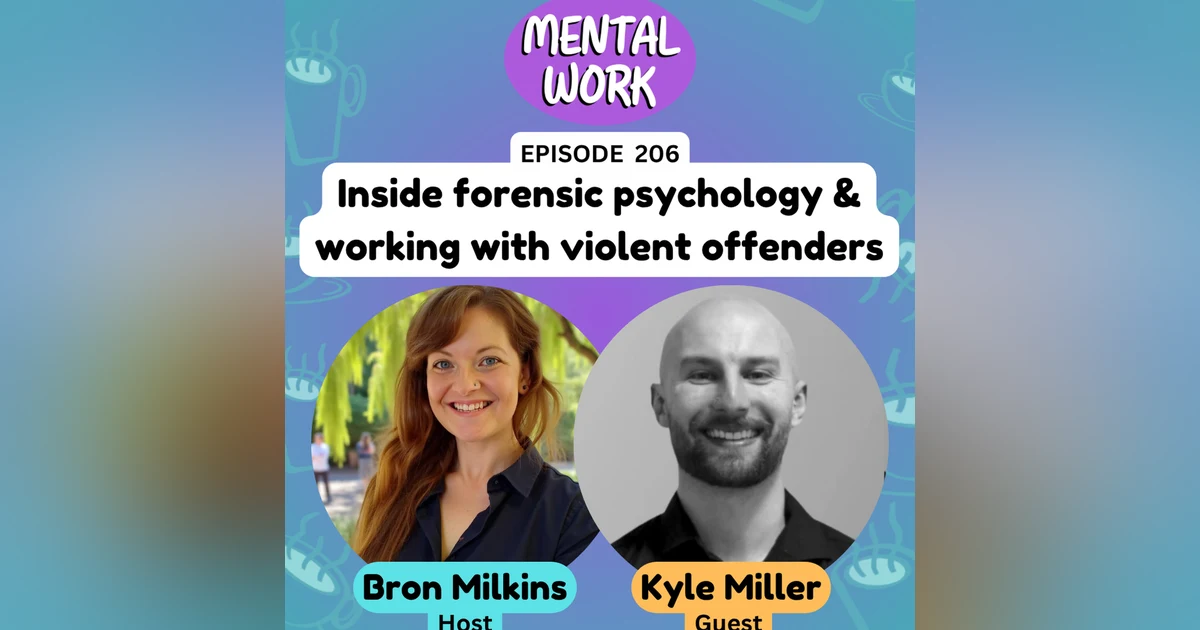
Bron is joined by Kyle Miller (psychologist working in forensic private practice) about what it's really like to work with people who have committed sexual or violent offences. Kyle shares how he found his way into forensic work almost by accident, and why "I work with people" has become his guiding philosophy.
They chat about:
👉🏽 The biggest misconceptions about people who commit sexual offences
👉🏻 How Kyle manages countertransference and the pressure to "fix" clients
👉 Why learning forensic terminology and skills happens on the job, not at uni
👉🏿 How to build rapport with clients who don't want to be in the room
Guest: Kyle Miller, Psychologist at Melbourne Private Psychology
LINKS
THE END BITS
Mental Work is the podcast for psychologists about the realities of working in mental health, with an early-career focus. Hosted by psychologist/researcher Dr Bronwyn Milkins.
Support the show by buying me a virtual coffee ☕🍵
Have a question, episode idea or just want to say hi? DM Bron on Instagram, leave a comment on the Spotify episode, or email mentalworkpodcast@gmail.com
Apply to be a guest / YouTube (with captions & transcript) / Website
CREDITS
Producer: Michael English
Music: Home
Commitment: Mental Work believes in an inclusive and diverse mental health workforce. We honour the strength, resilience, and invaluable contributions of mental health workers with lived experiences of mental illness, disability, neurodivergence, LGBTIQA+ identities, and diverse culture and language. We recognise our First Nations colleagues as Traditional Custodians of the land and pay respect to Elders past, present, and emerging. Mental Work is recorded on unceded Whadjuk Noongar boodja.
Disclaimer: Mental Work provides informational content. Mental Work is not a psychological service and being a listener or guest does not establish a therapeutic relationship. Content should not be considered a replacement for professional consultation or therapy. All views expressed are personal, subject to change, and do not represent those of any affiliated employer, service, or organisation past or present. Efforts are made to ensure accuracy, but opinions may not always align with fact. Listeners are encouraged to thoughtfully assess the information presented and report any inaccuracies or concerns via email. Further information can be found here.
See omnystudio.com/listener for privacy information.
[00:00:05] Bronwyn: Hey, mental workers. You're listening to the Mental Work podcast, the podcast about working in mental health for early career mental health workers. As always, I'm your host, Bronwyn Milkins, and today we are talking about working in forensics and with violent or sexual offenders. Forensic mental health work can feel intimidating for early career professionals, especially when it involves violence or sexual offending.
In this episode, we're going to explore what it's really like to work in this space, how to manage your own reactions, and what clinical skills and attitudes can support safe, ethical, and effective practise. Here to help us out this topic is our guest today, Kyle Miller. Hi Kyle.
[00:00:39] Kyle: Good afternoon.
[00:00:40] Bronwyn: How you going?
[00:00:42] Kyle: Pretty good. It's Friday afternoon in Melbourne, so certainly no complaints on my end.
[00:00:46] Bronwyn: Woo-hoo. It's so nice to have you on the podcast. Could you please start us off by telling listeners who you are?
[00:00:52] Kyle: Absolutely. I was gonna say, first of all, it's a bit surreal for me to be here because this was the podcast that I listened to through my internship. So to be a guest on, it's kind of like come full circle at this point.
[00:01:05] Bronwyn: Oh a listener in the wild. I'm so excited to have you on. I'm glad for this full circle moment.
[00:01:10] Kyle: Absolutely. So I'm, I'm Kyle, or as pretty much every GP clinic or correctional centre calls me is "Kylie", so at this point I've just kind of adapted to it. I've been registered now for, for two years. I'm a general psychologist. I took the five plus one pathway and at the moment I work three days in private practise clinically and then two days a week in forensic private practise.
[00:01:36] Bronwyn: Amazing. And how did you come to be interested in working with forensic populations? Was it something you kind of fell into or was it an interest that you already had?
[00:01:45] Kyle: Yeah, I, I think my journey into forensics was a little bit atypical for people when they go into a niche area of interest. So I finished my undergrad and then was working in aged care while I was doing my fourth year. And the, the work that I was doing was like behavioural management, behavioural support for families, and did that for a couple of years and really thought that I wanted to work in the aged care space and got to the end of my fourth year and a lot of my professors and tutors said, apply for an Ed and Dev, uh, uh, place, uh, sort of saying, well, this is the, you know, this is probably the best place for you if you wanna work with the elderly. And I got knocked back from a few courses and decided, well, I'll just throw myself into work for a couple of years instead. And so I continued working in aged care and I, I felt like I took everything that I needed from that.
And as many people say, I was looking for the next challenge. And in amongst a bunch of different jobs that I looked at, I found this role in outreach and I thought that I was going to be working with NDIS clients... I was, and I did, as it turns out, it was working with forensic clients as a part of the NDIS as well.
So the role that I made my way into was working outreach, so supporting people to access the community, which were primarily clients that were what are considered post sentence. So the clientele in particular were male sexual offenders, and I didn't fully realise that at the point that I started the job, but I fell in love with it immediately. It was just this very niche area with, you know, the need for people to get involved and provide support.
I worked in that role for a couple of years. I moved into the Melbourne Magistrates Court eventually through the court integrated services programme. So it's a non bail case management support programme. And at the point that I finished my, uh, internship through my master's, through the five plus one pathway, I was actually looking at sports psychology jobs, because that's always been an area of interest for me. And sort of smack bang in the middle of a lot of these adverts for sports psych jobs was this one role that said forensic private practise, uh, treatment of, of sexual offenders and violent offenders. And I looked at the key selection criteria and thought, no way I'm qualified for that. And thought, well, I've got nothing to lose. I'll throw my hat in the ring, and contacted the director, had a sort of short meeting with him. Week later I had an interview and then he said, well, once you're registered, we'll happily take you on for a job. And here I am once of 20 ish months later, maybe a little bit more still. Yeah, absolutely. Loving it, working in the same place.
[00:04:30] Bronwyn: Wow, what a journey.
[00:04:32] Kyle: Yeah.
[00:04:34] Bronwyn: I wanna unpack it a little bit. So when you applied for the first role you mentioned, what was the specific job title you applied for?
[00:04:42] Kyle: I, I think it said something like, mental health outreach worker, something like that.
[00:04:47] Bronwyn: Yeah.
[00:04:48] Kyle: I thought, I've studied psychology and, and mental, you know, just having that little title, mental health felt really appealing and something that I thought I could get on the resume to help me with university applications. And even, even, uh, through the interview process itself, we were broadly talking about things like, and I, I dunno what the terms for these organisations are in different states of Australia, but, you know, Department of Family Fairness and Housing, so DFFH and then child protection. Uh, we were talking about these sort of case scenarios around how would you navigate supporting someone if they had a visit with their child or if they had a visit with a spouse or, you know, those sorts of things.
But there was, at least as far as memory goes, there was no, no mention of, so these things like supervision orders and detention orders and post sentence and that sort of thing. And then the first day on the job, it was normal orientation and induction, and then I got a case put on my desk and said, you'll meet this client at the end of this week. These are all the files and psych reports and whatnot about them. Have a read and familiarise yourself. And I started flicking through it and I thought, oh, you know, cool, I get to read some psych reports, this is really, really awesome. And then I started to get to police reports and police summaries, and I thought, I, I don't know if I've been provided the wrong information. Should I be looking at this, basically... and I went and spoke to my team leader and they said, yeah, yeah, yeah, that's, that's your client. That's who you are working with.
[00:06:13] Bronwyn: Okay.
[00:06:14] Kyle: And that's how I found my way into it.
[00:06:16] Bronwyn: Okay, so I did the five plus one pathway as well, and unless I missed a lecture or a workshop, this isn't the kind of stuff that was covered in my course. How did you feel getting this information? Like was your heart rate spiking incredibly high or were you...
[00:06:34] Kyle: yeah.
[00:06:34] Bronwyn: What was that like for you?
[00:06:35] Kyle: Yeah, I mean, at the point that I started working that job, I, I hadn't entered my master's yet, so I felt like I was even less prepared for what it was that I was, I was doing. And I looked around at the other people that were in the office and, you know, there were some people of a similar age to myself as far as I knew they'd finished their degrees and things like social work in, you know, certificates and whatnot in, in criminology and, and those sorts of things. And I thought, I, I, I just know how to be a research student. I don't really know this, this hands-on application stuff.
So I, I certainly felt unprepared. And then I remembered the, the important thing, which is I know how to talk to people and that's what I'm gonna do and, and I wanna support people. So I'll, I'll learn on the job and, and I'll ask questions when I need to.
So, even at the point that I moved into working at the magistrate's court, which was just before I went back to, to do my masters, I felt even less prepared despite having more experience in that space. And again, it was okay, this is a challenge, I, I'm really motivated to do this work. I really like this clientele. So I'll, I'll figure out how to do it and I'll ask questions when I'll need to, and I'll do some reading and I'll do some professional development and we'll, we'll keep working at it.
[00:07:50] Bronwyn: Amazing. You must have some good personal characteristics to kind of be like, look, we'll just take it as it comes.
[00:07:56] Kyle: I hope so. I think that's what's helped me, uh, survive and thrive in this area.
[00:08:00] Bronwyn: No good to, good to hear. So I'm interested in your current work as well. What kinds of clients or presentations do you typically work with these days?
[00:08:12] Kyle: This is always my favourite question whenever friends or family or even sort of other psych colleagues ask me is the, the question is, who do you work with? Or how do you work with those people? And my response at this point is to, to always go to, without sounding, you know, I'm not making light of it, I'm not making a joke, it's I work with people. That's what I do. I work with people just as every other clinician does. Yes, my clients are very different to, to the next person. But I work with people. They've got the same limbs and organs that we all do. And as far as I'm concerned, there, there are no less deserving of respect and dignity than the rest of us. And I'd like to be part of the solution rather than adding to the problem.
I think I'd say that first and foremost is it's people that I work with and I think I'm pretty good at working with people. So unless I have animals start to walk into the room, then I'll, I'll keep doing this. So on a sort of presentation, personality level, you know, naturally within forensics, you, you typically see a, a high number of personality disorders come through, typically around the, the sort of cluster B. So borderline narcissistic, histrionic, antisocial, with a lot of the male clients that I work with who have committed internet related offending, so what we would call non-contact offending. They typically show up with some of the cluster C type personality traits. So you're avoidant personality traits, for example.
I'd say the, the main question that I get asked, or, or sort of the assumption that many people make is that I primarily and purely work with people that are paedophiles. And I can only speak for my own experience and, and I recognise that I, the work that I do might be slightly different to clinicians who sit within a custodial centre or, or a jail, for example, is most of the, the people that I work with aren't what we would diagnose as paedophiles. Have I worked with some? Yes, we sort of typically refer 'em as people that have committed a sexual offence and we try and avoid the pejorative diagnostic label unless it's absolutely necessary for something like a court report.
Other things that we see come through, you know, forms of, of anxiety disorders, forms of depressive disorders, adjustment disorders, especially for someone that's going through the, the legal space. And then naturally, as I was sort of referring to, there are sexual disorders that come through as well.
[00:10:37] Bronwyn: Wow. So a wide variety of presentations. I really love how you framed it as you work with people, because when we think of people who have committed sexual crimes, it is a widely and societally condemned action. So there is a lot of negativity to towards people who offend in that way, and bringing it back to their humanity and working with people... I mean, it is aligned with our ethical principles of affording people dignity and respect.
[00:11:06] Kyle: Absolutely.
[00:11:07] Bronwyn: Mm. And I'm just wondering like on a personal level, how is it working with people, I guess, who society marginalises in a way and has a very negative attitude towards, how do you work with that personally?
[00:11:20] Kyle: Yeah, really good question. I, I'm, I'm glad that I've had the exposure that I've had previously with sort of in the, almost like the stepped approach of outreach into case management, into treating practitioner, because I've also been able to, build some knowledge by working alongside clinicians along the way and being able to ask those same questions.. You know, what's allowed you to, to stay in this industry for 10 years, 20 years, 30 years, those sorts of things. And I think it's always bringing myself back to I'm working with people, I'm working with people, I'm working with people.
And there is my director at the, the forensic private practise that I work, Pete, he frames it really nicely, or, or a way that I found was quite nicely was to two ways of thinking about it is you need to be able to identify with victim and perpetrator in order to, to sit in this space. And that can be quite uncomfortable, but it's also necessary because if, if you're sort of just looking at the horror of what's happened or the, the grim details in a police summary, yeah, it's a, it's a bit full on at times.
If I think, okay, sort of the second part being why was it this thing for this person at this time? It's a lot easier to separate from as soon as you go at things with the lens of curiosity. I find the judgement or the values judgments or the, the negative thoughts that you might otherwise have just naturally fall away because then you just start to get curious about the person that's in front of you. And it typically then makes it quite easy as well. I think I really enjoy what I do, so it doesn't make it hard to walk in, sit down and say, talk to me about what happened or, how are you, it's, it's a normal part of treatment.
[00:13:03] Bronwyn: It's really nice the way you've framed it. I am wondering what you do in a typical week? So do you do individual therapy, group therapy or is it reports and assessments?
[00:13:14] Kyle: Yeah, so primarily for me, I do individual, uh, so one-on-one therapy, treatment. And I also write treatment reports for the court space. So I haven't dipped into assessment just yet, and I don't get involved in, in group programmes. The forensic space is very broad in the sense of how it operates on a treatment level. So there's treatment that's provided in custody to, to clients. There are group programmes that exist within different organisations, such as through Department of Justice or, or corrections. There are individual treatments that are provided by them as well. The, the, the private practise that I sit in is probably quite niche in how it operates, and we identify that because we get a lot of referrals from lawyers saying, I've struggled to find anyone that does this work the way that, that you, you guys do it there.
So a typical week for me, I would see somewhere between 10, 12, 13, uh, forensic clients alongside the, the general private practise clinical work that I do. And you're basically, you're waiting at any given moment for a lawyer to email you to say, "Hey Kyle, I know you've been working with John, the client for X amount of sessions, now he's got this court date coming up in a month's time, could you write us a treatment report"? Always happy to do it. It's very finicky to do, and there's a lot of sort of the technical aspects to make sure that what you're writing is what we would call defensible. I absolutely love, love getting involved in it, and I love the support that I've got in the space to be able to do it.
In terms of the ins and outs of the sessions themselves, it, it varies. Sometimes you get clients coming in and they just wanna talk about how bad a week they've had, and that's okay. I, I, I'm aware that when they come into the space, most of the time they've got a stick in their back from a lawyer, from a family member, both, saying, go and see this person and, and sort out what's going on. Or, sometimes lawyers might say, it might be the thing that changes your sentence from a community based sentence to spending time in custody... Pick your poison, basically.
[00:15:24] Bronwyn: Yeah.
[00:15:25] Kyle: The conversational topics or treatment topics that we have that come up are quite varied. Was there anything sort of specific that you'd like to know out of that space?
[00:15:35] Bronwyn: Yes, many things.
[00:15:36] Kyle: Yeah.
[00:15:37] Bronwyn: The first thing that stands out for me is with clients who have that stick in their back from a lawyer or a family member. Therapy with clients who may not want to be there or may have, reasons to say, present in a more favourable way or present themselves in a positive light, what's that like?
[00:15:55] Kyle: Yep, absolutely. I, I will typically spend a first session with a client going to exactly that point. It's normalising it for them, it's validating it for them. And it's effectively what I end up saying is, if I was in your position, I'd be doing exactly the same thing. And I can't imagine anybody that wouldn't be doing the same thing. The opportunity to go and talk to someone or not talk to them, but you know, the, the thing that might be a, a swinging factor when it comes to your sentence in court, I can't imagine anybody that wouldn't wanna take that opportunity. So it is normalising it for them.
It's also spending time within like a motivational interviewing space. It's, it's meeting them where they're at. If we are thinking about that idea of the Stages of Change model, you know, if they're pre contemplative about changing their behaviour, there's no point in me sitting in a planning or, or an action phase with them... it's sitting with them and going, well, what are the reasons not to change? 'cause change is really difficult, you know? So it's, it's a lot of normalising and validating where they're at and trying to just find little ways to get them to buy into treatment. And if that's that you kind of dangle the, the carrot in front of them by talking about a treatment report and saying, at some point your lawyer's gonna say to me, can you write this report, and we really hope it's positive... well, what would you like me to be able to tell the court after we've done 5, 10, 15, 20 sessions, whatever it might be. And, you know, often they'll say, I don't know.
And then we formulate some goals from there on in. Formulating goals, whether you do it implicitly or explicitly with any client in any type of therapy, is helping identify the reason why you are there and where you're going. And so sometimes it is just about helping them sort of sit in the dark for a little bit and finding a way out of there by, by building goals and, and absolutely building rapport. You know, you want them to trust you. And especially with these clients, sometimes it does take quite some time.
[00:17:54] Bronwyn: I really like how you framed that, meeting them where they're at and normalising their thought processes and really putting your own humanity in that as well. It's like, if I was in your position, I'd be doing the same thing. That sounds like a great approach.
I was thinking as we were chatting as well, that there may be clients who have their own feelings about their behaviours, and these may involve like, everything that may range from shame and guilt to justification or minimization. How do you manage clients' feelings when maybe they don't feel like there has been a problem?
[00:18:29] Kyle: Yeah, so we could sort of put a lot of those, you know, cognitive distortions or thought errors around a banner of denial as well. And, and look, plenty of clients do come in with different forms of denial. It might be denial of responsibility. It might be denial of, of intent. You know, they might be placing blame on a victim, for example.
There's different schools of thought. You know, I've read different, uh, treatment manuals and books and that sort of thing. Some will talk about, you can definitely work with a client who's in denial and maybe you just work around it or you, you make that the entire focus of what you're doing. And then there are other books and manuals that we'll talk about. Unless you can get through the denial, unless you can address it, that there's, you know, this client isn't going to make progress. It is very much an individual thing in my experience.
And, I'd say one of the most normal things that comes up in treatment is some form of denial. We all deny, you know, we all do it. It's not, it's not unique to these clients. If, if you wanna talk about it, say from like a, an ACT point of view, acceptance and commitment therapy, if we were talking about a value of health, well, I could be quite, uh, in denial myself by saying, oh, well, you know, me eating this packet of biscuits for the fourth time this week is, is living by my value of health because I'm just looking after myself 'cause I've had such a busy week... Well, maybe I'm lying to myself at the same time. And sometimes these clients do it too. Why do we deny? Because it's protective.
And for many of, of the clients that I work with, and I kind of keep making this point, that, that the clients that I work with are possibly quite different to what would might appear in, say, like a maximum security prison at times, because those clients aren't necessarily granted bail whereas the ones that I see are typically granted bail and I see them face to face. So most of these guys, especially when it comes to internet related or non-contact defending, are generally quite pro-social people for the most part. You know, they're typically either employed or have completed some form of, of tertiary or at least secondary education. Most of them have some form of social network, whether they catch up with them in person or not. So there's generally these pro-social elements to them that having to sort of turn and face the, the really daunting things that they've perpetrated as a part of their offending is really scary. And it's not uncommon to see them in tears when, when you're in the room with them because it's confronting to have to talk about this part of your life that was just tucked away over there for days, weeks, months, or even years... you're navigating that as best that you can with them and, and sometimes they're just not ready to turn and face it, and that's okay. We work with them where they're at.
Ultimately, you want to build their, what we call their insight into the motivations for why they offended. But we can't just assume kind of as, as we're alluding to before with the stick in the back, we can't just assume that they're ready to talk straight away. Just because they're presenting doesn't mean that they're ready. And that turns up in the clinical space as well. Probably turns up in a more heightened version of that within the forensic space because you are typically working with sort of less intrinsically motivated individuals.
[00:21:48] Bronwyn: Really interesting. I wanted to ask you a bit about the terminology. So forensic language, um, because again, this isn't something, usually psychologists have a background in legal terminology and forensic terminology. How have you gone with learning that and feeling confident with using that sort of language? I guess it requires a lot of precision?
[00:22:09] Kyle: Yeah, so I, I make it very clear when I talk to my clients that if they want, if they want an in-depth rundown of everything that happens in the legal space and every little term that comes up in court and that sort of thing to ask their lawyer instead of me.
[00:22:25] Bronwyn: Good one.
[00:22:26] Kyle: Thankfully for me, I worked in the court space that I, I learned terms like mention hearing or committal mention or in indictable offence or what a suppression order is, these sorts of things. So I got to learn them through experience. You made the point before is this stuff doesn't really come up at university unless you go into the, forensic space specifically. So I think from memory within the five plus one I did, might have been one week that involved one tutorial that involved any sort of discussion about forensic clients and I think that was alongside learning about DBT for about an hour.
Learning on the job is a part of any field and any career. And I think unfortunately for many early career psychs, and I will throw myself in that category as well, is there's this pressure that we heap on ourselves to have to know everything by the time we finish our undergrad or our fourth year or our, our masters or our internship or PhD, whatever it might be, is kind of like, well, I'm here now so I must know everything.
I went to a really wonderful networking event while I was doing my internship where we lined up based on how many years of experience we had, and the question was asked around who still gets imposter syndrome? And there were, I think, three clinicians standing at the 20 plus years in the field and, and all three of them put their hands up.
[00:23:47] Bronwyn: Wow.
[00:23:49] Kyle: It's okay not to know everything in terms of how it shows up in my space, thankfully there's a degree of consistency around the language that we use. The, the court doesn't really move all that quickly with, with time. So we still use a lot of the same terms that we have used for a long time. Reading books, listening to podcasts, getting supervision, those sorts of things, professional development, all of those are wonderful ways to, to upskill.
And, you know, it does happen where a client will say something, they'll mention a, a term say to do, if I'm working with someone that's in the substance use space, they might use a term around a particular drug that I've just never heard of. I think last week I learned a new term, I think it was called capping or something like that, to do with sexual offending, and I thought, I've never heard that term before. I'll just go and find out what it means and then I'll know and it's okay not to know right now.
[00:24:39] Bronwyn: I really love that core takeaway message of it's okay not to know. And I love that activity as well in that networking event. How-, what a great visual demonstration and a normalisation of that imposter syndrome feeling.
Another thing I really liked about what you said was, I guess, the expectation of learning on the job, and I wanted to ask you about what supports you've had. So it sounds like you're really proactive and you'll go out and learn things yourself and go listen to things and read things. But how instrumental has it been to say, have a supervisor or a mentor, or your workplace?
[00:25:08] Kyle: Yeah, imperative. Uh, I, my, my director at, at the forensic practise, Pete, has been invaluable for a number of reasons. First of all, and I keep phrasing it to him after all this time of working with him, that you know how grateful I am that he took a chance on me and he keeps saying, I didn't take a chance on you. You know, you, you earned the position, and I'm really happy to have you here.
Pete has been so lovely for me to just be able to go into his office at the drop of a hat or text him and say, I'm working with this client. I'm stuck. I don't know what to do. They're mentioning A, B, and C. Could we just sit down for 10 minutes and talk, and 10 minutes becomes half an hour every single time, even though I always promise him it's just one minute.
And the thing that he often brings me back to is formulation. What's your formulation? How are you understanding this? If, if you wanna put it into your four Ps, put it into your four Ps. If there's a, an another format that works for you, go with that. Coming back to formulation and thinking about what your goals are, that's where you go. And every time, despite the fact, it's the main thing he'll repeat to me over and over, that's what's helpful.
I also do get formal supervision, from a very qualified clinician in the field. We do telehealth sessions probably sort of once a month, once every three weeks. I bounce off my other colleagues as, as well. There are some really helpful podcasts out there. Um, I think the one that I listened to, which my supervisor is a part of, is called Beyond the Crime, which for anybody that's, that's interested in forensic work, it's forensic schema work. So I find that I take a lot away from that.
In terms of books, you would be surprised how many books exist on Amazon about providing forensic treatment, whether that's to do with sexual offending, violent offending, drug offending, anything to do with that. So, uh, I tend to have a pretty heavy stack of books that I read one chapter from, and then I bounce to the next one, and then I bounce to the next one.
But having those supports in place, I'd say is imperative, not just for forensic work, but for any work. Because, for example, if, if you're working in private practise broadly in the psych space, it can feel quite isolating. It can feel a little bit lonely at times when you're just sitting in an office and bouncing in and out, seeing clients. So having individual or even group supervision is wonderful just as a way of saying, I'm stuck with this client, does anybody else get like that? And then you watch about 10 hands go up immediately and you go, okay, it's not just me that gets stuck with clients.
[00:27:44] Bronwyn: Totally. Have you thought about doing a master's in forensic psychology? Like uh, or do you feel like you're gaining enough through your experience? Just curious.
[00:27:53] Kyle: Yeah, I, I think I'm a little bit done with study just for the formal, formal study, let's call it, just for the moment.
[00:28:01] Bronwyn: That's so fair.
[00:28:02] Kyle: Yeah, I, I think within the forensic spaces, there's probably a couple of competing ideas around it. I don't think I've been held back from doing what I do by, and I'm using air quotations here by only being a general psychologist. I got to pick where I wanted to go with a great amount of flexibility and I'm, I wasn't forced into the forensic space or anything like that.
I think one of the very unfortunate things about forensic work, especially when you do it in private practise, is that there's no Medicare rebate available for clinicians that are undertaking forensic treatment. It's, it's not listed as a, as a part of that, which is a, you know, it's quite a significant barrier for many clients and, and they make it known, and I certainly acknowledge that. If there was a, a need to have an endorsement, it wouldn't have any sort of benefit for the client in terms of rebate either.
Would it help my knowledge? Oh, undoubtedly it would. Do I have the capacity right now? Probably not. I think I'm, I'm quite content with, with what I'm doing and I really like the idea of learning on the job. If it comes to the point that I think that I need more education in a very formal sense, I, I'd happily go down the, that, that path. But right now I'm pretty content with what I'm doing and it hasn't been a barrier for me at this point. Nor should it be for any clinician that wants to get in the forensic field.
[00:29:19] Bronwyn: Really good to hear. I think a theme that we've had across podcast episodes for maybe a few years now has been this tension between getting further qualifications and learning more on your own. And this stems usually from this early career sense of inadequacy and that we need to go get all these certificates and formal qualifications to feel okay with ourselves, really. And so it's really good to hear from you that you're like, look, like I could, and it may be beneficial in this way, but I'm content where I am right now.
[00:29:45] Kyle: Very much so. Very much so.
[00:29:46] Bronwyn: I wanted to ask you about something that may happen when working with forensic clients, and I think this would be a counter transference reaction in that the clinicians might feel a pressure to fix the client or prevent re-offending entirely and put a lot of pressure on themselves to do that. How do you approach, realistic goals of forensic work and maybe some countertransference reactions of your own?
[00:30:08] Kyle: Yeah, it doesn't matter if I'm working with the forensic clients or if I'm working with clinical clients, I really don't like the idea of fixing someone. And yeah, it just doesn't sit right with me. And kind of as I, as I was saying earlier, I work with people, I don't work with cars. I don't, I, I really like the analogy of talking to people about this.
Again, whether it's in the forensic or the clinical space to say, I'm not a mechanic. I'm not about to go into your brain and pull a bunch of parts out and then sort of put some secondhand ones in there and hold it together with some, either WD40 or some duct tape. You're a person, what you're experiencing is human. I work with people, let's figure this thing out together.
I'm not under the false illusion that the sessions that clients have with me is going to be the be all and end all for them. And that every client that I meet is going to be, again, air quotations treated and healthy and contributing members of society. It is the case that some clients will bounce through treatment over and over again, and, and that their behaviour may or may not change. It's in some ways comforting for me to know that I can work with someone that a, a 20 year experience clinician can work with, and that we both get to the same point where we're just stuck and nothing changes for the client. And I think some of that is putting some responsibility back on the client themselves and coming down to that idea of, well, how willing are they or how much do they want to do the things that they would need to do in order to change.
In terms of that, that pressure, re-offending is, is the number one thing that you would probably fear within the forensic space. Is this person gonna re-offend? Is this person going to re-offend? Typically, with the majority of the clients I work with who are non-contact sexual offenders, as far as the research goes there of the lowest likelihood to, to re-offend... but it doesn't mean that they don't re-offend. Some of that's just that they haven't been caught.
And, you know, it's a bit of a daunting thought when you are in sessions with clients and thinking that they're talking the talk right now, they're walking the walk. What happens when they stop having sessions with me in 12 months, in two years, or in six months, whatever it might be. Are they gonna go back to old ways? And if you get yourself caught into that way of thinking and you get really stuck with it, you're gonna feel very, very overwhelmed. And it's just going to feel like the oncoming title pressure of clients over and over again who aren't going to get better.
The concern about re-offending always sits there in mind as it as it should. A prime difference between, say, doing forensic work and doing clinical work, is that the number one, population that you are holding in mind around safety with, with forensic work, is the community. You are more focused on the community and their safety than you are on the individual clients mental health, so to speak. We wanna protect the community because they're, they're in need of protection and we wanna balance that up with looking after the client as well.
I do leave sessions with clients and think, bloody hell, I've, I've done the best that I I can with this person. Are they gonna come back next week? Or are they just gonna cancel their appointment because they've had enough? Or you might be doing some work with a client who's, you know, I do work with people who are in custody, and you think, okay, at the point that they're done with their sentence, will they be equipped enough from what we've done or even what we've done, plus what they're going to do once they're released from custody to live a pro-social life? Ultimately, I hope the answer is always yes, unfortunately, we just don't know.
[00:33:42] Bronwyn: I'm wondering about managing risk in sessions. When I, for example, work in clinical practise with people who have risk of suicide, I go through a risk assessment with them, and that's usually a conversation that we have, and I've got a few things in my mind like access to means, past suicide attempts, their suicidal ideation and the fluctuation of that. Are you holding in mind like a checklist in your head of risk of re-offending, and is that something you actively assess or is that something that's not quite in the treatment?
[00:34:12] Kyle: A bit of column A and a bit of column B. So in, in terms of, I, I guess I'd like, I can speak about a few things to do with risk here is, well, what's the risk that this person sort of re-offend broadly? I wish I could look inside a crystal ball and tell you for every single client what their risk is. And even with the best sort of structured risk assessments that we've got at the moment, which sort of, I was reading something the other week and it was basically saying, I think we've basically hit the pinnacle of what we can with risk assessment. So what we've got is probably as good as it's going to get because the assessment tools that we've got are really thorough, but we just don't know. There's just no way to know with absolute certainty because a lot of it's based on, well, it is based on past behaviour and no one can necessarily predict the future with a hundred percent accuracy. So there's that element of risk.
When I'm working with clients and we're thinking about what's their, their likelihood of re-offending just based on, let's say, structured professional judgement, again, sometimes you just never know it, it's, you're doing the best that you can to develop insight, help them understand the motivations of what was, what was going on. You're looking at things like what we would call their offence pathway or their offence chain. What was the, what started with the seemingly unimportant decision that you made that led to being in a risky situation that led to a lapse in your behaviour that led to the, the give up stage and then you've offended. Sort of looking at all of those things is, I, I found with many of these guys is the easiest way to break it down so that they can sort of identify it.
Another way of thinking of that is the slippery slope. You know, what's the slippery slope that leads you to offending and how do you know when you're starting to get close to it? So if you can help them understand that, develop insight, if you can help them develop their relapse prevention plan. Develop things like pro-social activities that don't involve isolating yourself at home and looking at pornography on the internet, or building pro-social connections with people rather than anti-social connections. These things are, are helpful. Uh. At the end of the day, it's, it's the client's choice. When they leave that session or when they're in the, you know, the, the heat of the moment or a risky situation, are they going to be able to, or will they even remember what their relapse prevention plan is? And, and again, if you sort of think about it from an ACT point of view, can they make a move that would be towards what their values might be instead of away from it or, or toward a valued life instead of away from one?
I think the only other thing that I'd add in terms of risk, which I often get asked is what's it like to sit in the room with, with these clients? Again, I, I sort of reiterate with the private practise that I work in, I'm not necessarily working with high risk violent offenders that we'd bring in and, and be a little bit concerned about what our welfare's going to be like. Generally, again, many of those clients might not be granted bail at, at the point that they're charged by police. So if I do work with them, it's typically while they're in custody and I'm doing a video link with them into, into a custodial centre.
So in, in the, what sort of seven years at this point that I've worked with forensic clients, sort of two, basically two years of treatment. But in seven years of working with these clients, I've only felt in danger once with a client, and apart from that, if, if I'm not there to antagonise the client, and if I'm doing my best to validate where they're at, if I'm showing them that I'm as much on their side as I can possibly be, while reiterating my job is to sit firmly in the middle of prosecution and defence, if I am showing up for the appointments, if I'm not forgetting that we had a session booked and all of those sorts of things, generally they're okay with me.
I'm not there to antagonise them. I'm there to help and I've never had a hairy situation. I'm always vigilant as most clinicians are, regardless of the population you work with, you know, sit yourself closest to the door. If you're worried about a client coming in, posing some sort of risk, let someone know. Those sorts of things have, have access to a senior clinician to, to debrief with those sorts of things. But as I say, aside from this one instance, and it was while I was doing case management where security was standing just outside the door anyway, I've never felt threatened or in harm's way from any of my clients.
[00:38:26] Bronwyn: I was going to ask you how you manage this uncertainty, and then as I was listening to you more, I think what stood out for me is I think you have a really clear idea in your head on what your role is with these clients, and you're like, you know, my role isn't to fix or change or prevent offending completely. You're like, my role is to be with you as a human and meet you where you're at. That kind of sounds like for me, what, what you think is that right?`
[00:38:48] Kyle: Yeah, I, I, I would probably boil it down to that because if I start, you know, I, I certainly have days where I go, what the hell am I doing with this client? What, what am I doing? Because naturally, I did a, uh, three day PD a couple of years ago online, uh, with a psychologist named Gregory Lester. He's, he's American. He's provided training for more people worldwide on personality disorders than anybody else. If anybody's interested in personality disorder training, look up Gregory Lester. Uh, he, he's an interesting guy. You get, takes a little bit to get used to him, but it, the trainings that he's got are, are really, really lovely and, and very helpful.
And one of the things that he talks about, particularly with personality disorders is drama. It's not getting pulled into the drama. Not getting pulled into the drama. And so the more that you keep your sort of internal dialogue about what's going on, separate from your external dialogue where, where possible and where, and we are suitable, and you don't get hooked into the drama that the client might be trying to pull you into and you remain clear on what your goals are with this client and what your role is, happy days.
Now, as I say, there are certainly days when I go, this person has confused the flying fox out of me. I don't know what, what I'm doing. I'll, I'll, you know, pull my socks up and come back next week. And that's just naturally part of working with people, right. We're confusing. It's, it's not unique to, to forensic clients. We are confusing and I'm sure every, you know, clinician working in private practise or ed and dev psych working in a school or clinician working in a hospital has had a day where they've gone, what the hell was I doing with that client? Or they've confused me or I don't know what I'm doing. Or I should definitely consider resigning. It happens, it's just part of the job.
[00:40:37] Bronwyn: I really loved what you said about humans not being internally consistent. You know how when you do this work and you just start learning about general principles of humans and humans not being internally coherent or consistent is just one of those like general principles you learn and then you don't get frustrated by people, 'cause you're just like, everyone's messy.
[00:40:53] Kyle: Absolutely. And it certainly shows up with these clients because it's that idea, as I was saying before about talk, the talk and walk the walk. You kind of go, how could you not see that what you were doing, the situation you were walking yourself into was one of risk? And then you go, well, they don't function the same way that I do, or they don't see things the same way that I do. Can I have empathy for this person?
And one of the things that, that my director Pete has really sort of drummed into me over and over, which is really lovely, is that idea of taking a strengths-based approach with clients. Okay, well what did they do? Well, they might have still used, for example, if it was drug use or, or they might have, you know, if we're trying to develop a healthy sexuality plan and we're talking about reducing their pornography use, and I'm, I'm talking legal pornography, in that case, they might go, look, I, I've actually been looking at it a fair bit, and rather than sort of chastising them for, it's looking at what did they do well in that situation? Did they even if, if they even had the glimmer of a thought to think about what their relapse prevention plan was or thought, is this helpful for me right now? Or is this really what I want to do... then, you know, throw a party for them at that point. Reiterate the, the things that they've done really well, and then kind of look at it as well, this is a learning opportunity for us. You know, you can do it. You've just proven to me that you can do it. Let's settle up and see if we can refine this thing together.
[00:42:16] Bronwyn: Totally. What's the biggest thing that people get wrong about working with people who have sexual offending or forensic clients in general?
[00:42:25] Kyle: I'd say the two biggest things would be the idea that I, that everybody that commits a sexual offence is a paedophile that's just blatantly wrong, and that all of these clients are untreatable and we should lock them up and throw away the key. I, I fundamentally disagree with, with both of those things. I mean, one's backed by research is that not, not every client that commits those, those type of offences has that diagnostic or pejorative label.
And I've seen some really good outcomes for some, for some clients. I've worked, and I'm working with several clients where when I get to the point that I write a treatment report for them, I really luckily get to say, this person's made really good progress. This person's made good progress, and here's all the wonderful things that they're doing in treatment. Here's all the wonderful things that I see. And that's, I mean, those, those are the wins that you take to keep moving forward.
But I'd certainly say those would be the two biggest misconceptions that, that people get around working in this field is, is these pejorative labels and that there's nothing that we can do for them, because there are things we can do for them. It's slower work with fewer of these massive light bulb moments that you might get with, with other types of clients. And so you need to be ready for that if you're working in the space that you will probably have a few more moments of just sort of gently, nudging the head against the wall at the end of a session and thinking we've been talking about this thing for 20 sessions, and then think, okay, well we've been talking about this thing for 20 sessions, but they keep turning up and if they're gonna keep turning up, I'll do that as well.
[00:43:56] Bronwyn: Can I just ask you, like, forgive my ignorance on this, but with the word paedophile, is, is that like the word psychopath? Like it's not an actual diagnostic term in the DSM, and is it an actual term or is it just a, a negative pejorative term?
[00:44:10] Kyle: Yeah, so it is a diagnostic label, sort of pedophilic disorder. So it, it does exist in the DSM, uh, in, in that capacity. It's a very specific label.
[00:44:22] Bronwyn: Okay.
[00:44:23] Kyle: Unfortunately whenever there's sort of an offence that comes against a, a child, which is, which is what the specific label of, of a pedophilic disorder would, would relate to, it's sort of the sexual dysfunction that, that goes along with that, it's the distress that comes with it. It's, it's this ongoing sexual arousal for at least, off the top of my head, I think the DSM says six months. And to think that, that all of these clients are exactly the same is, is inaccurate. It's, so, it's sort of separate to psychopath. That would be another one I think is many people asking, how many psychopaths do I work with? I don't know. I really don't know.
[00:45:01] Bronwyn: Yeah.
[00:45:01] Kyle: I tend not to necessarily focus on it too much. There's, there's a time and a place for diagnostic labels and there's a time for doing the work, and, you know, I'll, I'll leave that to each individual clinician to have their view on that.
[00:45:15] Bronwyn: Mm. Awesome. Thank you for clearing that up.
[00:45:17] Kyle: Of course.
[00:45:18] Bronwyn: So for listeners who have listened to this conversation and they're like, I wanna get involved in this field, this sounds so interesting. What would you say to them?
[00:45:26] Kyle: I would say please come and just throw your hat in the ring and, and sign up and jump right in and we'll help you. To, to be perfectly transparent, and I've got the permission of the clinic for this, the, the clinic that I work at is Melbourne Private Psychology. We're in Richmond in Victoria. And if you jump online and look at our website, if any clinicians are looking for, for roles, we're, we're happily taking applications at the moment. If anyone wants to reach out to me directly, I'm, my email address is my first name, kyle@melbourneprivatepsychology.com.au, it's a bit of a mouthful.
But if anyone's interested in, and they're not so sure about whether they wanna get involved in this work, go on Amazon, find a book about, just type in sexual offender treatment or violent offender treatment, or listen to Beyond The Crime, the podcast. Jumping on Spotify or Apple or Podbean, whatever exists these days and just looking up forensic psychology.
It's, it is a wonderful area to get involved in. It is a difficult area to get involved in, but I also don't think there's any area of psychology that's not, I mean, the idea of walking into a session with one of these clients, I think, yeah, no problem. The idea of walking into a school and working with a large number of adolescents and and their parents, that scares me. So, uh, you know, individual difference. But, uh, yeah, if anyone wants to get involved, there's no shortage of resources. Just start with Google, to be honest and stay away from Netflix documentaries 'cause they don't really reflect what we do.
[00:46:57] Bronwyn: Good tip, and I'll make sure I put some of those links in the show notes, the links to your practise and the podcast as well, that would be really interesting.
Kyle, it's been so interesting speaking with you. I've learned a lot just from hearing your perspectives and experiences. It's been very humbling as well. What do you hope that listeners will take away from our conversation today?
[00:47:17] Kyle: That this isn't a completely damned field and that it's very interesting. I mean, I, I hope maybe just broadly speaking that there's somebody listening that was like me at that point in, in terms of trying to figure out what they wanted to do in psychology. Thought that they weren't good enough or looked at a job application and went, uh, I don't know, because that's asking for this many years experience or, or, these key selection criteria. There is never any harm for any psychologist early career or not to, to look at the phone number that's on that application, call it and say, I'm not sure, but I'm really interested. Is it worth me sending through my application?
It's normal to have doubts about yourself. Early career. I still have plenty of doubts about myself, but do this work for a reason. And you, you're playing the long game with it. Just for anybody listening, keep it up. You'll get there and you'll have your ups and downs, but it is worth it.
[00:48:13] Bronwyn: Thank you so much, Kyle. Very inspiring, and I'm so glad that we were able to have you on today. Thank you for coming on.
[00:48:18] Kyle: Thank you very much for having me.
[00:48:20] Bronwyn: Listeners, if you found this episode helpful or thought provoking or something else, please follow the podcast. Share it with a colleague, pop it in their ears. It's the best way to get the podcast out there, and leave a rating! Thanks for listening to Mental Work. I'm Bronwyn Milkins, have a good one, and catch you next time. Bye!


