
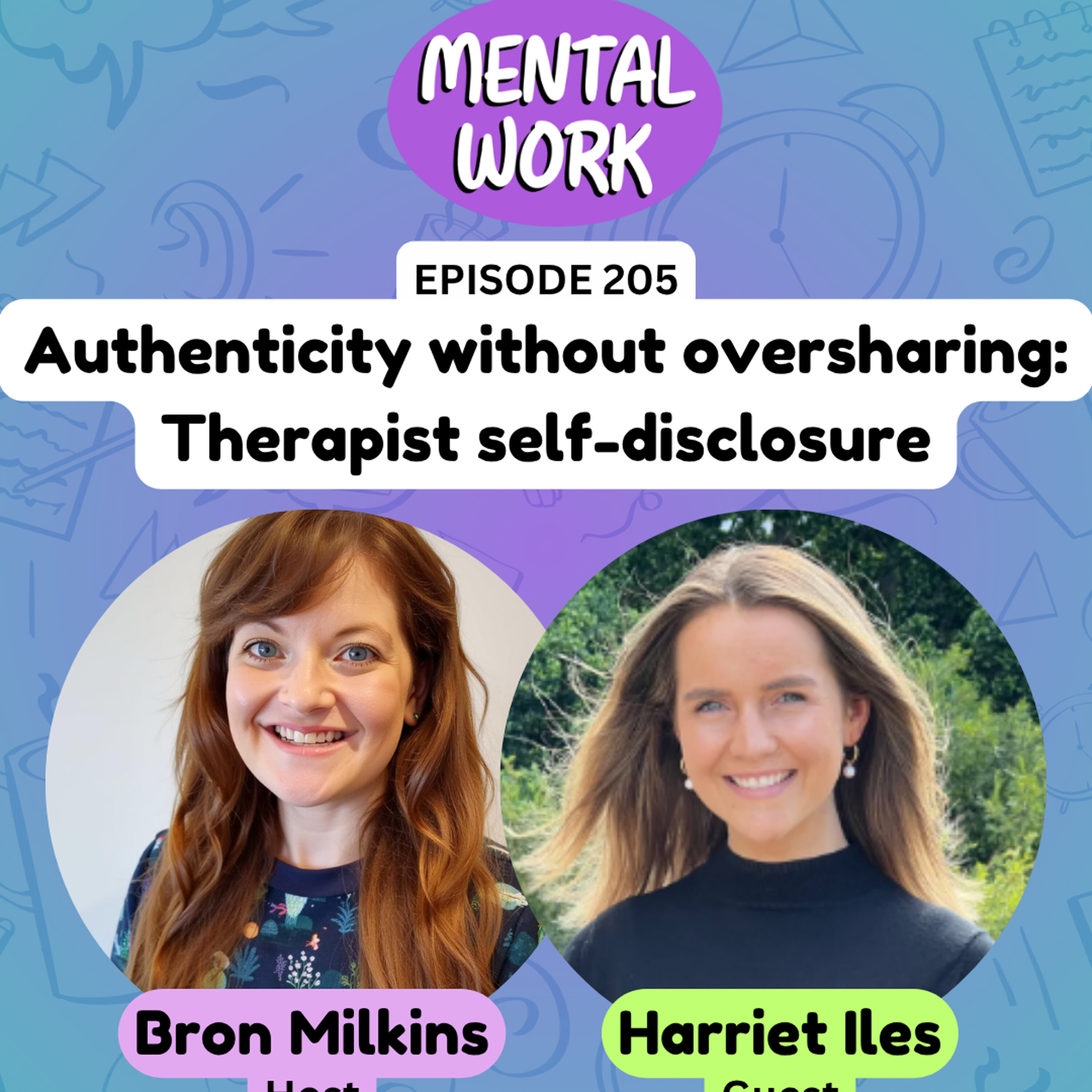
Bron is joined by returning guest Harriet Isles (psychologist and founder of Restorative Space Psychology) to talk about therapist self-disclosure. Harriet shares her practical, intentional approach to deciding when sharing personal information with a client helps the therapeutic relationship, and when it gets in the way.
They chat about:
👉🏽 How to know when self-disclosure is actually for the client's benefit, not your own
👉🏻 What the AHPRA Code of Conduct says about sharing personal information with clients
👉 Findings from the 2025 "Goldilocks Disclosures" study on when self-disclosure lands well (and when it backfires)
👉🏿 Why speaking "from the scar, not the wound" protects clients from role confusion
Guest: Harriet Isles, Psychologist and Founder of Restorative Space Psychology
LINKS
- Research article: "Goldilocks disclosures: A qualitative exploration of when therapist self-disclosure of lived experience is "just right"
- Harriet's Instagram: https://www.instagram.com/restorativespacepsychology/
THE END BITS
Mental Work is the podcast for psychologists about the realities of working in mental health, with an early-career focus. Hosted by psychologist/researcher Dr Bronwyn Milkins.
Support the show by buying me a virtual coffee ☕🍵
Have a question, episode idea or just want to say hi? DM Bron on Instagram, leave a comment on the Spotify episode, or email mentalworkpodcast@gmail.com
Apply to be a guest / YouTube (with captions & transcript) / Website
CREDITS
Producer: Michael English
Music: Home
Commitment: Mental Work believes in an inclusive and diverse mental health workforce. We honour the strength, resilience, and invaluable contributions of mental health workers with lived experiences of mental illness, disability, neurodivergence, LGBTIQA+ identities, and diverse culture and language. We recognise our First Nations colleagues as Traditional Custodians of the land and pay respect to Elders past, present, and emerging. Mental Work is recorded on unceded Whadjuk Noongar boodja.
Disclaimer: Mental Work provides informational content. Mental Work is not a psychological service and being a listener or guest does not establish a therapeutic relationship. Content should not be considered a replacement for professional consultation or therapy. All views expressed are personal, subject to change, and do not represent those of any affiliated employer, service, or organisation past or present. Efforts are made to ensure accuracy, but opinions may not always align with fact. Listeners are encouraged to thoughtfully assess the information presented and report any inaccuracies or concerns via email. Further information can be found here.
See omnystudio.com/listener for privacy information.
[00:00:05] Bronwyn: Hey, mental workers. You're listening to the Mental Work podcast, the podcast about working in mental health for early career mental health workers. As always, I'm your host, Bronwyn Milkins, and today we are talking about therapist self-disclosure.
Ever wondered whether you should share something personal with a client? Therapist self-disclosure can strengthen rapport and foster trust, but it can also risk boundaries and shift the focus away from the client. In this episode, we'll unpack what ethical self-disclosure looks like, how to balance authenticity with professionalism, and what the latest research says about getting it just right.
Today's episode will be less of an interview and more of a conversation as we delve into it, and here to help us out this topic is our return guest, Harriet Isles. Hi Harriet.
[00:00:47] Harriet: Hi, how are you?
[00:00:48] Bronwyn: Yeah, I'm good. Thanks. How are you going?
[00:00:50] Harriet: Yeah, good. Thank you.
[00:00:52] Bronwyn: It's nice to have you on the podcast again. For listeners who have not heard you, could you please remind them who you are?
[00:00:58] Harriet: So my name's Harriet. I am a psychologist. I work across private practise in corporate settings supporting a range of different individuals, mainly with, um, anxiety, low mood, um, disordered eating, and yeah, worry and overthinking.
[00:01:16] Bronwyn: Interesting. Thank you for coming on again. So I think to start us off, I wanted us to have a chat about how you think about self-disclosure in practise and what's your approach.
[00:01:28] Harriet: Great question, and I think it's something that all those working in mental health should have a think about and reflect on in terms of self-disclosure. I think it can be a tool, a tool to use in the space with clients. It's not something that, you know, you just do without thought. Um, it's got to be very intentional.
And so I have definitely reflected on, uh, what, um, appropriate ethical self-disclosure looks like. So I guess sort of the way I, the way I think about it, it's a tool that can be used in various contexts, with the goal of benefiting the client and helping to foster the therapeutic rapport and engagement.
[00:02:14] Bronwyn: Yeah. And how do you approach disclosure then in practise? Like do you do it freely or do you have some conditions . How do you go about it?
[00:02:23] Harriet: I think in terms of my approach generally at the, the core is it needs to benefit the client. Uh, and there's gotta be some sort of relevance, um, to what we're doing in therapy. For example, it could involve disclosing to the client that... uh, say, say if they ask, you know, how was your weekend, for example, which sometimes clients, you know, they wanna know one or two little things about you so that, you know, they, they feel that they're talking to a another human and not just a blank canvas. So if a client does say, ask me that, um, I might say, I went to the beach. You know, nature, time and nature, you know, we talk about that around, you know, managing anxiety, don't we? The importance of time and nature.
So my general kind of guideline is a little bit of self-disclosure, we're warranted, that links back to some sort of therapeutic tool or theme in sessions to highlight, you know, I'm human too, that this work that we are doing, you know, it, it's shared amongst all humans.
I guess in terms of what guides me, I just think how does this relate back to therapy? How's it gonna benefit the client and how's it gonna build, and foster the alliance and their engagement.
[00:03:44] Bronwyn: That's a really good approach, and I like how you highlighted there as well, that the nature of some of our client interactions is that they can ask us questions about ourselves, not because they're digging for personal information, but sometimes they're just trying to be polite or show interest in us as well.
And then we can be like, oh my gosh, okay, what am I gonna do here? But a simple sentence like I went to the beach, doesn't take too much focus away from the client can enhance rapport, and then you can return back to the focus on them.
[00:04:14] Harriet: A hundred percent. A hundred percent. So, yeah, and I think also because, um, I do a lot of work in generalised anxiety and worry and overthinking, as well as low mood as humans for all of us, mood, anxiety, overthinking, worry there, they're things that we're all kind of having to navigate and support ourselves on a day to day.
In the area that I work, there is a bit more scope to kind of emphasise, look, these are lifestyle practises and tools that, that everyone uses. You know, I, I meditate too, you know, I go for a walk too. And so I guess that common humanity, which links to self-compassion, you know, that's, it's also very important.
So I think self-disclosure, particularly in the context that I work, can be used to really emphasise that common humanity, which can help to reduce that sense of shame and isolation for clients that may be thinking, I'm the only one in the world that experiences anxiety. And it's like, well, no... everyone experiences anxiety. It's just how we manage it.
[00:05:17] Bronwyn: Yeah, it reminds me of, I did some training in Acceptance Commitment Therapy a few years ago now and one of the things that the trainer said was that you could say to clients, for example, that, you know, your brain is a lot like mine. Like it goes off on tangents, it thinks about different things, just to emphasise that yeah, we're both humans here. And as you were saying, it's like, yeah, we're both humans, walking can help both of us. It's generally favourable for both our mental health. So emphasising that you are a fellow human and traveller in this can be helpful.
[00:05:47] Harriet: Hundred percent.
[00:05:48] Bronwyn: Yeah.
[00:05:49] Harriet: And I also think with self-disclosure too, the extent to which you disclose and what you, what you disclose about, um, can be very much impacted by, you know, the context, the client's cultural factors, the demographic, uh, the age is huge as well. Um, and, and I've had teens and tweens, you know, ask me a question about my favourite movie or, um, TV show or beach and whatnot, and have basically said, look, I don't wanna speak to someone if I don't know anything about them.
[00:06:28] Bronwyn: Yes.
[00:06:29] Harriet: And so sometimes you do need to, as a psychologist, respond to the client, as I said, if you think it's gonna help to build that alliance. And, and I guess another thing that I just, that came to mind as we were talking through this is, you know, sometimes clients will ask you questions and, and, and it can be very helpful to actually ask them, why they asked that question. What is it about that question that, that is important that, that led you to ask it in this space?
And I think when, when I have had clients ask me, say, you know, what my favourite TV show is? Um, I think there's been one or two moments, um, where, you know, I've thought, oh, is is that important to you? You know, and, and that sort of led them to, to say, uh, I, I wanna know one or two things about you, and that's gonna help me to feel safe enough to talk to you.
[00:07:30] Bronwyn: Yes. I think it can be helpful to ask clients that both for your benefit as the clinician and for the client, it helps prompt them into some self-reflection as well.
Okay, I wanted to bring our new friend the AHPRA Code of Conduct into this conversation. By the time this episode is released, it might be, you know, uh, maybe a six month or a seven month friend. The code of conduct says that effective practise includes that you recognise it can be inappropriate to share your personal information with clients and or associated parties. And if possible, you should only do this if it is in the best interest of clients, and it forms part of your standard and well-documented method of providing services that you can justify for ethical, legal, or organisational reasons and have discussed with an experienced practitioner.
I feel like this really fits in with what you were saying beforehand, which is that you're doing it for a reason, you're doing it for the best reason of the client, and it forms part of your standard approach that you can back up with theory and ethics. Fair?
[00:08:35] Harriet: Definitely.
[00:08:37] Bronwyn: Yeah. There's this tension between authenticity and self-disclosure, and I wondered what your thoughts were on, can you still be authentic if you are not self disclosing personal information?
[00:08:51] Harriet: Authenticity is a very broad term, and I think authenticity also captures, you know, how we present ourselves just in terms of our energy, um, our demeanour, how we engage. And I think you can be authentic in your delivery of therapy. You know, we're all different in terms of, our energies. And, I think we, we don't need to be self-disclosing all the time to give the client an understanding of who we are authentically. I think that can come out through our delivering of psychoeducation, as well as, you know, how we engage with clients.
So through those, you know, relational skills and, and through that relational dynamic, um, the client can definitely get a sense of how we present as an authentic therapist, as as an authentic psychologist. I definitely believe that clients can get a taste of who we are, um, as a person and as a psychologist in our interactions with them in the session.
[00:09:54] Bronwyn: I completely agree. I share exactly the same view. I think it's really hard to... um, well maybe if you're trying hard I was gonna say, I feel like it's really hard to not be authentic, but you can mask as much as you want, I guess.
I think maybe something that I've become more comfortable with over the years of practise is just being myself. Um, and so I would say if I'm being authentic in session, I do speak a little bit quickly, but I'll slow it down for clients when needed. I do sometimes laugh at myself. That's a common trait that I have. I don't like using clinical jargon. I will break down terms and be like, look, it's like this, or kind of like that, or if it was in your real life, it would look like this. So I do do that a lot and I feel like those are the authentic aspects of how I do therapy that do not require any disclosure of personal information. And clients can get a good sense of who I am as a human. And it sounds like the same for you, just by doing things in your own way.
[00:10:56] Harriet: Hundred percent. So much of who we are can be conveyed through our relationship skills, how we, yeah, how we engage, how we interact with people and our energy and presence, you know, that's what I say to people, your presence, your energy, that's your power.
I think, um, when we work on ourselves as therapists to get grounded and to get centred and to work on being present, that's obviously very evident to clients, and we can bring so much of ourselves through that presence.
[00:11:22] Bronwyn: Yes, definitely. The word that keeps coming back to me is like vibe and I'm like, it's just a vibe of who you are and the clients get that vibe.
[00:11:31] Harriet: I say vibe all the time!
[00:11:33] Bronwyn: Yeah, it is a vibe though. It is such a vibe because I know that with other therapists, they do have a calmer demeanour than me, for example, and that's their authentic self, so you can't pretend to be somebody else as a therapist, you'd need to be yourself, right?
[00:11:48] Harriet: Yeah. It's balancing, you know, you've, you've obviously got that professionalism that you need to uphold and maintain. So ensuring that, you know, there is that professionalism there and then going, okay, well, how can I also bring my authentic, um, self into the room grounded by what's important to me, my values, um, and how I deliver, you know, these tools and this psychoeducation to my clients.
[00:12:10] Bronwyn: Exactly. I think a common misconception that could be held by early career clinicians is assuming that not disclosing will make them appear cold or inauthentic to the client. I don't believe that's the case. r Like, like I've just described, I think you don't have to disclose any personal information to be warm, attentive, present in the room. What do you think?
[00:12:32] Harriet: Hundred percent. As we've said, that warmth comes through, verbal and nonverbal cues. It comes through just your energy, your vibe, you know, your aura in the room. So, uh, I think that, will become, like, particularly for those that are starting out in the profession, it's very normal as, as, you know, with anyone, depending on how much experience they've had, it is normal to get a little anxious in the room and to get a bit perfectionistic in terms of where are we going, what are we doing? And we get in our heads at times and things like that. But, you know, as you get more and more experienced, you do become more grounded, more confident, more clear, more calm in, in who you are and your ability to do the work and to do it well. I definitely think that, um, the clients can definitely get, uh, a sense of, of your authentic vibe and energy through your presence with them.
[00:13:21] Bronwyn: I completely agree and I feel the framework we we're talking about, that it needs to be intentional, purposeful, for the benefit of the client, is really key. When I was first starting out and even now sometimes when I was learning a new therapeutic technique, I would go away for like an hour, watch a video, read a chapter, talk with someone else about it. So I'd spend a few hours potentially preparing for this one session. Now authentic and self-disclosing me, could have been like to the client, I spent hours preparing for this session, I'm feeling really nervous, um, about this technique, i, uh, oh boy, I hope it goes well! But I'm not gonna do that 'cause it's not in the best interest of the client. It may make them feel confused, anxious about the technique themselves. So I'm actually going to be, yeah, careful about how I arrive at that session to make sure that it's for their benefit.
[00:14:14] Harriet: Yeah, I mean, for example, if you know it, let's just say, um, the client expressed anxiety over having to public speak, you know, on the weekend. I, I, I think if, depending on the situation, it may well be appropriate for you as a therapist to go, I can totally validate that because you know, that is stepping outside your comfort zone a little bit. And I would feel the same way. And, and, and so when you're saying that you are expressing the fact that you might feel anxious, but it's not the anxiety you have right now in the room with the client, it's, it's, it's saying I would feel anxious too. It's sitting alongside that client and that's part of the common humanity and saying, you are not alone because that situation, it would be outside of my comfort zone, it would make me anxious too. You're not alone in that.
[00:15:01] Bronwyn: Yes, absolutely. Mm, I really like that approach as well. And it, it is emphasising the short disclosure, the purposeful disclosure for the benefit of the client. So I feel like, yeah, we keep on coming back to these key themes.
Something I wanted to talk about in this episode is a study I came across a few months ago. So it was released earlier in 2025, and it's called "Goldilocks Disclosures: A Qualitative Exploration of When Therapist Self-disclosure of Lived Experience is Just Right". So it was conducted by researchers at the Australian National University, and what they did was they got 160 clients, so people who had participated in therapy and 158 therapists to share their thoughts and experiences about therapist disclosure. So the therapist talked about, or wrote in online forms, what their approach to therapist self-disclosure is, and then clients also wrote about how they felt when therapists disclosed personal information to them. And they analysed all of that data qualitatively. So had a look at all their responses, developed some themes around their responses to kind of summarise what is going on here and why do therapist disclose, and what do clients think of that disclosure.
The basic summary of what they've found is that it's always a double-edged sword with whatever you do. So I thought that we could go through each of the themes and then get, do a vibe check on what you think and then yeah, just have a little talk. How does that sound?
[00:16:31] Harriet: Perfect.
[00:16:33] Bronwyn: Okay. So they found four themes. The first theme was this idea of warm humans versus cold machines. So this is the idea that lived experience disclosures may demonstrate humanity, but clients may also perceive that we are less professional because of it. So that's the double-edged sword. What's your immediate thoughts on this?
[00:16:57] Harriet: I guess it highlights the importance of just being so attuned to your client and it's tricky. You don't quite know exactly how it's going to land with someone, and it could land with a client in one way on a specific day and then on another way on another day for that client.
But I guess, you know, when I think about that, my initial thought is to just get so attuned to the client to, to really help you to, to, um, predict as best you can, how that could land with them, 'cause I can understand for some clients value having a therapist that has sort of walked the path that, that they're walking now. Whereas I know for some other clients that's not necessarily for them at all and they might not really want or need or care.
Sometimes clients will ask you and, say, you know, I, I'm generally looking for someone that really understands this and has potentially been through it themselves. For some clients that say, want parenting support, they wanna speak to a parenting psych that is a parent, I guess maybe trying to gauge whether it's important for that client to see someone with that lived experience, and if, and if it is, then that might open up a safe space, an appropriate space and a rationale for gently disclosing something like that.
[00:18:31] Bronwyn: Hmm, completely agree with everything you have said. And it's also highlighted in their results, this double-edged sword. So for example, they quoted one participant in their research study as saying that when a therapist disclosed their personal experience, they said, "it made me feel like I had a bit of a kindred spirit. It helped to know that they are human too". So that's the one side. And then the other side was that a participant said that therapists should be a mirror, they should be blank so I can project and work through my issue. So they didn't want any therapists self disclosure. So I really like how you said that it's important to attune with the client, engage what they are looking for.
[00:19:06] Harriet: Exactly, and something else just came to mind as well. Usually when I'm meeting with a client for the first time, I do say to them, you know, what is important for you in a therapist? You know, just to kind of gauge are we the right fit? You know, what are, what, what, what, what kind of approach are you looking for potentially?
Like, are there specific things that that is important to you in a therapist? How do you work? Do you want lots of worksheets or do you want a safe space to talk through bits and pieces? And for me to drip feed tools of, and, and, and psychoeducation as we go along? 'Cause some clients wanna come in and they want their worksheet, their resource, um, whereas others come in and they want that safe space and then they wanna have a few little, little things to take away and implement.
So, you know, maybe it is as a, as a therapist, maybe it is about really gauging with the client in those first few meetings what they're really wanting in a therapist and how they want their therapy to look. And that could give, um, the therapist, um, some more clues and answers as to, you know, whether or not it might be appropriate if that therapist has been through that to self-disclose that.
[00:20:12] Bronwyn: Yeah, such a great point to make. I also, find it indispensable to talk about what therapy is going to look like and include. So I usually say something along the lines of like, I'm trained in the full spectrum of like, I can talk about your childhood all day and connect it to your parents' experiences. And I'm very happy to do that and deep dive into that right up until I can give you strategy by strategy for each presenting problem that you have or difficulty in your life. And we can talk about strategies and solutions and that can be very brief. Um, what's your sense of what you're looking for? But you know what, I don't actually say, what are you looking for in a therapist? Maybe I should add that in, that sounds like a good question.
[00:20:49] Harriet: Yeah, yeah. What are you, what are you looking for? And like, have you seen a therapist before? What was it like? Because that often can give you...
[00:20:59] Bronwyn: Very informative.
[00:21:01] Harriet: Yeah, it can give you insight into what they really valued and also what they found challenging. And, and I'll ask that question and I say, I am asking this question not to be nosy about your past therapeutic experiences, but more so because it's gonna help and inform how we go about things moving forward.
[00:21:19] Bronwyn: Exactly, yep. So purposeful asking as well of that question. I say the same thing, I'm like, it helps me to know what I can keep on doing that you find helpful and alternatively the things that you don't find helpful that I shouldn't do.
So that was a really interesting theme. Okay, the second theme was titled Client or Therapist: Lived experience disclosures enable openness, but shift focus from client to therapist.
So let's see if I can find a few quotes here. So participants on the one hand described therapists who disclosed own lived experience as honest, truthful, open, vulnerable, and brave, and that it helped to deepen the connection between themselves and the therapist. On the other hand, some participants felt, for example, one participant said, "I would be concerned that sharing my problems after the therapist had shared theirs and leaning on the therapist would make the therapist's current episode of mental health worse". So it was that role reversal of client and therapist. So what's your reaction to this?
[00:22:25] Harriet: My, my response to this, when therapists are self-disclosing certain things, I think we, we want to be really careful to ensure the client doesn't feel like they've suddenly gone into the role of therapist. You know, how we communicate and self-disclose, say if the client has, um, some generalised anxiety, you know, we all as humans experience a bit of anxiety. So if the, if the therapist felt that for whatever reason that it was appropriate in that situation to say, I have a bit of anxiety too, I guess it, we, we wanna be able to communicate it in a way gives that client that assurance that I'm regulated, I've got it, but I'm regulated and you know, I've got it under control, right? As opposed to, oh my gosh, I am so, so anxious all the time too, 'cause it's likely to make the client feel uncomfortable, um, as if suddenly they're taking on all this nervous energy that's not theirs to take on and they're not paying for that.
But I guess communicating, say, you know, I've got, um, I've experienced a little bit of anxiety too at times from that sense of groundedness of this is something I might experience, but I've got the tools and whatnot to, to move through it. You can see in just those two examples I've, I've given you, very different way of communicating.
[00:24:00] Bronwyn: Yes.
[00:24:00] Harriet: So I guess, you know, as therapists, if we were to self disclose, again, it comes back to needing to make sure it's, it's for the benefit of the client, it's relevant in therapy and it's communicated in a way that, um, is not gonna put the client in that position of, oh gosh, am I the therapist now?
[00:24:25] Bronwyn: Yeah. The phrase that I was reminded of as you were talking was speak from the scar, not the wound. So speak when you are are better or you have those skills and resources to deal with your anxiety, for example, that you're not actively, burdening the client with your current difficult experiences that may cause role confusion.
And I guess another thing is that many of our clients are vulnerable and they have difficult circumstances and lives, and they may have also had difficult relationships growing up or currently where it's difficult for them to understand what the role of that person is and what the boundaries are. Like lots of clients come to psychologists because they find it difficult to manage boundaries. So it's really important for us to not introduce that role confusion potentially for them.
[00:25:14] Harriet: Hundred percent.
[00:25:15] Bronwyn: I found another quote that I think encapsulates our discussion. So this is another participant from the research study and they said "I was touched that they, the therapist, felt comfortable enough to be so open about their own struggles, but to be honest, it kind of put me off a bit. It was like seeing a GP about a sore knee and them telling me about theirs. It may sound selfish, but if I'm receiving any kind of treatment, I hope and expect that it will be focused on me".
[00:25:40] Harriet: Yeah.
[00:25:41] Bronwyn: That's pretty fair.
[00:25:42] Harriet: We are providing a service to the client, and so what we do in say, needs to be in the interest of them.
[00:25:50] Bronwyn: Totally. Okay, the last theme is a little bit complicated, so I'm gonna explain it to you a little bit first and then I'll get your response. Otherwise you'll be like, I dunno what's happening, um, and I think that'd be a little bit mean. So the third theme is titled Empathetic but Ineffective: lived experience demonstrates empathy, professional experience demonstrates competence.
So let me explain this a little bit to you. So what the authors of the study say is that having lived experience demonstrated that the therapist had a special understanding of what it's like to experience mental health concerns. However, it also meant that the therapist was viewed sometimes as quote, incompetent requiring monitoring and not qualified. So the double-edged sword again was like if you've got lived experience, clients may see you as empathetic and I guess deeply understanding what it's like, for example, to experience depression and recover from that. So they can empathise with the difficulties. But on the other hand, sometimes clients were like, yeah, that means that they're not qualified to help me necessarily, they don't have the competence. And I think this theme was really demonstrating that it's hard to get that one, in particular, right.
[00:26:58] Harriet: I guess it comes down to this. Just because you've had say major depressive disorder doesn't mean you can treat it.
[00:27:06] Bronwyn: Hmm, yeah.
[00:27:09] Harriet: That, that being said, you know, some people would say, because I've had major depressive disorder and I've gone through therapy and I've, I've really implemented the tools, I understand the theory. Plus I've done the training then therefore, I'm not only competent, but I just get it
[00:27:33] Bronwyn: I think, um, my response to this is like, maybe if you, the therapist, are thinking that your experience and recovery from depression is the same as your client's experience, then that might be an incorrect assumption. I think everybody's experience is different just for various factor- reasons, culture, social age, gender. Um, there's so many different factors that I think it could be a mistake if the therapist is like, ah, like my clients experienced depression, I've recovered from depression. I'm gonna share my experience because of that. Because it would develop empathy and the client might be like, your experience is completely different to mine, that's not actually helpful to me.
[00:28:17] Harriet: Yeah, a hundred percent. So yes, of course, of course. So that sort of adds in another aspect to consider. For a therapist that say, you know, has experienced, depression and is working with a client with depression, they need to be very aware of that fact, that their experience may be completely different to another person's experience.
You know, they can definitely empathise with certain symptoms, you know, that the root cause of that depression could be a little bit different too. So, I guess we wouldn't want therapists to jump to the conclusion that I had depression, therefore I can treat it. It's like you've had depression, you probably have an awareness of some of those evidence-based tools and how they, they've been able to support you, and I guess when working with a client, we really have to bring it back to our therapeutic knowledge and skillset, to then be able to work with a client who may have a little bit of, a little different, different history, different experience, we, we wouldn't wanna let that lived experience blind us to the fact that, you know, the client may need a different approach and a different lens.
[00:29:25] Bronwyn: Yes, totally. Let me get out a few quotes from that theme. I think this was the most, this is probably why it's the last theme in the paper, because it appeared difficult, this is what the researchers said for participants to accept the idea that a therapist could be both a person with lived experience and a person with professional competence. So yeah, it was a really difficult one. They were more likely to be like, yeah, that's nice and empathetic, but I'm also questioning their competence.
[00:29:51] Harriet: And something else to kind of throw into this is the idea that, maybe us as humans, need to be able to acknowledge and accept that as humans we can be everything. You know, we can be ambitious and resting, we can be a professional whilst also, um, be experiencing other bits and pieces in our world as long as it's managed and contained and it's doing no harm. We can be, generally living and practising what we preach, and at times forget to- forget a tool, um, in, in the moment when we need it. I guess also, this is, this is inviting perhaps us all as a society to consider that we're everything.
[00:30:41] Bronwyn: Yeah, exactly. So maybe I wanna couch this as well in these results in being like, and this was an acknowledged limitation in the study, but they asked for therapists and they also asked clients to reflect on self-disclosure from therapists. But in Australia for instance, they are peer workers, there are psychologists, mental health nurses, counsellors, so there's a wide variety of professions who deliver therapy, and there may be different expectations from the public about the extent of self disclosures. Like peer workers, they are known to have lived experience and they come into that being like, I'm a lived experience peer worker. So there may be different perceptions of like competence, um, when they share their lived experience compared to psychologists. I reckon there's a different public perception of the amount of self-disclosure that is expected from psychologists.
[00:31:31] Harriet: Yes. And I think also, you know, really it comes down to the guidelines that, that shape how we advertise. Um, and, and I guess from different, across different professions, there's different guidelines in terms of what we can and can't do.
[00:31:44] Bronwyn: Yes, exactly. Mm, so a lot to consider. They did summarise their, I guess, shorthand for the Goldilocks, like getting it just right. So it pretty much is what we already talked about. But here's, here's the four things, they summarised it, they said, once I know you well, so you should only self-disclose once you know the client well, and that's something that you said as well. They also said not too much detail. Again, something that we both were like, yeah, we can say we've gone to the beach, but we don't need to be like, and it was a beautiful day and I went on the town, I read-
[00:32:17] Harriet: I got these new bikinis.
[00:32:18] Bronwyn: Yeah, yeah, exactly. Not too much detail. The third one was, they titled it "something we share". So this is mapping onto relevance. So it's like, it should only be relevant to the client's experiences or what you're working on in therapy. You don't wanna be like, "I went to the beach" when you're talking about the client's, um...
[00:32:37] Harriet: Snow, snow
[00:32:38] Bronwyn: Yes, snow holiday. Yeah. Relevant, otherwise it's gonna be a bit weird. And then the last thing they said was, "only when you're better". So this is that concept we were talking about. I was speaking from, um, the scar, not the wound. They said that if you keep these four things in mind, that yeah, that is kind of like getting it just right, but they also said in summary, the right time, the right amount, and the right fit.
[00:33:06] Harriet: I think it just comes down to as well, case by case atune to your client, because I think there's some clients that might want a little bit of you in the first session. Now, what I mean by a little bit of you is they want, they wanna know your favourite colour, you know, or the, or the, or the kid comes in and wants to know, know your favourite animal, uh, or your favourite holiday destination.
And so it's like, I think as therapist, I don't think there's ever like a series of of rules. I think it's just like the guideline to me is case by case attuning to your client and, you know, it's, it's always in their benefit and you're conveying it from a place of, yes, scar and being grounded.
[00:33:49] Bronwyn: Yeah, absolutely. Reflecting back on my early career and some of the things that happened early in my career, I just like, haven't dealt with for years... but it's like, I remember in the first few sessions I ever had with clients, I was asked, have you ever experienced depression or anxiety yourself? Never been asked it again. But it's just like, oh my God, what do I say? What do I do? So I think it highlights that like, we probably need to be thinking about our approach right from the start. I would ask listeners, if you are early career, have a chat with your supervisor about it. Have a think about it. I think it's useful. What do you think Harriet?
[00:34:22] Harriet: Yeah. Yeah, definitely. Just getting kind of like prepared for, questions that sound like that, and sometimes clients can ask quite personal things, um, such as, are you married? Do you have kids? And so having a few answers, in your, in your pocket as to how you would respond can be, can be helpful.
And, and sometimes it's just actually asking the client, is that important to you that I have kids, you know, and really, I guess calling out the actual process that's going on here, which is the asking of the question and actually gauging from the client what it is about that question that's important and why they asked it. Because sometimes like they, there's no reason why they asked it. They're just like, I just kind of thought it was polite.
[00:35:07] Bronwyn: Yeah, exactly!
[00:35:09] Harriet: It's like, okay, well, you know, we don't, that's okay. Well we don't really need to, to focus on that, you know?
[00:35:13] Bronwyn: Yeah. It's like the focus is on you for this session, you don't need to worry about me.
[00:35:17] Harriet: So yeah, no, I think, I think that's, that's a good guideline.
[00:35:21] Bronwyn: Awesome. well, is there anything else you wanted to add before we wrap up, Harriet?
[00:35:25] Harriet: Nothing else, just other than, you know, being self-reflective. And I think that's one of the, um, the new competencies, isn't it? Professional reflexivity and just being really attuned, like we are not always gonna get it perfect, but it's about just being mindful and intentional and attuned to your client.
[00:35:46] Bronwyn: Yes, absolutely. I completely agree. I think we've covered some really good ground today. Thank you for this thoughtful discussion. It was, it was tricky at times to like talk about and I was like, huh, what about this? What about that? Um, and I think I loved hearing your responses, so thank you so much for joining me, Harriet.
[00:36:01] Harriet: Thanks for having
me.
[00:36:03] Bronwyn: No worries. And if listeners wanna get in touch with you, Harriet, to find out more, where can they find you?
[00:36:09] Harriet: So my, uh, private practise is Restorative Space Psychology. So we've got the Instagram @restorativespacepsychology, and uh, that Instagram will take you to our website. So all the, um, the communication is through email, through the website.
[00:36:26] Bronwyn: Awesome. Great, thank you so much again.
Listeners. Thank you for listening to the Mental Work podcast. I've been Bronwyn Milkins. I hope you have a good one and catch you next time, bye!


